John 1
The Word Became Flesh
The eternal Word who created all things entered our world as Jesus Christ, the source of life, the Lamb of God, and the Messiah who calls people to follow Him.
QUICK STUDY + DEEP DIVE · Scripture: World English Bible (WEB)

Study at Your Own Pace
Quick Study: a focused overview of the chapter. Deep Dive: seven full WEB passages with guided S.O.A.P. study and room for your personal answers.
John 1 - Geographic Setting
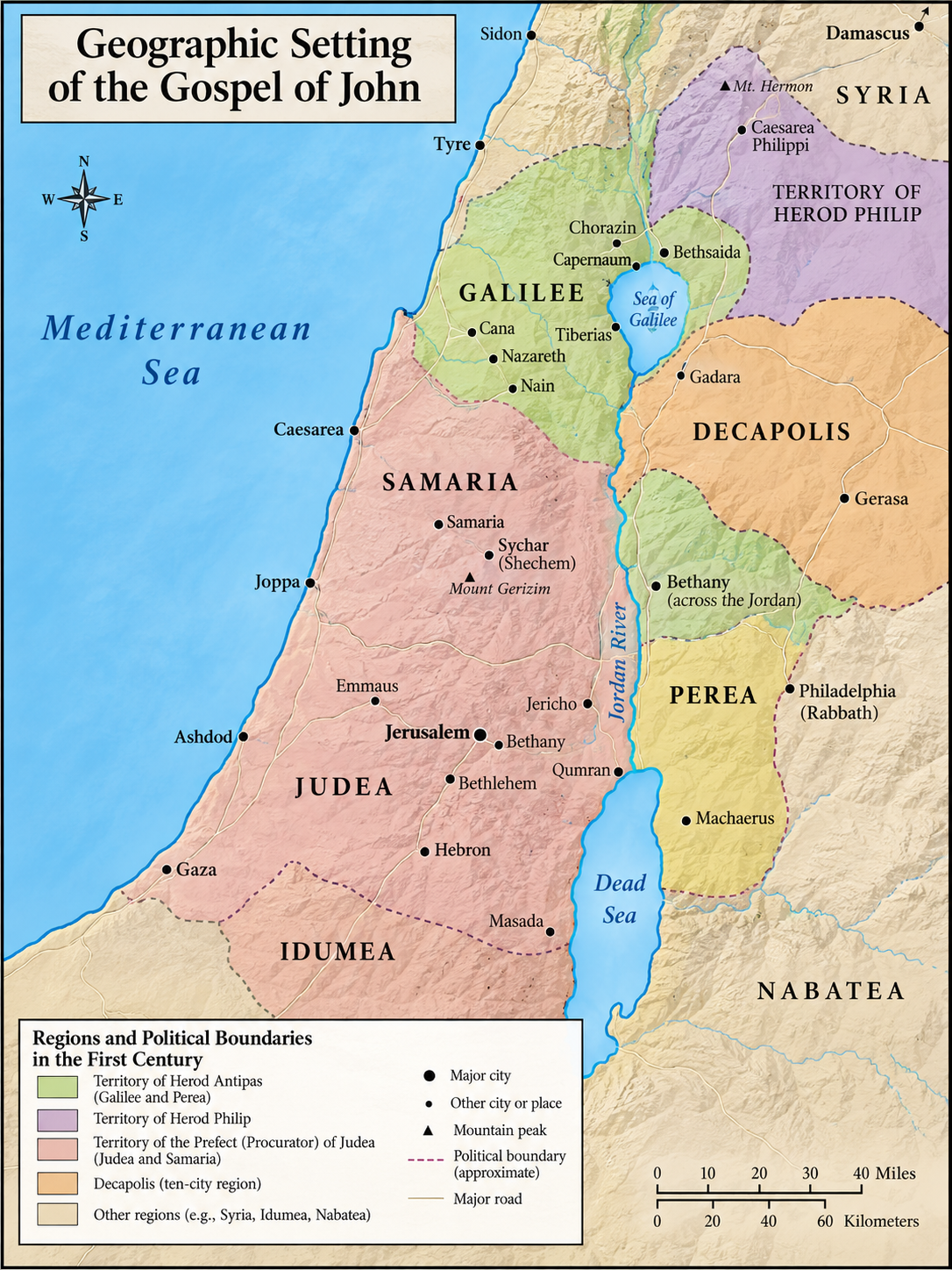
The approved shaded historical map now includes a more detailed regional locator that better matches the style of the larger atlas. The outlined rectangle shows roughly where the large map falls within today's regional geography.
Regional location
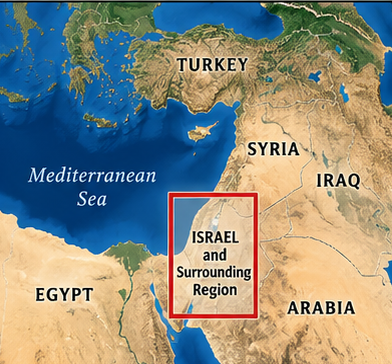
Red box indicates the main map area.
Locations mentioned in John 1
Nazareth (1:45–46): Jesus is identified as being from this Galilean town.
Jerusalem (1:19): The priests and Levites questioning John came from Jerusalem.
Galilee (1:43): Jesus begins moving into the northern region.
Bethsaida (1:44): The hometown of Philip, Andrew, and Peter. Exact archaeological identification is debated.
Bethany beyond the Jordan (1:28): John's baptizing location. The exact site is uncertain. The map's illustrated placement is not a confirmed archaeological location.
How to read the atlas
Pastel shading shows approximate first-century political regions. Terrain shading suggests mountains and valleys, and blue identifies water. The modern inset provides regional orientation rather than indicating ancient political borders.
Main historical map: original WGM illustration. Modern locator: coastline and national boundaries; outlined area is approximate.
John 1 — The Word Became Flesh
“The Word became flesh and lived among us. We saw his glory, such glory as of the only born Son of the Father, full of grace and truth.” John 1:14, WEB
John begins before creation. Jesus is the eternal Word, fully divine, through whom everything was made. The Word enters human history, reveals the Father, and brings life. People respond in rejection or faith. John the Baptist testifies about Him; the first disciples begin to follow Him. The question is not merely what Jesus teaches, but who He is.
The Word Was God (1:1–5)
Before anything was created, the Word already existed. He was with God and was God. Creation, life, and light come through Him.
The World Must Respond (1:6–13)
John the Baptist bears witness. Some reject Jesus, but those who receive Him by faith are given the right to become God’s children.
God Came Near (1:14–18)
The eternal Word truly became human, revealing the Father’s glory, grace, and truth.
John Points Away from Himself (1:19–28)
Questioned by religious leaders, John identifies himself as a voice preparing the Lord’s way.
The Lamb of God (1:29–34)
John identifies Jesus as the Lamb who takes away sin and the Son upon whom the Spirit remains.
Come and See (1:35–42)
Two disciples begin following Jesus; Andrew brings Simon to meet the Messiah.
Follow Me (1:43–51)
Jesus calls Philip, Nathanael responds, and Jesus promises a greater revelation of His glory.
Quick Study Flow
Important Bible Words
| Word / Phrase | Simple Meaning | Why It Matters |
|---|---|---|
| Word (Logos) | God’s eternal self-revealing Word | John identifies the Word as divine and later as Jesus Christ. |
| Light / Darkness | Truth and life contrasted with evil and unbelief | Jesus brings revelation and life that darkness cannot defeat. |
| Believe / Receive | Trusting Jesus and welcoming Him for who He is | Faith, not ancestry or merit, is connected to becoming God’s child. |
| Only born / monogenēs | The Son’s unique relationship with the Father | John emphasizes Jesus’ unique identity and revelation of God. |
| Lamb of God | God’s provision for dealing with sin | John announces the saving mission of Jesus. |
| Messiah / Christ | God’s anointed king | The first disciples recognize Jesus as the promised Messiah. |
| Son of Man | Jesus’ self-designation with biblical background | John 1:51 portrays Jesus as the link between heaven and earth. |
Translation Word Notes
Short comparison phrases only; full Scripture remains WEB.
Pronunciations are approximate classroom-style New Testament Greek. CAPITAL letters mark the stressed syllable; they are a reading aid, not a claim of exact first-century speech.
| Verse | Greek / How to say it | NKJV | NIV | NLT | What It Means |
|---|---|---|---|---|---|
| 1:5 | katalambanōkah-tah-lahm-BAH-noh | did not comprehend | has not overcome | can never extinguish | Can carry senses of grasping and overcoming; note literary context. |
| 1:14 | monogenēsmoh-noh-geh-NAYS | only begotten | one and only | one and only | Stresses the Son’s unique relationship; traditional rendering differs. |
| 1:29 | airōEYE-roh | takes away | takes away | takes away | The Lamb removes or bears away sin; a strong announcement of His mission. |
| 1:41 | Messias / Christosmeh-SEE-ahs / khri-STOHS | Messiah / Christ | Messiah / Christ | Messiah / Christ | The Hebrew and Greek titles both mean “Anointed One.” |
The Gospel Connection
John 1 proclaims the gospel before Jesus’ miracles or cross. The eternal Son enters the world He made and is announced as the Lamb who takes away sin (1:29). He would give His life, rise again, and offer eternal life to those who believe (20:31). Salvation is not earned through ancestry, religious status, or merit; those who receive Him by faith become God’s children (1:12–13).
A Short Prayer from John 1
Father, thank You for sending Your eternal Son into the world. Thank You for the light darkness cannot defeat and the Lamb of God who takes away sin. Forgive me when I prefer my way over Your truth. Help me receive Christ by faith, follow Him with humility, and invite others to come and see. In Jesus’ name, amen.
One Truth to Carry With You
Jesus is not merely a teacher to admire; He is the eternal Son of God, the Lamb who saves, and the Lord who calls me to follow Him.
Ready to Go Deeper?
S — Scripture: Read the full passage slowly.
O — Observation: What does this reveal about God, Jesus, people, and faith?
A — Application: What should I believe, change, practice, or trust?
P — Prayer: Respond to God personally.
The Eternal Word and the Light
What does this passage say? What does it teach about God, Jesus, people, faith, sin, salvation, or obedience?
The Gospel begins before creation, echoing Genesis 1:1. John identifies the Word as already existing, personally distinct from God the Father (“with God”), and fully divine (“was God”). The Word is not a created being; everything that came into existence was made through Him.
Life and light flow from the Word. Darkness is real, but it neither extinguishes the light nor gains final victory over it. The wording of “overcome” can also suggest failure to grasp or comprehend. John will develop the contrast between light and rejection throughout his Gospel.
This introduction prepares us to understand Jesus’ actions and words as the work of the eternal Son, not merely the teaching of an unusually wise man.
Lord Jesus, teach me to see You as the eternal Word, the source of life and the light that darkness cannot defeat. Help me trust Your truth.
Witness, Rejection, and New Birth
What does this passage say? What does it teach about God, Jesus, people, faith, sin, salvation, or obedience?
John the Baptist is carefully distinguished from Jesus: he is a man sent by God to bear witness, not the light itself. His purpose is that people might believe through his testimony. Faith does not rest on John’s personality, but on the One to whom he points.
The world was made through the Word, yet many did not recognize or receive Him. Rejection is not the only response: those who receive Jesus by believing in His name are given the right to become children of God. John describes this new identity as birth from God, not as a privilege inherited through ancestry or produced by human effort.
The passage calls for an actual response to Jesus. Religious familiarity is not the same as receiving Him; becoming God’s child rests on God’s gracious action.
Father, thank You that becoming Your child is a gift of grace. Help me believe in Jesus rather than depend on my family background or effort.
The Word Became Flesh
What does this passage say? What does it teach about God, Jesus, people, faith, sin, salvation, or obedience?
“The Word became flesh” is the astonishing center of John’s opening. The eternal Son truly entered human life, not merely appearing human. “Lived among us” evokes God dwelling among His people. John declares that witnesses saw His glory, characterized by grace and truth.
John the Baptist again points beyond himself to Jesus’ surpassing greatness. Moses and the law are not belittled; rather, John announces the climactic revelation of God’s grace and truth in Jesus Christ. Verse 18 explains why the Son can reveal the unseen Father: He uniquely knows the Father.
Translations differ in verses 14 and 18 over the Greek word monogenēs (“only born,” “one and only,” or traditionally “only begotten”), and manuscripts vary at 1:18 between readings commonly rendered “the only Son” and “the only God.” These differences deserve notice without obscuring John’s clear testimony to Jesus’ divine identity.
Jesus, thank You for coming among us and making the Father known. Shape me by Your grace and truth.
A Voice Preparing the Way
What does this passage say? What does it teach about God, Jesus, people, faith, sin, salvation, or obedience?
Officials from Jerusalem question John the Baptist about his identity. He explicitly denies being the Messiah. He also rejects the titles “Elijah” and “the prophet” as they are put to him. His positive answer quotes Isaiah 40:3: he is a voice calling people to prepare the Lord’s way.
John’s humility is not uncertainty about his calling. He understands his task as witness and preparation, not self-promotion. His baptism points toward the greater One already standing among them, whose sandal strap John considers himself unworthy to loosen.
The setting is called “Bethany beyond the Jordan,” distinct from Bethany near Jerusalem. Its exact site is debated, so we should not confidently place it on a modern map.
God, give me the humility and courage of John the Baptist: to know my calling, speak truth, and make much of Christ.
Behold, the Lamb of God
What does this passage say? What does it teach about God, Jesus, people, faith, sin, salvation, or obedience?
John publicly identifies Jesus as “the Lamb of God, who takes away the sin of the world.” The title evokes the Old Testament world of sacrificial provision and deliverance; the passage itself emphasizes Jesus as God’s answer to human sin. John does not say the world is automatically saved regardless of response, but announces the scope and sufficiency of the Lamb’s mission.
John testifies that he saw the Spirit descend from heaven like a dove and remain on Jesus. This fulfills what the One who sent John had told him to watch for. Jesus is the One who baptizes in the Holy Spirit, and John’s testimony culminates in the declaration that Jesus is the Son of God.
John the Baptist’s role is eyewitness witness rather than independent savior. He identifies Jesus so Israel and the world may recognize the One sent by God.
Lamb of God, thank You for coming to deal with sin. Teach me to rely on Your saving work and to bear faithful witness to You.
Come and See
What does this passage say? What does it teach about God, Jesus, people, faith, sin, salvation, or obedience?
John the Baptist again points to Jesus, and two of his disciples begin following Him. Jesus’ first recorded question in this Gospel is searching: “What are you looking for?” He invites them to “Come and see,” leading them toward personal knowledge of Him.
Andrew, identified as Simon Peter’s brother, quickly brings Simon to Jesus. His confession that they have found the Messiah connects Jesus to Israel’s long-awaited anointed king. Jesus gives Simon the name Cephas, translated Peter, anticipating the identity and future service that will develop in the Gospel story.
Faithful testimony is often simple: one person meets Jesus and brings another to Him. The movement here is from hearing witness to encountering Jesus and sharing the discovery.
Lord, help me answer Your invitation with trust and lead others toward You without pressure or self-importance.
Follow Me and See Greater Things
What does this passage say? What does it teach about God, Jesus, people, faith, sin, salvation, or obedience?
Jesus calls Philip with the direct command, “Follow me.” Philip tells Nathanael that Jesus is the One written about by Moses and the prophets. Nathanael is skeptical because Jesus comes from Nazareth, but Philip answers with an invitation instead of a long argument: “Come and see.”
Jesus knows Nathanael before their encounter, and Nathanael responds with the titles “Son of God” and “King of Israel.” Jesus promises greater revelation: heaven opened and angels ascending and descending on the Son of Man. The image recalls Jacob’s vision in Genesis 28, now centered on Jesus as the meeting place of heaven and earth.
The chapter moves from eternal truths about the Word to real people meeting the Messiah. Seeing His identity rightly leads naturally to following Him.
Jesus, forgive my quick judgments and hesitation. Give me eyes to see who You are and a willing heart to follow You.
Hard Questions
Does John 1 really say Jesus is God?
Yes. John 1:1 distinguishes the Word from the One with whom He was, while explicitly calling the Word God. Verses 3 and 14 connect that eternal, divine Word with creation and the incarnation. Historic Protestant Evangelical Christianity understands this as affirming the deity of the Son, personally distinct from the Father.
What does “the Word became flesh” mean?
It means the eternal Son truly entered human life. John does not teach that the Son stopped being divine, or that He only seemed human. The incarnation means that He became fully human while remaining fully divine. Other passages further illuminate this truth (Philippians 2:5–11; Colossians 2:9).
What about “only begotten,” “one and only,” and “only born”?
Different English translations render Greek monogenēs differently. The core emphasis is the Son’s unique relationship with the Father. John 1:18 also has a significant ancient manuscript variation often reflected as “only Son” or “only God.” It should be acknowledged rather than hidden; the wider passage clearly identifies Jesus as uniquely revealing the Father.
Did John the Baptist contradict Jesus about Elijah?
John denies being Elijah when questioned in John 1:21, while Jesus later identifies John with Elijah’s promised preparatory role (Matthew 11:14; 17:10–13). Many evangelical interpreters distinguish John’s denial of being Elijah personally or literally from his ministry “in the spirit and power of Elijah” (Luke 1:17).
Where is Bethany beyond the Jordan?
John 1:28 describes a location beyond the Jordan where John baptized. Its precise archaeological identification remains debated. The workbook will not pin an uncertain location as a settled fact.
Does “Lamb of God” mean everyone is automatically saved?
The phrase declares the scope and significance of Jesus’ saving mission. John also repeatedly calls people to believe in the Son (1:12; 3:16–18; 20:31). It does not teach that trust in Christ is unnecessary.
Why does Jesus mention angels ascending and descending?
John 1:51 recalls Jacob’s vision of heaven and earth connected in Genesis 28:10–17. Jesus presents Himself as the Son of Man through whom God’s presence and revelation come. The chapter does not give every detail of how Nathanael immediately understood the image.
Reflection
A Prayer to Know and Follow Jesus
Heavenly Father, I praise You for revealing Your glory in Jesus Christ, the eternal Word made flesh. Thank You that in Him are life and light. Forgive me for overlooking His greatness or trusting myself instead of Your grace. Thank You for the Lamb of God who takes away sin. Help me receive Your Son by faith and speak of Him with humility and courage. In Jesus’ name, amen.
Jesus is not merely a teacher to admire; He is the eternal Son of God, the Lamb who saves, and the Lord who calls me to follow Him.