John 2
The First Sign and the Father’s House
At Cana Jesus reveals His glory through the first sign. In Jerusalem He honors His Father’s house, speaks about His resurrection, and shows that He knows the human heart.
QUICK STUDY + DEEP DIVE · World English Bible (WEB)

Study at Your Own Pace
Quick Study: a focused 15–20 minute overview. Deep Dive: five full WEB passages with Scripture, Observation, Application, Prayer, and your own response space.
John 2 — Geographic Setting
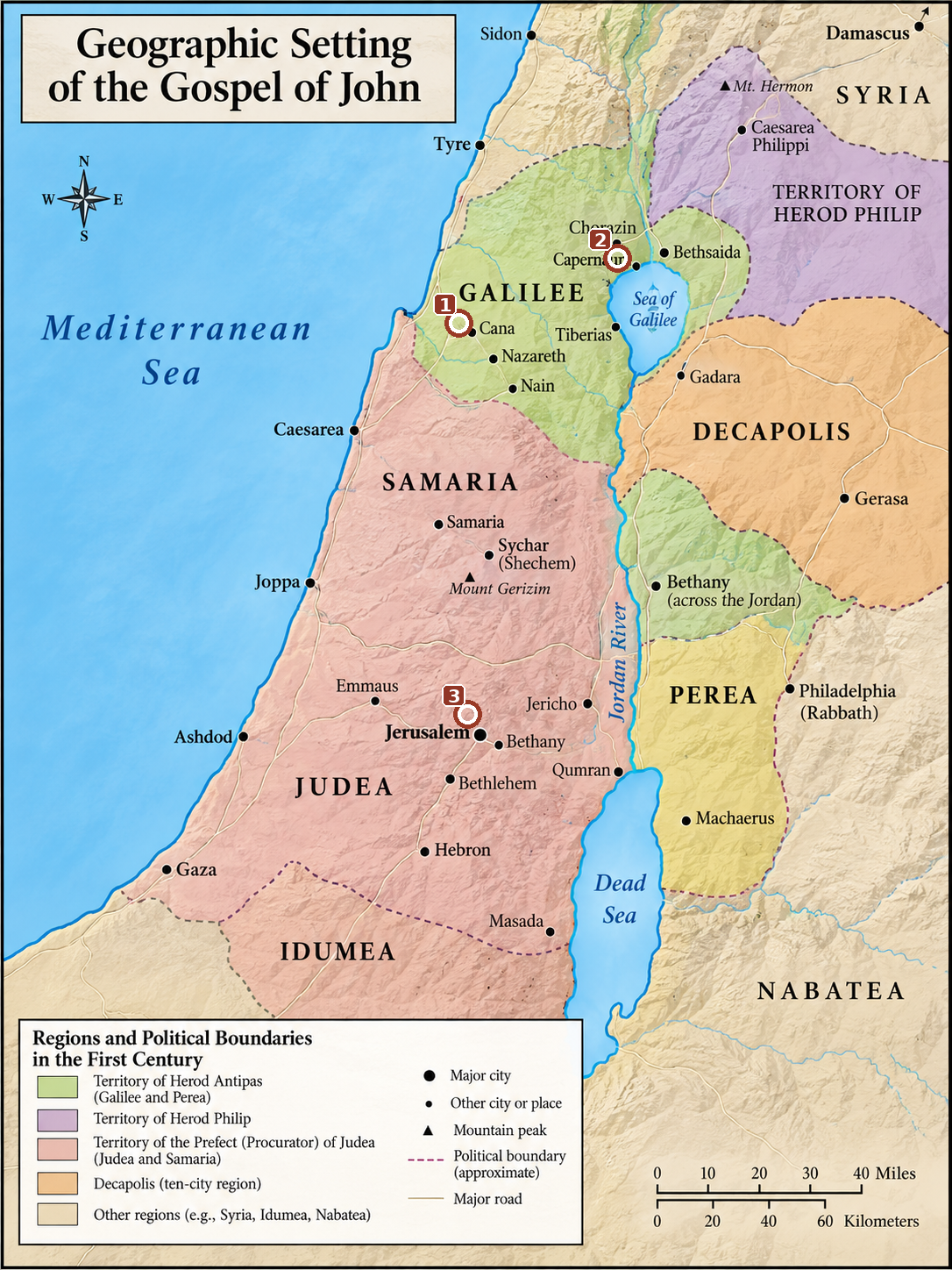
The chapter names Cana, Capernaum, and Jerusalem. Numbered rings highlight these locations on our original shaded Bible atlas. The map does not claim a precise route or certainty about Cana’s ancient site.
Regional location
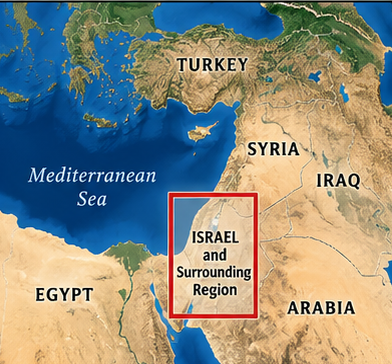
Red box shows the approximate main-map area.
Locations in John 2
1Cana of Galilee (2:1, 11): The wedding and Jesus’ first sign. Exact site uncertain.
2Capernaum (2:12): Short stay near the Sea of Galilee with Jesus’ family and disciples.
3Jerusalem (2:13–25): Passover, the temple, and signs.
How to read the atlas
Pastel territories and their legend show an approximate historical setting. Relief shading suggests mountains and valleys; blue marks water. The modern inset is a separate present-day geographic reference.
John 2 — The First Sign and the Father’s House
“This beginning of his signs Jesus did in Cana of Galilee, and revealed his glory; and his disciples believed in him.” John 2:11, WEB
John 2 moves from a wedding to the Jerusalem temple. The first sign reveals Jesus’ glory, His temple actions demonstrate His authority and devotion to the Father, and His words point toward His bodily resurrection. John warns that an outward response to signs is not the same as genuine trust in Christ.
A Wedding in Cana (2:1–3)
Jesus and His disciples attend a wedding in Galilee. When the wine runs out, His mother brings the need to Him, bringing an ordinary family celebration into John’s account of Jesus’ glory.
“My Hour” (2:4–5)
Jesus’ reply establishes that His actions follow the Father’s timing, not human direction. His mother directs the servants to do whatever He says.
Water Becomes Wine (2:6–11)
Six large stone purification jars are filled with water. Jesus turns the water into wine, and the steward notices its quality. John explicitly calls this the beginning of Jesus’ signs.
A Brief Stay in Capernaum (2:12)
Jesus travels with His mother, brothers, and disciples to Capernaum. John records a short stay without describing any additional activity there.
Passover and the Temple (2:13–17)
Jesus goes up to Jerusalem for Passover and confronts marketplace activity in the temple precincts. His words identify it as His Father’s house.
The True Temple (2:18–22)
Asked for a sign, Jesus speaks of raising “this temple” in three days. John explains that He means His body, and the disciples understand more fully after the resurrection.
Signs and the Human Heart (2:23–25)
Many respond to the signs, yet Jesus does not entrust Himself to them. John draws a distinction between outward attraction and faith rooted in who Jesus truly is.
Quick Study Flow
Important Bible Words
| Word / Phrase | Simple Meaning | Why It Matters |
|---|---|---|
| Sign | A miracle that points beyond itself | John shows that Jesus’ works reveal His identity and glory, not merely His power. |
| My Hour | The divinely appointed time for Jesus’ climactic work | The Gospel progressively points to His death, resurrection, and glorification. |
| Purification Jars | Stone jars associated with Jewish washing customs | The setting underscores Jesus’ action within real first-century Jewish life. |
| Glory | The visible disclosure of Jesus’ greatness | The first sign reveals who Jesus is and leads the disciples toward belief. |
| Passover | Israel’s feast remembering deliverance from Egypt | Jesus’ public ministry unfolds against Israel’s worship and redemption story. |
| Temple | The sacred center of worship in Jerusalem | Jesus calls it His Father’s house and later speaks of His own body as the temple. |
| Zeal | Deep devotion and concern for God’s honor | John connects Jesus’ action with Psalm 69:9. |
| Belief / Entrusting | Trusting or committing oneself | John 2:23–24 uses related Greek vocabulary while distinguishing superficial response from Jesus’ knowledge. |
Translation Word Notes
Greek terms and short NKJV, NIV, and NLT phrases are study aids; complete Bible quotations remain WEB.
Pronunciations are approximate classroom-style New Testament Greek. CAPITAL letters mark the stressed syllable; they are a reading aid, not a claim of exact first-century speech.
| Verse | Greek / How to say it | NKJV | NIV | NLT | What It Means |
|---|---|---|---|---|---|
| 2:4 | gynaiGYOO-nye | Woman | Woman | Dear woman | A respectful form of address in context, not an insult; Jesus stresses His appointed hour. |
| 2:11 | sēmeionsay-MAY-on | signs | signs | miraculous signs | John treats the miracle as a sign revealing Jesus’ glory. |
| 2:16 | oikos / emporionOY-koss / em-POH-ree-on | My Father’s house | my Father’s house | my Father’s house | The house of worship must not be treated as a marketplace. |
| 2:19 | naosnah-OSS | this temple | this temple | this Temple | The term for sanctuary is used figuratively of Jesus’ body (v. 21). |
The Gospel Connection
The wedding sign reveals the glory of Jesus, but John does not stop with the wine. In the temple, Jesus points to the greater sign that will define His mission: His body will be destroyed and raised in three days (2:19–22). The same Savior who enters ordinary celebrations will give His life and rise again. Only through His saving work can sinners be reconciled to God. John invites us to believe in Christ Himself, not merely admire the extraordinary things He does (20:30–31).
A Short Prayer from John 2
Father, thank You for revealing Your Son through His first sign and through His words about the temple. Forgive me when I seek benefits without seeking Jesus, or when I take worship lightly. Teach me to trust His timing, honor Your name, and believe the truth of His resurrection. In Jesus’ name, amen.
One Truth to Carry With You
Jesus reveals His glory through His signs, honors His Father’s house, and points to His resurrection. Genuine faith receives Him on His terms.
Ready to Go Deeper?
The Deep Dive follows S.O.A.P. Work one passage at a time.
S — Scripture: Read the whole WEB passage slowly.
O — Observation: Ask what it says and reveals about Jesus, God, faith, and worship.
A — Application: Respond to what you believe, change, practice, confess, or trust.
P — Prayer: Speak to God using the passage.
A Wedding, a Need, and Jesus’ Hour
John 2:1–5, WEB
What does this passage say? What does it teach about God, Jesus, people, faith, salvation, or obedience?
John places Jesus at a real wedding in Cana of Galilee. The wine runs out, creating a problem for the hosts in a culture where hospitality and honor mattered. Mary brings the lack to Jesus, but John does not report her specifying what He must do. The narrative invites us to see Jesus present in ordinary human life rather than distant from it.
Jesus addresses His mother as “Woman,” a respectful form of address in this setting rather than a rejection or insult. The idiom in His question signals that His mission cannot be directed by even a well-meaning family member. “My hour has not yet come” anticipates a theme that reaches its fullest expression in His death and glorification (John 12:23; 13:1; 17:1).
Mary tells the servants to do whatever He says. The passage does not promise that every human need will be resolved in the way we expect; it shows that Jesus acts according to the Father’s purposes, and faithful response begins with listening to Him.
When a need arises, am I willing to bring it to Jesus while submitting to His timing and commands?
Lord Jesus, teach me to bring my needs to You without trying to control Your response. Give me trust in Your timing and a heart ready to obey what You say.
The First Sign Reveals His Glory
John 2:6–11, WEB
What does this passage say? What does it teach about God, Jesus, people, faith, salvation, or obedience?
The six stone jars belong to the setting of Jewish purification practices. John reports that each held two or three metretes, approximately twenty to thirty U.S. gallons. The servants fill the jars completely. Jesus then commands them to draw some out and deliver it to the head steward, who discovers that the wine is excellent.
John does not describe the physical moment of transformation or identify the exact type of wine. His emphasis is on the result and its meaning. Verse 11 explicitly calls this the beginning of Jesus’ “signs”: a miracle that reveals His glory. The servants know where the wine came from, and the disciples respond by believing in Him.
The abundance and quality of the provision show Jesus’ power and generosity, yet the Gospel does not reduce the sign to an example of getting what we want. It invites us to see His true identity. We should also resist forcing every element of the six jars into an unstated symbolic code.
Am I most interested in what Jesus can provide, or in seeing His glory and trusting Him for who He is?
Father, thank You for showing Jesus’ glory through His first sign. Keep me from seeking only gifts, and draw my attention to the Giver. Strengthen genuine faith in Your Son.
From Capernaum to the Father’s House
John 2:12–17, WEB
What does this passage say? What does it teach about God, Jesus, people, faith, salvation, or obedience?
John records a short stay in Capernaum before Jesus goes to Jerusalem for Passover. The Gospel gives the destinations, but not every road or detail of the journey. Passover remembers God’s deliverance of Israel from Egypt and gives the setting for Jesus’ confrontation in the temple.
Jesus sees animals for sale and money changers sitting in the temple. He makes a whip of cords, drives out the animals, overturns tables, and commands the dove sellers to remove their goods. The stated issue is that His Father’s house has been made a marketplace. The temple was not merely an impressive building; it was set apart for worship.
The disciples connect this moment with Psalm 69:9, which speaks of zeal for God’s house. The text does not justify uncontrolled human rage or violence whenever someone believes worship is wrong. It shows Jesus acting with unique authority as the Son who cares for His Father’s honor. The evangelist does not give every detail of the marketplace’s organization or motives.
Where have I allowed convenience, profit, or appearances to crowd out sincere worship and reverence for God?
Father, give me reverence for Your name and truth. Forgive the ways I let distractions replace worship, and help me honor Jesus as Your Son.
Destroy This Temple — Raised in Three Days
John 2:18–22, WEB
What does this passage say? What does it teach about God, Jesus, people, faith, salvation, or obedience?
The leaders challenge Jesus to show a sign authorizing His actions. He answers, “Destroy this temple, and in three days I will raise it up.” His hearers take the word “temple” to refer to the Jerusalem sanctuary and object that its construction has taken many years.
John immediately tells the reader what the hearers miss: Jesus speaks about the temple of His body. His death and resurrection will become the decisive sign of His identity. The statement is not a claim that Jesus would demolish the stone temple Himself, nor is it an ordinary architectural prediction.
After Jesus is raised from the dead, the disciples remember His words and believe both Scripture and what He said. John presents genuine understanding as something that deepens in light of the resurrection. The “forty-six years” reference concerns the temple building program, not the length of Jesus’ ministry.
How does the bodily resurrection of Jesus change the authority I give His words in my life?
Risen Lord, thank You that Your resurrection vindicates Your promises. Help me trust Scripture, remember Your words, and build my hope on You rather than outward religious forms.
Signs, Belief, and the Human Heart
John 2:23–25, WEB
What does this passage say? What does it teach about God, Jesus, people, faith, salvation, or obedience?
During Passover in Jerusalem, many people believe in Jesus’ name as they watch the signs He performs. John records a real response but immediately adds a caution: Jesus does not entrust Himself to them because He knows all people.
The wordplay is important. The language for their “believing” and Jesus not “entrusting” Himself comes from the same Greek verb family. John does not specify the inner condition of each individual at the feast, so we should not declare every person there unconverted. Instead, he prepares readers for the difference between excitement about signs and the new birth Jesus explains in John 3.
Jesus knows the human heart without needing external testimony. His knowledge challenges shallow religious enthusiasm and invites honest self-examination. Genuine saving faith must not be reduced to amazement at a miracle or social affiliation with Jesus.
Is my confidence in Christ rooted in who He is and what He has done, or only in remarkable experiences and outward enthusiasm?
Jesus, You know my heart completely. Search my motives, expose shallow responses, and deepen my trust in You as Savior and Lord.
Hard Questions
Did Jesus insult His mother by calling her “Woman”?
No. The form of address itself did not necessarily convey disrespect in the first-century setting; Jesus uses it again at the cross (John 19:26). His reply emphasizes that His mission proceeds on the Father’s timing, not under human direction.
Does this miracle mean every wedding needs wine?
John describes what Jesus did at one wedding; it does not command Christians to drink or prescribe wine for weddings. Evangelicals may apply principles of wisdom and conscience differently regarding alcohol. The point of the narrative is the sign revealing His glory and inspiring faith.
Why six stone jars, and does each jar symbolize something?
John tells us the jars were for purification and gives their size. The setting is meaningful, but he does not assign a symbolic meaning to the number six or provide an allegory for each jar. Interpretations of symbolic fullness should be presented as possible, not as facts stated by the text.
Why does John record the temple cleansing early, while other Gospels put a similar event near the end?
Some evangelical interpreters understand John and the Synoptics to describe two distinct cleansings; others understand a single event presented with differing narrative placement. Both options attempt to honor the accounts, but John 2 alone does not settle the chronology. His purpose here is to highlight Jesus’ authority and the resurrection sign.
Was it wrong for worshipers to buy sacrificial animals or exchange money?
Purchasing animals or obtaining appropriate currency could serve legitimate pilgrim needs. John’s text focuses on the commercial activity Jesus opposes in His Father’s house. It does not state that commerce is wrong in every context or give all the details of abuses in the temple courts.
What is the “temple” Jesus raises in three days?
John explicitly answers in verse 21: Jesus was speaking of His body. The disciples understood the saying after His resurrection. He is pointing to His death and bodily resurrection, not announcing a construction project.
Why did Jesus not entrust Himself to people who believed?
John presents Jesus as knowing the hearts of all people. Their response to signs may not be identical to mature or saving faith, though John does not pronounce a final judgment on each person present. The next chapter develops the necessity of new birth.
Reflection
When I pray about a real need, how can I trust Jesus’ timing rather than demand my preferred outcome?
What does the first sign at Cana teach me about seeking Jesus Himself rather than simply seeking His gifts?
How does Jesus’ concern for His Father’s house reshape the way I approach worship and obedience?
What difference should Jesus’ bodily resurrection make to my confidence in Scripture and His promises?
A Prayer for Faith and Reverence
Heavenly Father, thank You for sending Jesus Christ into real human life and revealing His glory at Cana. Thank You that His authority is greater than a building or ceremony and that His resurrection is the decisive sign of Your saving work. Forgive me for shallow faith, distracted worship, and efforts to control Your timing. Search my heart as Jesus knows it completely. Help me obey His Word, live with reverence, and trust Him as my risen Savior and Lord. In Jesus’ name, amen.
Jesus reveals His glory through His signs, honors His Father’s house, and points to His resurrection. Genuine faith receives Him on His terms.