John 3
You Must Be Born Again
Jesus tells Nicodemus that only the Spirit can give new life, announces God’s saving love through His Son, and reveals the joy of putting Christ first.
Scripture quotations: World English Bible (WEB)

Study at Your Own Pace
Quick Study: A focused 15–20 minute overview, Bible words, translation notes, Gospel Connection, and prayer.
Deep Dive: Seven SOAP sections with all 36 WEB verses, full explanations, applications, reflection, and prayers.
John 3 — Geographic Setting
John 3 grows out of the Jerusalem setting and later places Jesus with His disciples in the land of Judea. John the Baptist ministers at Aenon near Salim, whose exact location remains debated. No speculative travel routes or uncertain sites are pinned.
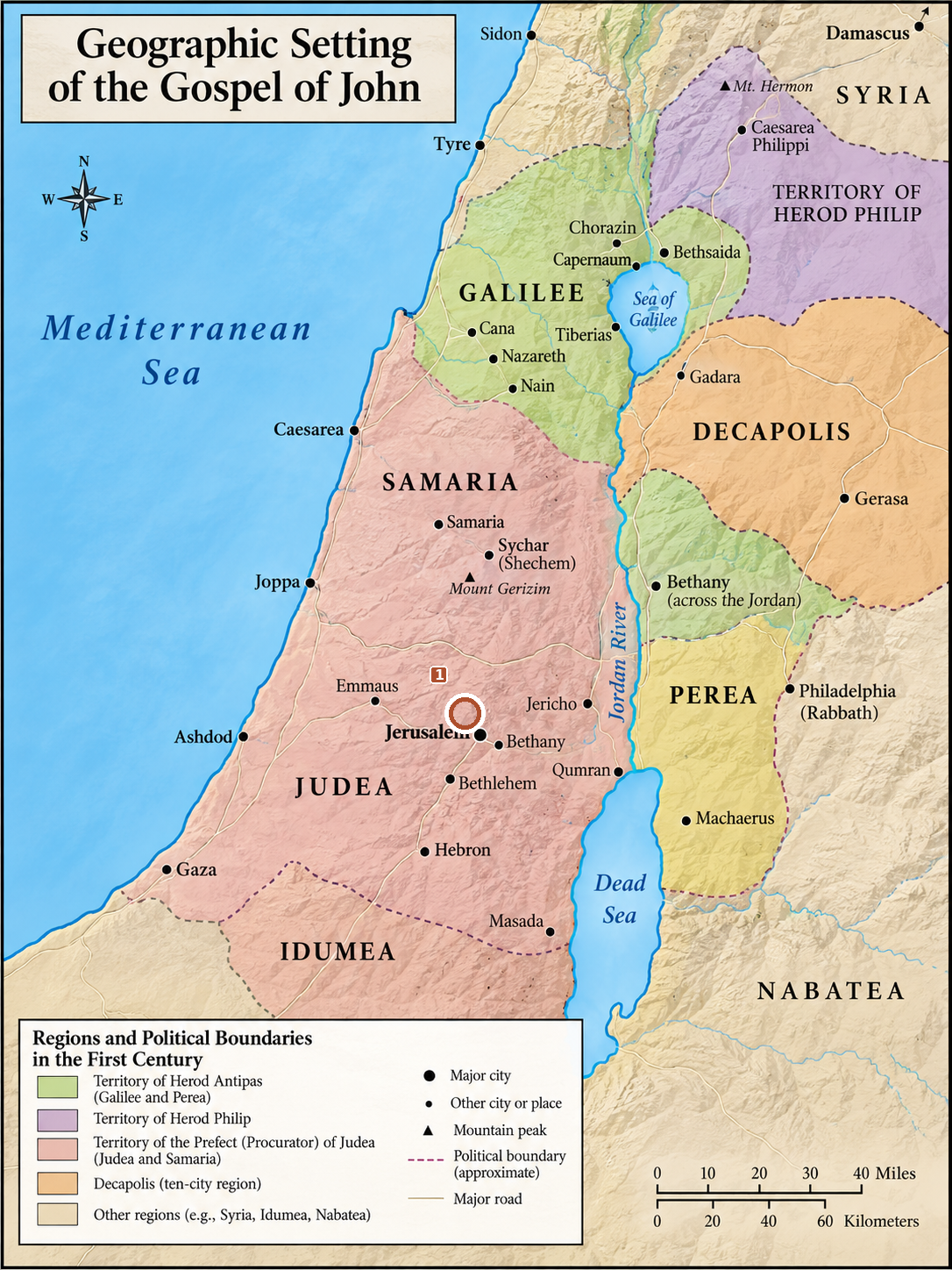
Regional location
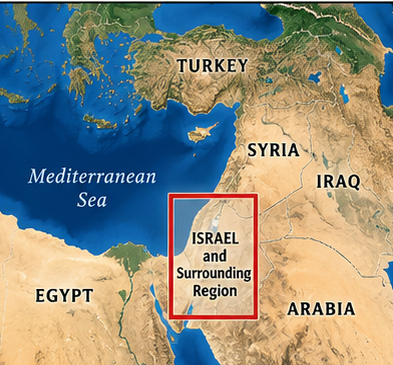
Red box indicates the larger atlas area.
John 3 location notes
1 — Jerusalem context: John 2:23 places Jesus in Jerusalem; John 3 begins “Now there was a man…” without restating the location.
Judean countryside (3:22): Jesus and His disciples continue in the land of Judea. The specific site is not supplied.
Aenon near Salim (3:23): A baptism location with abundant water. Exact site uncertain — not pinned.
Jordan area: John 3:26 recalls John’s earlier witness beyond the Jordan (1:28), whose precise site is debated.
Reading the atlas
Shaded regions identify historical political areas; hills and mountains are relief-shaded; blue identifies lakes, seas, and rivers. The small inset shows today’s surrounding countries.
Quick Study
“For God so loved the world, that he gave his only born Son, that whoever believes in him should not perish, but have eternal life.” John 3:16, WEB
Jesus tells Nicodemus that entering God’s kingdom requires birth from above by the Spirit. He speaks of His coming death and announces God’s saving love for the world. The chapter then shifts to John the Baptist, who rejoices when people turn to Jesus. John 3 brings together God’s initiative, the call to believe, light versus darkness, and Christ’s supreme authority.
The Chapter’s Major Movements
Nicodemus approaches Jesus (3:1–2)
A respected Pharisee and ruler comes by night. He recognizes the signs but still needs to understand who Jesus is.
The necessity of new birth (3:3–8)
Jesus teaches that entry into God’s kingdom requires new life from the Spirit, not merely human effort or ancestry.
Heavenly testimony and the lifted-up Son (3:9–15)
Jesus connects spiritual life to His heavenly origin and to the saving pattern of Numbers 21.
God’s love and the world’s response (3:16–21)
God gives His Son so believers may live. Unbelief and love of darkness leave people under judgment.
Ministries in Judea (3:22–26)
Jesus’ disciples and John the Baptist minister at the same time; John’s followers become concerned.
John’s joyful humility (3:27–30)
John gladly points attention to Jesus: “He must increase, but I must decrease.”
The Father’s Son and eternal life (3:31–36)
Jesus’ testimony is from above. Believing in Him brings life; rejecting Him leaves judgment in place.
Quick Study Flow
Important Bible Words
| Word / Phrase | Simple Meaning | Why It Matters |
|---|---|---|
| Pharisee | Member of a Jewish religious movement attentive to the Law | Nicodemus brings learning and authority, yet still must hear Jesus’ teaching about new birth. |
| Born anew / from above | New life whose source is God | Spiritual birth is more than improving behavior or inheriting religious privilege. |
| Kingdom of God | God’s saving reign and rule | Jesus says one must be born anew to see and enter God’s kingdom. |
| Water and Spirit | Language of renewal and spiritual life | Evangelicals differ on “water,” but Jesus clearly emphasizes the Spirit’s work. |
| Son of Man | Title Jesus uses for Himself | He comes from heaven and must be lifted up for the salvation of believers. |
| Eternal life | Life received through faith in the Son, beginning now and enduring forever | The promise runs through John 3:15–16 and 3:36. |
| Light and darkness | Truth revealed by Christ contrasted with sinful concealment | Jesus’ coming exposes the human response to God. |
| Bridegroom | The central figure in John the Baptist’s wedding illustration | John rejoices that Jesus, not John, receives the honor. |
Translation Word Notes
Short comparison phrases from NKJV, NIV, and NLT. The full Scripture text remains public-domain WEB. Greek notes illuminate meaning but are not essential to understand Scripture.
Pronunciations are approximate classroom-style New Testament Greek. CAPITAL letters mark the stressed syllable; they are a reading aid, not a claim of exact first-century speech.
| Verse | Greek / How to say it | NKJV | NIV | NLT | What It Means |
|---|---|---|---|---|---|
| 3:3 | anōthenAH-noh-then | born again | born again | born again | WEB says “born anew”; the Greek also means “from above.” Jesus stresses God’s source of new life. |
| 3:8 | pneumaPNEW-mah | wind / Spirit | wind / Spirit | wind / Spirit | A single Greek word links the mysterious movement of wind with the Spirit’s work. |
| 3:16 | monogenēsmoh-noh-geh-NAYS | only begotten | one and only | one and only | The Son is uniquely related to the Father, not one son among many. |
| 3:30 | auxanein / elattousthaiowk-SAH-nayn / eh-lah-TOOS-thye | increase / decrease | greater / less | greater / less | John rejoices as Christ becomes central and his own public prominence fades. |
| 3:36 | apeitheōah-pay-THEH-oh | does not believe | rejects | doesn’t obey | The Greek can convey refusal to believe or obey; rejecting the Son is not neutral. |
The Gospel Connection
John 3 does not present salvation as a reward for being moral or religious. Even Nicodemus needs life from above. Jesus identifies Himself as the Son of Man who must be lifted up, recalling God’s provision for dying Israelites in the wilderness (Numbers 21:4–9). God loved the world and gave His only born Son so that whoever believes in Him would not perish but have eternal life. The gospel is both gift and summons: Christ saves sinners, and we are called to believe in Him rather than remain in darkness. This is the same Savior whom John the Baptist gladly honors above himself.
Reflection
Am I resting in the life Christ gives or relying on my own spiritual credentials?
A Short Prayer from John 3
Father, thank You for loving the world and giving Your Son. Forgive me for trusting my own goodness, hiding from Your light, or seeking recognition that belongs to Jesus. Teach me to depend on the Holy Spirit for true renewal, to believe the promises of Christ, and to rejoice as He increases in my life. In Jesus’ name, amen.
One Truth to Carry With You
New birth comes from the Holy Spirit, eternal life comes through faith in God’s Son, and joyful discipleship puts Jesus—not ourselves—at the center.
Ready to Go Deeper?
The Deep Dive follows S.O.A.P.: Scripture, Observation, Application, and Prayer. Read the complete passage before considering the explanation. Scripture is the final authority.
Read the full passage slowly. Notice Jesus’ words, the conversation, repeated phrases, and Old Testament references.
Ask what the passage teaches about new birth, the Spirit, the Son, faith, judgment, and our response.
What should I believe, trust, confess, change, obey, or thank God for?
Respond to God from the truth of the passage, using the example prayer as a starting point.
A Teacher Comes at Night
What does this passage say? What does it teach about God, Jesus, people, faith, salvation, or obedience?
Nicodemus is a Pharisee and a member of the Jewish ruling leadership. He approaches Jesus at night and recognizes that Jesus’ signs point to God’s presence. John does not explain all of Nicodemus’s motives for coming at night; secrecy, caution, and a desire for conversation are possible, but not stated as facts.
Jesus does not stop at the compliment. He tells this religious teacher that a person must be “born anew” to see God’s kingdom. The Greek word carries the sense of being born again or from above. Nicodemus hears the language as another physical birth and asks how such a thing could happen.
The contrast matters: religious knowledge, office, and even respect for Jesus’ miracles cannot produce the spiritual life Jesus describes. Jesus confronts a respected teacher with the same fundamental need shared by everyone.
Am I relying on my religious knowledge or good reputation, instead of trusting Jesus for the new life only He gives?
Lord Jesus, help me approach You humbly, not merely admiring Your teaching but listening to what You say about my deepest need. Give me a teachable heart.
Born of Water and the Spirit
What does this passage say? What does it teach about God, Jesus, people, faith, salvation, or obedience?
Jesus explains that entry into God’s kingdom requires birth “of water and Spirit.” The exact relationship of water and Spirit has been interpreted differently by evangelical Christians. Many connect the wording with God’s promised cleansing and new heart in Ezekiel 36:25–27; others emphasize the contrast with natural birth or baptismal imagery. John does not explicitly define “water” in this conversation.
Jesus clearly contrasts flesh with Spirit: natural human life cannot produce spiritual birth. The Holy Spirit must give life. The command “You must all be born anew” includes Nicodemus and everyone else; no class or background exempts anyone.
The same Greek word can mean “wind” and “Spirit.” Jesus uses the movement of wind to show that the Spirit’s work is real and powerful even though people cannot control or fully trace it. He calls for faith, not a technique for manufacturing new birth.
Where do I substitute self-improvement for dependence on the Holy Spirit’s work in my heart?
Father, thank You for the promise of cleansing and new life. Keep me from trusting my own effort to do what only Your Spirit can do. Renew my heart and lead me to Christ.
The Son of Man Must Be Lifted Up
What does this passage say? What does it teach about God, Jesus, people, faith, salvation, or obedience?
Nicodemus still struggles to understand. Jesus asks how a teacher of Israel could miss the need for spiritual renewal, then speaks of the witness He brings from heaven. The Son of Man is uniquely qualified to reveal heavenly truth because He has come down from heaven.
Jesus turns to Numbers 21:4–9. In the wilderness, Israelites bitten by serpents were commanded to look at the bronze serpent God appointed, and those who looked lived. Jesus says the Son of Man must likewise be “lifted up.” John later connects Jesus’ being lifted up with His death (John 12:32–33).
The comparison is about God’s provision for those who cannot rescue themselves. Eternal life is received by believing in Jesus, not by earning it. His coming cross is not an accident outside the Father’s purpose; it belongs to the saving mission He has announced.
What keeps me from looking to the crucified and risen Christ as my only sufficient Savior?
Jesus, thank You for coming from heaven and giving Yourself for sinners. Turn me away from self-rescue and teach me to look to You in trusting faith.
God Loved the World
What does this passage say? What does it teach about God, Jesus, people, faith, salvation, or obedience?
John 3:16 gives the motive and gift at the center of the gospel: God loved the world and gave His only born Son. “World” points to humanity in need of salvation, not to the goodness of human rebellion. The promise of eternal life is offered to whoever believes in the Son.
Verses 17–18 explain the urgency. The Son came on a saving mission, yet those who reject Him remain under judgment. John does not describe salvation as automatic for everyone; he calls readers to believe in Jesus. This chapter holds together God’s love, real accountability, and the necessity of faith.
The light-and-darkness contrast uncovers why people resist Christ: exposure of evil can be unwelcome. Coming into the light is not claiming sinlessness. It is a truthful response to God that stops hiding from His Word and acknowledges what He is doing.
How should God’s costly love change the way I respond to Jesus and bring my life into His light?
Father, thank You that You loved the world and gave Your Son. Forgive my efforts to hide in darkness. Teach me to believe Your promise, confess sin honestly, and walk in Your light.
The Judean Countryside and a Question
What does this passage say? What does it teach about God, Jesus, people, faith, salvation, or obedience?
After His conversation with Nicodemus, Jesus goes with His disciples into the Judean countryside. John also continues baptizing at “Enon near Salim” where water is plentiful. The precise modern location of that ancient site is debated; the Gospel itself does not give coordinates or a travel route.
A dispute about purification becomes an occasion for John’s disciples to express concern that people are going to Jesus. The text does not require us to assume John himself shares their jealousy; the next passage shows his response.
John includes the chronological note that John the Baptist had not yet been imprisoned. The overlapping ministries emphasize transition: John’s purpose was always to prepare people to recognize the Christ, not to build a competing movement.
When attention shifts toward another person’s fruitful ministry, do I respond with gratitude or competition?
Father, guard me against jealousy and comparison in serving You. Help me welcome Your work wherever it brings people to Jesus Christ.
He Must Increase
What does this passage say? What does it teach about God, Jesus, people, faith, salvation, or obedience?
John the Baptist answers his disciples by putting God’s gift and calling first: a person can receive only what heaven gives. He reminds them that he never claimed to be the Messiah. His mission is to prepare the way for Someone greater.
The wedding illustration makes the point warmly. The bridegroom receives the bride, while the bridegroom’s friend rejoices at his voice. John finds fulfillment not in keeping attention on himself but in hearing and honoring Jesus.
His statement “He must increase, but I must decrease” is not an invitation to despise ordinary responsibilities or deny God-given gifts. It expresses the proper direction of Christian witness: our influence is not the goal; Christ’s honor is.
Where am I seeking recognition that belongs to Christ, and what practical choice would help me point others toward Him?
Lord Jesus, increase in the way I think, speak, and serve. Give me John’s joy when others see You more clearly, even when I receive less attention.
The Father Has Given All Things to the Son
What does this passage say? What does it teach about God, Jesus, people, faith, salvation, or obedience?
The chapter closes by contrasting heavenly testimony with earthly limitations. The One who comes from above is greater than all. Receiving the Son’s witness means affirming that God is true, because Jesus speaks the words of God and the Spirit is given without measure.
Verses 31–36 may continue John the Baptist’s testimony or may be the Gospel writer’s concluding explanation. John does not identify the change of speaker with an explicit label. The theological message is clear either way: the Father loves the Son and has placed all things in His hand.
Finally, belief and disobedience are set in serious contrast. Verse 36 joins receiving eternal life in the Son with the warning that God’s wrath remains on the one who rejects Him. This is not merely a call to admire Jesus; it is a call to trust and submit to God’s Son.
What would genuine trust in the Son look like in a decision I face this week?
Father, You have given all things into the hands of Your beloved Son. Help me hear His testimony, trust His promises, and obey Him rather than resist Your truth.
Hard Questions
Is being “born again” simply deciding to become a better person?
No. Jesus distinguishes natural life from the Spirit’s work. Repentance and faith are necessary responses to the gospel, but they are not a self-improvement project that creates divine life by human power (John 3:3–8; Titus 3:5).
What does “born of water and Spirit” mean?
Evangelical interpreters differ. Some understand water as the cleansing promised in Ezekiel 36:25–27 alongside the Spirit’s renewing work. Others understand a reference to natural birth or to baptismal imagery. The immediate teaching is unmistakable: the Spirit gives the new life necessary to enter God’s kingdom. This passage should not be used to erase salvation by grace through faith.
Does “God so loved the world” mean everyone is automatically saved?
No. John 3:16 promises life to whoever believes. Verses 18 and 36 distinguish those who believe in the Son from those who remain under judgment. The offer is wide and sincere, but John does not teach that rejecting Christ has no consequence.
Who is speaking in John 3:16–21?
Some editions print Jesus’ speech through verse 21; others place a break after verse 15 and treat verses 16–21 as John’s inspired explanation. Ancient Greek manuscripts did not use our modern quotation-mark conventions. The workbook follows a common red-letter convention but does not claim the boundary can be established with certainty.
Does “lifted up” refer only to Jesus’ crucifixion?
John 3:14 evokes Moses lifting the bronze serpent (Numbers 21:4–9). In John, the phrase also anticipates Jesus’ death and exaltation (John 8:28; 12:32–33). The point is that God provides life through the Son who is given for sinners.
Where was Enon near Salim?
John 3:23 places it near a source of plentiful water, but the exact ancient location is uncertain. Several identifications have been proposed. Our chapter map shows the broad regions without pinning this disputed site or inventing Jesus’ travel route.
Do verses 31–36 come from John the Baptist or the Gospel writer?
The text gives no clear quotation boundary. They may continue John the Baptist’s testimony or summarize it in the narrator’s voice. Both readings emphasize that Jesus comes from above, bears the Father’s testimony, and gives eternal life.
How do belief and obedience relate in John 3:36?
The final contrast is not between earning salvation through perfect works and earning it by intellectual agreement. John portrays true faith as receiving and trusting the Son; persistent refusal to hear Him exposes unbelief. The Greek can be rendered “disobeys” or “disbelieves.”
What have I relied on for spiritual confidence instead of the new life Jesus says I need?
How does the cross show God’s love without minimizing the seriousness of sin and judgment?
Where am I tempted to hide from the light rather than confess the truth before God?
What would it look like this week for Christ to increase and my desire for recognition to decrease?
A Prayer for New Life and Faith
Heavenly Father, I praise You for Your love displayed in sending Your only born Son. I confess that I cannot give myself new birth or earn eternal life. Thank You that Jesus was lifted up for sinners and that You promise life to everyone who believes in Him. Bring hidden sins into Your light and lead me in genuine repentance. Guard my heart from religious pride and envy. Like John the Baptist, teach me to rejoice when Jesus is honored and to say with sincerity, “He must increase, but I must decrease.” Help me trust Your Son and obey His Word. In Jesus’ name, amen.
New birth comes from the Holy Spirit, eternal life comes through faith in God’s Son, and joyful discipleship puts Jesus—not ourselves—at the center.