John 4
Living Water for a Thirsty Soul
Jesus offers living water, reveals true worship, and calls a Samaritan town and a Galilean family to trust His word.
Scripture quotations: World English Bible (WEB)

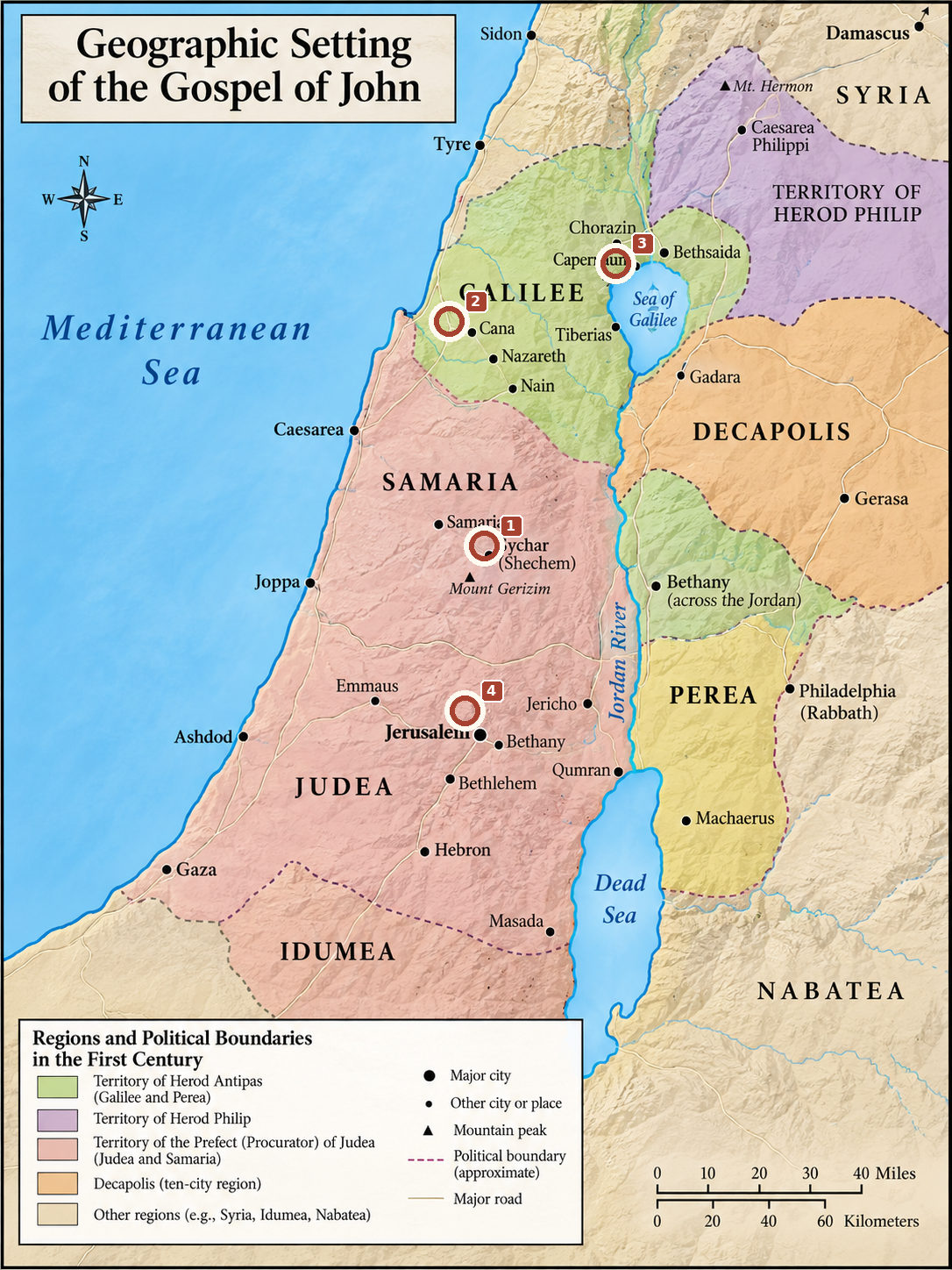
John 4 — Geographic Setting
John 4 moves from Judea through Samaria into Galilee. The numbers mark places mentioned in the chapter for orientation, not a claim about exact ancient routes.
Regional location
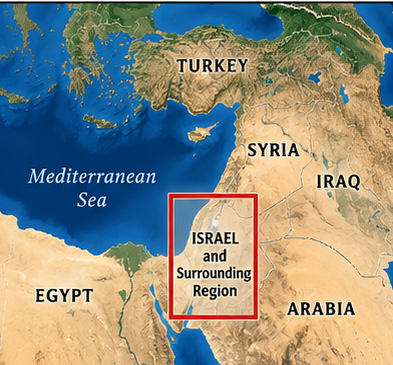
Red box locates the larger biblical atlas.
Locations in John 4
1 — Sychar / Jacob’s well: Samaritan setting near Mount Gerizim. Ancient place identifications are approximate.
2 — Cana: Jesus returns to this Galilean town; the precise ancient site is debated.
3 — Capernaum: The official’s son is ill here (4:46–54).
4 — Jerusalem: Jesus leaves Judea; the Galileans had seen His earlier signs at the festival in Jerusalem.
Reading the atlas
Shaded political regions and borders are approximate for the first century. Terrain relief shows mountains and valleys; blue shows seas, lakes, and the Jordan River.
Quick Study
“but whoever drinks of the water that I will give him will never thirst again; but the water that I will give him will become in him a well of water springing up to eternal life.” John 4:14, WEB
Jesus offers living water to a Samaritan woman at Jacob’s well, teaches worship in spirit and truth, and identifies Himself as Messiah. Her neighbors hear Him and confess Him as the Savior of the world. Later, Jesus heals an official’s son in Capernaum from a distance, calling for trust in His word.
The Chapter’s Major Movements
From Judea into Samaria (4:1–9)
Jesus stops at Jacob’s well and speaks with a Samaritan woman across a longstanding social divide.
Living water offered (4:10–15)
Jesus offers a gift that leads to eternal life, beyond the water drawn from a well.
Truth and worship (4:16–26)
Jesus knows the woman’s story, teaches worship in spirit and truth, and identifies Himself as Messiah.
An invitation to come and see (4:27–30)
The woman brings her neighbors toward Jesus with honest testimony.
Harvest and mission (4:31–38)
Jesus teaches His disciples to see and join the Father’s work.
The Savior of the world (4:39–42)
Samaritans come to believe through both testimony and hearing Jesus personally.
Faith at a distance (4:43–54)
An official trusts Jesus’ word and discovers his son has been healed.
Quick Study Flow
Important Bible Words
| Word / Phrase | Simple Meaning | Why It Matters |
|---|---|---|
| Samaritan | Member of a community with historic ties and tensions with Judean Jews | Jesus ministers across a real religious and social divide without abandoning truth. |
| Living water | Ordinary expression for flowing water; Jesus uses it for divine life | His promise reaches beyond temporary thirst to eternal life. |
| Jacob’s well | An ancient well associated with Israel’s patriarch Jacob | The setting makes the contrast between physical water and spiritual life concrete. |
| Mount Gerizim | Mountain associated with Samaritan worship | The woman raises a longstanding dispute about sacred worship locations. |
| Spirit and truth | Worship aligned with God’s Spirit and His revealed reality | Worship is not a matter of location or feeling alone. |
| Messiah / Christ | God’s Anointed One, the promised Deliverer | Jesus tells the woman that He is the awaited Messiah. |
| Harvest | Agricultural image for gathering people in response to God | Jesus calls disciples to recognize and join the Father’s work. |
| Sign | An act that points beyond itself to Jesus’ identity and authority | The official’s son is healed by Jesus’ word, leading to faith. |
Translation Word Notes
Capitalized pronunciation syllables mark stress; pronunciations approximate classroom Biblical Greek. Full Scripture text remains WEB. NKJV, NIV, and NLT phrases are short comparisons.
| Verse | Greek / Pronunciation | NKJV | NIV | NLT | What It Means |
|---|---|---|---|---|---|
| 4:10 | hydōr zōnhoo-DOR ZOH-on | living water | living water | living water | Jesus uses the image of flowing water for His gift of lasting life. |
| 4:23 | proskyneōprohs-koo-NEH-oh | worship | worship | worship | To bow or worship; the Father seeks worship grounded in spirit and truth. |
| 4:24 | pneumaPNEW-mah | Spirit | spirit | Spirit | Greek can refer to spirit or Spirit; context and translation decisions matter. |
| 4:24 | alētheiaah-LAY-thee-ah | truth | truth | truth | True worship responds to God as He has revealed Himself. |
| 4:42 | sōtērsoh-TAIR | Savior | Savior | Savior | The Samaritans recognize Jesus as the world’s Savior. |
| 4:50 | pisteuōpis-TEV-oh | believed | took Jesus at his word | believed | The father trusts Jesus’ statement before seeing the result. |
| 4:54 | sēmeionsay-MAY-on | sign | sign | miraculous sign | The sign points to Jesus’ authority, not merely the wonder itself. |
The Gospel Connection
John 4 shows the reach and power of Jesus’ saving mission. The One who offers living water to a Samaritan woman is confessed as the Savior of the world. His gift is not earned by ancestry, location, reputation, or ritual; it is received by faith in Him. The woman’s town hears His words and believes. Later, the official trusts Jesus’ word before the result is visible. Both accounts direct us away from self-reliance and toward the Son who gives life. The cross and resurrection will show fully how this Savior brings eternal life to sinners (John 19–20).
Reflection
Am I looking to Christ for lasting life, or to things that can never satisfy my deepest need?
A Short Prayer from John 4
Father, thank You for sending Jesus to give living water and to call people from every background to trust Him. Forgive the times I look to temporary things for lasting life. Teach me to worship You in spirit and truth, to speak of Christ with humility, and to believe His Word even before I see the answer. In Jesus’ name, amen.
One Truth to Carry With You
Jesus offers living water for eternal life, seeks worship in spirit and truth, and invites us to believe His Word.
Ready to Go Deeper?
SOAP means Scripture, Observation, Application, Prayer. Read the complete passage before considering the explanation. Scripture remains our final authority.
Read the entire WEB passage in context.
Notice what the chapter actually states about Jesus, worship, faith, people, and salvation.
Respond personally with faith, repentance, obedience, or thanksgiving.
Pray in response to the truth of the passage.
A Journey into Samaria
What does the passage say about Jesus, God, people, faith, salvation, or obedience?
Jesus leaves Judea for Galilee and enters Samaria. John says He “needed” to pass through Samaria, but does not specify whether the necessity was geographical, purposeful, or both. The setting includes Jacob’s well near Sychar. Jesus is genuinely weary and asks a Samaritan woman for water; His humanity is not hidden behind His divine identity.
The woman recognizes the social distance between Jews and Samaritans. John mentions the friction, but this conversation does not make every Jewish or Samaritan person identical. Jesus addresses her directly rather than letting inherited hostility prevent the encounter.
Before the woman understands who He is, Jesus has already moved toward her with a simple request. The conversation will redirect attention from ordinary water to the life that only He can give.
When do inherited assumptions or social discomfort keep me from treating another person as someone Jesus values?
Lord Jesus, thank You for crossing barriers to speak with those who need You. Give me humility, compassion, and courage to listen to Your word.
The Gift of Living Water
What does the passage say about Jesus, God, people, faith, salvation, or obedience?
Jesus calls the water He gives the “gift of God.” The woman hears the language through the practical setting of a deep well; Jesus speaks of something far greater than a new source of ordinary drinking water.
Water drawn from Jacob’s well can meet thirst temporarily. The water Jesus gives becomes a spring leading to eternal life. The imagery points to the enduring life and satisfaction found in Him, and the Gospel later connects living water with the Holy Spirit (John 7:37–39).
The woman asks for this water, although her words show that she has not yet fully understood Jesus’ promise. The chapter invites us to move from curiosity about a useful gift toward faith in the giver Himself.
What do I keep expecting to satisfy my deepest spiritual need when Jesus offers eternal life?
Father, turn my heart from temporary substitutes. Teach me to receive the lasting life Jesus gives and to trust Him more than what fades.
Truth Before the Savior
What does the passage say about Jesus, God, people, faith, salvation, or obedience?
Jesus knows details of the woman’s relationships that she has not disclosed. His knowledge demonstrates that He is more than an ordinary traveler. The text states the facts of her marital history, but it does not tell us the causes of those marriages or authorize us to invent her motives.
She recognizes Jesus as a prophet and raises a genuine question about the proper place of worship. The contrast between Mount Gerizim and Jerusalem reflects a historic difference between Samaritan and Jewish worship communities.
Jesus does not ignore truth about personal life, yet the conversation also refuses to end with the woman’s circumstances. It moves toward the identity of God and the kind of worship He seeks.
Can I allow Christ’s truth to examine my life without hiding, while refusing to make unsupported judgments about others?
Lord, You know me completely. Give me honesty in confession and gentleness toward others; lead me into truth, not shame or pretense.
Worship in Spirit and Truth
What does the passage say about Jesus, God, people, faith, salvation, or obedience?
Jesus announces that true worship will not be confined to either Mount Gerizim or Jerusalem. This does not mean history and revelation are unimportant; He explicitly says that “salvation is from the Jews,” recognizing God’s promises through Israel.
Because God is spirit, genuine worship must be in spirit and truth. Evangelical Christians explain aspects of this phrase differently, but the point is not that sincerity alone replaces truth, nor that outward location creates a worshiper. Worship is a response to God as He truly reveals Himself.
The woman expects the Messiah to explain these matters. Jesus answers with a direct self-disclosure: He is the One speaking to her. The question of worship comes into focus in the person of Christ.
Is my worship shaped by who God has revealed Himself to be in Christ, or merely by habit, place, or feeling?
Father, bring my heart and mind into faithful worship. May I honor You in spirit and truth because Jesus has made You known.
Come, See a Man
What does the passage say about Jesus, God, people, faith, salvation, or obedience?
The disciples arrive and are surprised to see Jesus speaking with the woman. John does not record an argument; the woman immediately returns to the town, leaving behind her water jar.
Her invitation is simple: “Come, see.” She does not claim to understand everything about the Messiah. She tells what she knows, asks an honest question, and points others toward Jesus for themselves.
Her testimony becomes the beginning of a wider response in the town. Witness is not always a polished speech; it can be a faithful invitation to examine Jesus’ words.
Who could I invite to encounter Jesus through Scripture rather than merely listen to my opinions?
Jesus, give me courage to speak truly and humbly about You. Help my testimony direct people to Your Word.
Fields Ready for Harvest
What does the passage say about Jesus, God, people, faith, salvation, or obedience?
As the disciples focus on food, Jesus speaks of the sustaining purpose that guides His ministry: doing the Father’s will and accomplishing the work for which He was sent.
He tells them to look at fields ready for harvest. In the surrounding story, people from the Samaritan town are coming to meet Him. Whether the image points immediately to those people or more broadly to His mission, the call is to see what God is doing rather than postpone obedience.
One person sows and another reaps, yet both rejoice. The mission is God’s work, and faithful servants need not claim the credit for what others have prepared.
Am I attentive to opportunities to serve God now, even when someone else receives the visible results?
Father, open my eyes to people ready to hear. Give me patience to sow faithfully and humility to rejoice in another person’s harvest.
The Savior of the World
What does the passage say about Jesus, God, people, faith, salvation, or obedience?
Many Samaritans initially believe because of the woman’s testimony; more believe after hearing Jesus Himself. John moves from secondhand witness to firsthand conviction through Jesus’ own words.
The townspeople confess Him as “the Savior of the world.” John’s Gospel consistently shows that salvation in Jesus is not restricted to one ethnic or social group. This does not mean everyone is automatically saved; the narrative records people coming to believe.
Jesus remains with them two days. His presence gives weight to the invitation that began at the well: people can come, hear, and believe.
How can I help someone move from hearing my testimony to reading and believing Jesus’ words personally?
Lord, thank You that Your saving invitation reaches people across human divisions. Use my words to lead others to hear You.
A Desperate Request in Cana
What does the passage say about Jesus, God, people, faith, salvation, or obedience?
Jesus returns to Galilee. John briefly reflects on the saying that a prophet has no honor in his own country, then describes how Galileans receive Him after observing signs at Jerusalem. Their response invites us to distinguish fascination with wonders from trust in Jesus Himself.
At Cana, where He had turned water into wine, an official asks Him to come heal a son who is gravely ill in Capernaum. The distance matters because the father cannot control the outcome by his own presence or authority.
Jesus’ response uses a plural “you people,” challenging dependence on signs and wonders. The passage does not portray this father as simply faithless; it shows his trust developing as he listens to Christ.
Am I seeking Jesus only for a result I can see, or learning to trust Him and His word?
Lord Jesus, I bring You my needs. Guard me from making visible results the measure of Your truth and goodness.
He Believed the Word
What does the passage say about Jesus, God, people, faith, salvation, or obedience?
The official pleads for his dying child. Jesus answers, “Go your way. Your son lives.” The man believes what Jesus says and starts home before he has evidence that the fever has ended.
His servants meet him with news of healing. The timing confirms Jesus’ word, and the father’s faith is joined by the belief of his household. John identifies this as the second sign in Galilee in his selected sequence of signs.
The story does not promise that every sincere request will result in immediate physical healing. It reveals Jesus’ authority across distance and calls readers to trust His word.
Where is Jesus calling me to obey or trust His word before I can see what He will do?
Lord, strengthen my confidence in Your Word. Teach me to follow You faithfully in uncertainty, and care for those who suffer.
Hard Questions
Why did Jesus “need” to pass through Samaria?
John 4:4 uses language of necessity but does not give one explicit explanation. The road through Samaria was a possible route between Judea and Galilee; the unfolding encounter also shows Jesus’ purposeful ministry. We should not assert a secret travel route or motive beyond the text.
Was the Samaritan woman immoral because she had five husbands?
Jesus states her marital history and current situation but gives no explanation for how the five marriages ended. Death, divorce, exploitation, or sinful choices cannot be assigned as established facts. Her need for truth and salvation is real, as is ours.
Does worship “in spirit and truth” mean churches or places no longer matter?
Jesus teaches that authentic worship is not confined to Mount Gerizim or Jerusalem. Christian fellowship, orderly worship, and the truth of God’s revelation still matter. The passage centers worship on the Father as known through Christ, not on a privileged geographic site.
What does “salvation is from the Jews” mean?
Jesus recognizes God’s saving promises and the Messiah coming through Israel’s story (Genesis 12:3; Romans 9:4–5). It does not license hatred toward Jewish or Samaritan people; Jesus Himself is Jewish and offers salvation to Samaritans in this chapter.
Does “living water” mean material prosperity or freedom from every difficulty?
No. Jesus contrasts a temporary physical drink with the water that leads to eternal life. He does not promise that believers will never experience physical thirst, hardship, or suffering. John 7:37–39 connects living water with the Holy Spirit.
What makes the official’s faith different from chasing signs?
The man asks for help, hears Jesus’ word, and goes before seeing the evidence. His trust grows as the miracle is confirmed. The chapter does not teach that miracles are automatic for believers; it shows the power and trustworthiness of Christ.
Where exactly was Sychar, and where was Cana?
Sychar is placed near the area of Shechem and Jacob’s well in Samaria; proposed identifications include the vicinity of modern Askar. The precise identification of first-century Sychar and ancient Cana remains debated. Our atlas places them approximately and does not draw an exact itinerary.
What temporary source of security or satisfaction do I turn to instead of the life Jesus offers?
Where do I need to face truth honestly without assuming the worst about someone else?
How can my worship be more grounded in the Father’s truth and the Spirit’s work?
Who can I invite to come and see Jesus for themselves through the Gospel?
Where can I trust Jesus’ Word even while the outcome remains unseen?
A Prayer for Living Water and Faith
Heavenly Father, You know my life and every hidden need. Thank You for meeting the woman at the well with truth and mercy, and for showing Your authority through the healing of the official’s son. Forgive my attempts to satisfy my soul with lesser things, and my reluctance to trust when answers are not immediate. By Your Spirit, form in me sincere worship grounded in the truth of Your Word. Help me invite others to come and hear Jesus for themselves. Make me faithful to sow and joyful when others reap. I ask all this in the name of Jesus Christ, the Savior of the world. Amen.
Jesus offers living water for eternal life, seeks worship in spirit and truth, and invites us to believe His Word.