John 5
The Authority of the Son
Jesus heals at Bethesda, reveals His authority to give eternal life and judge, and calls readers to receive the testimony of Scripture.
Scripture quotations: World English Bible (WEB)

John 5 — Geographic Setting
John 5 takes place in Jerusalem. The regional map marks the city within Judea; the local context illustration below shows how Bethesda relates to the Temple area without asserting exact ancient streets.
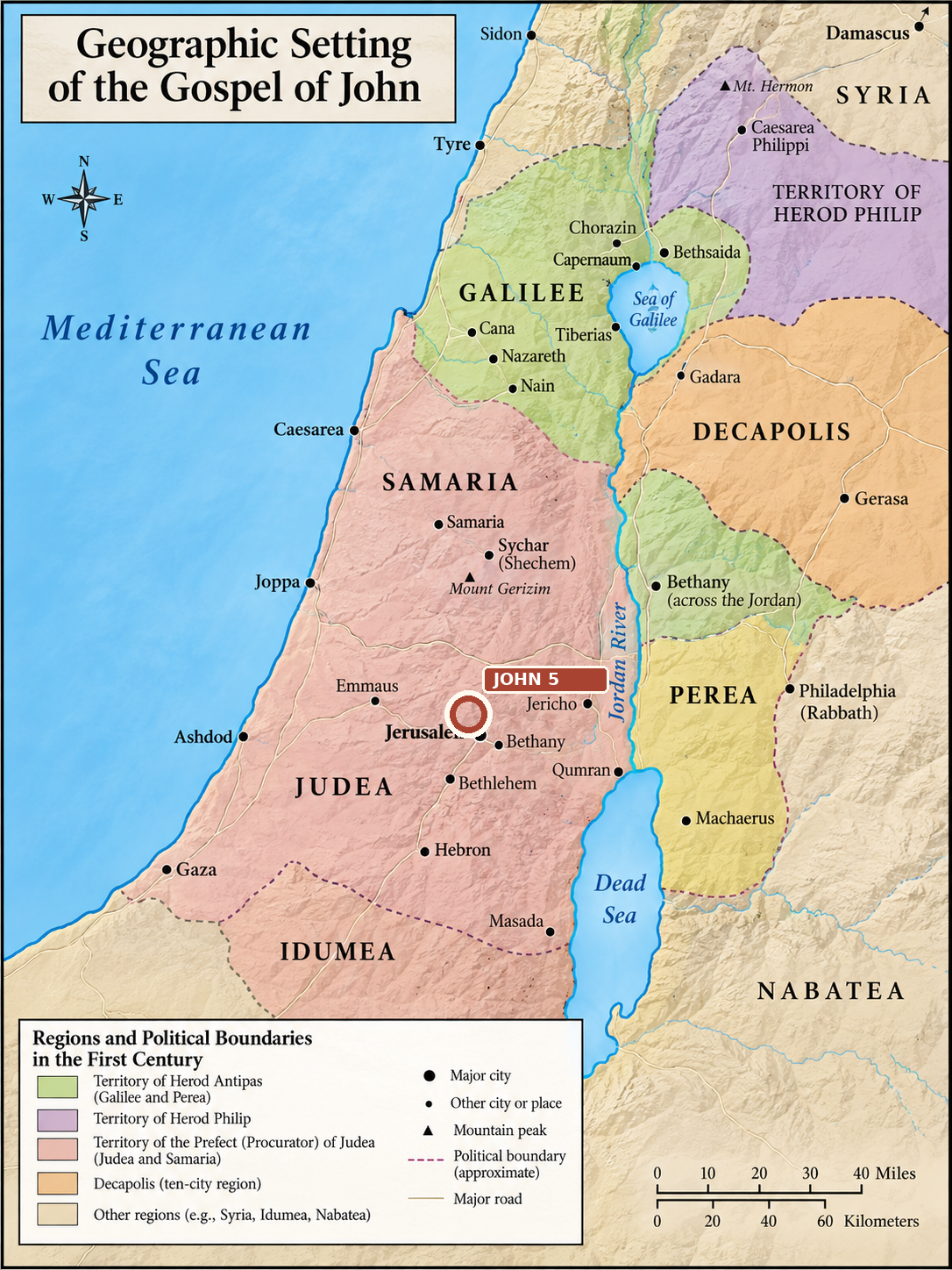
Regional location
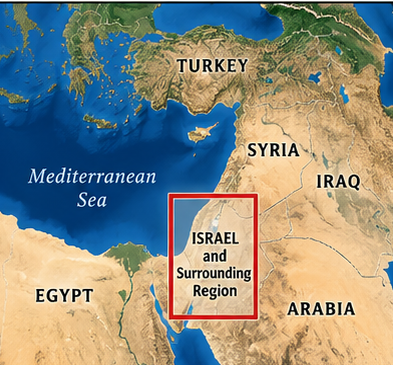
Red box locates the larger biblical atlas.
Locations in John 5
Jerusalem (5:1–2): Jesus goes to a feast here.
Bethesda: A pool near the Sheep Gate, traditionally identified north of the Temple Mount; the ancient gate position is not pinned.
Temple (5:14): Jesus finds the healed man in the temple precincts.
Uncertain festival: John 5:1 does not name the feast.
Reading the atlas
Pastel shading shows approximate first-century political regions; topographic shading suggests hills and mountains, and blue marks water.
Closer look: Bethesda and the Temple
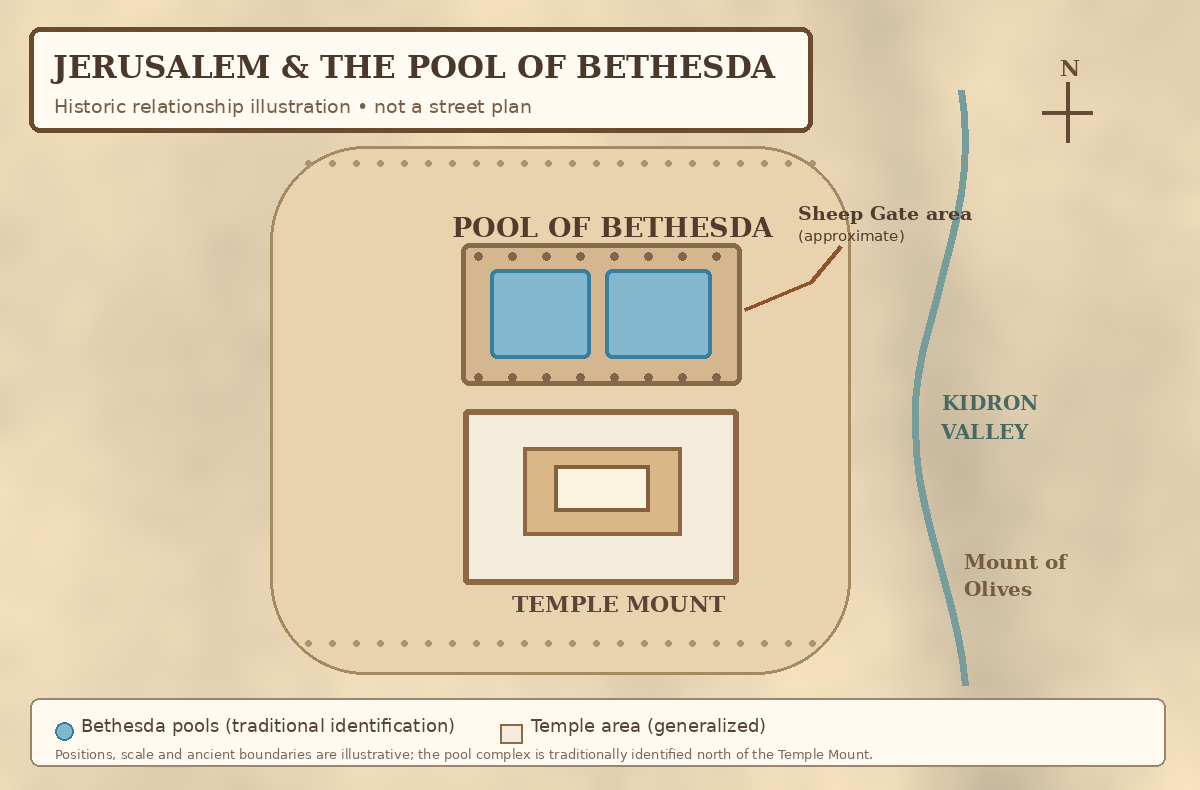
Conceptual orientation only—not a surveyed first-century street map. The pool complex north of the Temple Mount is the traditional archaeological identification.
Quick Study
“Most certainly I tell you, he who hears my word and believes him who sent me has eternal life, and doesn’t come into judgment, but has passed out of death into life. John 5:24, WEB
Jesus heals at Bethesda and explains His unique relationship with the Father. The Son gives life, judges, and deserves the same honor as the Father. Scripture and other witnesses testify to Jesus; faith in Him brings eternal life.
The Chapter’s Major Movements
Healing at Bethesda (5:1–9)
Jesus heals a man who has suffered thirty-eight years and tells him to rise and walk.
The Sabbath controversy (5:10–15)
Religious authorities question the healed man about carrying his mat on the Sabbath.
Jesus’ divine claim (5:16–18)
Jesus identifies the Father’s ongoing work as the pattern for His own.
The Son’s authority (5:19–23)
The Son gives life, judges, and receives the honor due to the Father.
Life now and resurrection later (5:24–29)
Faith brings eternal life now, and the Son will summon the dead to resurrection.
Witnesses to Jesus (5:30–38)
John the Baptist, Jesus’ works, and the Father testify about Him.
Scripture and the heart (5:39–44)
The Scriptures testify to Christ; pursuit of human praise can block faith.
Moses points to Christ (5:45–47)
The writings of Moses bear witness to Jesus.
Quick Study Flow
Textual Note: John 5:3b–4
The WEB Classic prints the explanation about an angel stirring the water. A WEB footnote notes that the NU critical text omits wording from late in 5:3 through 5:4. This workbook prints WEB faithfully and distinguishes the manuscript question from Jesus’ certain act of healing in 5:5–9.
Important Bible Words
| Word / Phrase | Simple Meaning | Why It Matters |
|---|---|---|
| Bethesda | A Jerusalem pool near the Sheep Gate; name also appears as Bethzatha in manuscripts | Site of the healing that begins John 5. |
| Sabbath | Weekly day of rest under Israel’s covenant law | The Sabbath dispute brings Jesus’ divine authority into focus. |
| Son of God | Jesus’ unique relationship to God the Father | The chapter describes His life-giving works and rightful honor. |
| Equal with God | John’s explanation of the force of Jesus’ claim in 5:18 | Jesus is not presented as merely another prophet. |
| Eternal life | Life given by the Son to the person who believes | Jesus says the believer has it now (5:24). |
| Resurrection | The raising of the dead | Jesus promises a future bodily resurrection and judgment. |
| Witness / Testimony | Evidence or testimony supporting a truth claim | John, Jesus’ works, the Father, and Scripture point to Christ. |
| Moses’ writings | The Law / first five books of Scripture | Jesus says that Moses wrote about Him. |
Translation Word Notes
Capitalized pronunciation syllables mark stress; pronunciations approximate classroom Biblical Greek. Full Scripture text remains WEB. NKJV, NIV, and NLT phrases are short comparisons.
| Verse | Greek / Pronunciation | NKJV | NIV | NLT | What It Means |
|---|---|---|---|---|---|
| 5:2 | kolymbēthrakoh-loom-BAY-thrah | pool | pool | pool | The pool near the Sheep Gate is the setting for the sign; Bethesda and Bethzatha are textual name variants. |
| 5:6 | hygiēshoo-gee-AYS | made well | get well | get well | Jesus addresses the man’s need with an invitation to be restored. |
| 5:17 | ergazomaier-GAH-zoh-my | working | at work | working | Jesus relates His action to the Father’s ongoing work. |
| 5:18 | isosEE-sohs | equal with God | equal with God | equal with God | John reports the perceived significance of Jesus calling God His Father. |
| 5:21 | zōopoieōzoh-oh-poy-EH-oh | gives life | gives life | gives life | The Son gives life as the Father does. |
| 5:24 | metabebēkenmeh-tah-BEH-bay-ken | passed from | crossed over | passed from | The believer has passed from death into life. |
| 5:29 | anastasisah-NAH-stah-sis | resurrection | rise | resurrection | Jesus teaches resurrection to life and to judgment. |
| 5:39 | eraunateeh-rah-OO-nah-teh | search | study | search | The Greek form may be read as a statement or command; context matters. |
The Gospel Connection
The center of John 5 is not merely an astonishing healing. Jesus reveals that the Father has entrusted life and judgment to the Son. He promises eternal life now to those who hear His word and believe the Father who sent Him (5:24), and He will one day raise the dead (5:28–29). The miracle demonstrates His authority; the Father, His works, John the Baptist, and the Scriptures bear witness to His identity. Salvation comes not through ritual, knowledge, or applause, but through faith in Jesus Christ, who would give His life and rise again for sinners (John 19–20).
Reflection
Am I receiving life through Christ, or trying to secure it through my own efforts?
A Short Prayer from John 5
Father, thank You for sending Your Son, who has authority over life and death. Forgive me for trusting my efforts or reputation more than Your Word. Help me receive Jesus by faith, honor Him as Lord, and read Scripture with a heart ready to obey. In Jesus’ name, amen.
One Truth to Carry With You
The Son has the Father’s authority to give life and judge, and the Scriptures call me to believe Him.
Ready to Go Deeper?
SOAP means Scripture, Observation, Application, Prayer. Read the complete passage before considering the explanation. Scripture remains our final authority.
Read the entire WEB passage in context.
Notice what the chapter states about the Son, Father, life, judgment, witness, and Scripture.
Respond personally with faith, repentance, obedience, or thanksgiving.
Pray in response to the truth of the passage.
The Man at Bethesda
What does the passage say about Jesus, God, people, faith, salvation, or obedience?
Jesus goes to Jerusalem for an unnamed festival and meets a man who has suffered for thirty-eight years. The pool near the Sheep Gate had five covered porches. The man focuses on his inability to reach the water; Jesus directly asks whether he wants to be made well and commands him to rise.
John emphasizes Jesus’ authority: the man is immediately healed by His word, not by a ritual or an advantage over other sick people. The healing happens on the Sabbath, introducing the dispute that follows.
The WEB includes an explanation in 5:3b–4 about the stirred water and an angel; many early Greek manuscripts omit that explanation. The healing itself in 5:5–9 is not dependent on the disputed wording.
Where do I limit my expectations of Jesus to what I can personally arrange or control?
Lord Jesus, help me listen to Your Word rather than placing my hope in my own ability to manage outcomes.
The Sabbath Dispute
What does the passage say about Jesus, God, people, faith, salvation, or obedience?
Some authorities object when they see the healed man carrying his mat on the Sabbath. Their question concerns a Sabbath prohibition, but the narrative directs readers to the Person who healed him.
Jesus later finds the man in the temple and tells him not to continue in sin. The text does not say that his thirty-eight years of illness were caused by a particular sin, and we should not assume that suffering always results from personal wrongdoing.
John records that the man identifies Jesus to the authorities. The narrative does not fully explain his motives, so interpreting him as a deliberate betrayer goes beyond what John states.
Am I more concerned with defending my habits than recognizing what Jesus is teaching?
Father, give me a heart that honors Your Word and responds humbly when Christ confronts sin.
The Son and the Father
What does the passage say about Jesus, God, people, faith, salvation, or obedience?
John connects the mounting opposition to Jesus’ actions on the Sabbath. Jesus responds that His Father is still working and that He, too, is working.
His opponents understand His claim to God as His own Father as a claim to equality with God. John does not soften Jesus into merely another religious teacher; the rest of the chapter develops His unique divine authority.
The passage must be read alongside Jesus’ complete teaching about His relationship with the Father rather than as an isolated accusation.
Do I receive Jesus as the divine Son, or try to reduce His claims to something more comfortable?
Jesus, give me reverence for Your true identity and courage to follow Your teaching even when it challenges me.
The Son Gives Life and Judgment
What does the passage say about Jesus, God, people, faith, salvation, or obedience?
The Son does not act independently or in rivalry against the Father. He perfectly does what He sees the Father doing. The language of unity and love shows a unique relationship, not a denial of His deity.
Jesus claims authority to give life and to exercise judgment—acts associated with God Himself. The Father wills that people honor the Son just as they honor the Father.
In traditional Trinitarian theology, the Father and the Son are personally distinct yet one in divine nature. This passage reveals a unity of purpose and action that calls for worship and faith.
Does my worship and obedience give the Son the honor that belongs to Him?
Father, thank You for revealing Yourself through Your Son. Teach me to honor Jesus as You command.
From Death into Life
What does the passage say about Jesus, God, people, faith, salvation, or obedience?
Jesus promises that the one who hears His Word and believes the Father who sent Him has eternal life now and has passed from death into life. Saving faith rests on Christ and His promise, not religious performance.
He also speaks of a future hour when all in the tombs will hear His voice and rise to either life or judgment. Christians may explain the timing of prophetic events differently, but Jesus clearly teaches a real resurrection and accountability before God.
Good and evil actions reveal a life’s orientation; this should not overturn John’s repeated teaching that eternal life is received through faith in the Son (3:16; 5:24).
Am I resting in Christ’s promise of life, and am I living as someone who belongs to Him?
Lord, thank You for the sure promise of life in Christ. Shape my daily conduct to reflect the faith I profess.
A Righteous Judgment and John’s Witness
What does the passage say about Jesus, God, people, faith, salvation, or obedience?
Jesus’ judgment agrees perfectly with the Father’s will. He is not seeking an independent reputation but carrying out the mission of the One who sent Him.
Jesus points to testimony about His identity, including John the Baptist, whose witness the people had heard. The Baptist is a lamp that shines; he is not the final light.
The issue is not a lack of opportunity to hear testimony. John’s warning invites us to respond to what God has made known rather than enjoy religious interest without trusting Christ.
Do I treat Christian testimony as interesting information, or as an invitation to believe Jesus?
Father, thank You for faithful witnesses. Lead me beyond admiration of them to trust in Your Son.
The Works and the Father Testify
What does the passage say about Jesus, God, people, faith, salvation, or obedience?
Jesus’ works are evidence that the Father has sent Him. His signs do not exist merely to impress observers; they bear witness to His authority and mission.
The Father Himself testifies of the Son, and Jesus exposes the problem of unbelief: His opponents do not have God’s Word abiding in them because they reject the One He sent.
Scripture and the signs are not competing authorities. Both are meant to lead us to Christ, who fulfills the Father’s saving purpose.
Will I receive the testimony God has given about Jesus even when it challenges my expectations?
Lord God, open my heart to hear Your Word and recognize Your Son through the testimony You have given.
Scripture Points to Christ
What does the passage say about Jesus, God, people, faith, salvation, or obedience?
Jesus says that the Scriptures themselves testify about Him. Careful Bible reading matters, yet knowledge about the text must lead to the Savior to whom it points.
He rebukes the search for praise from people instead of the glory that comes from God. Religious expertise and social approval cannot substitute for genuine love of God and faith in Christ.
This is a warning to any reader, including us; it is not a claim that all Jewish people rejected Jesus. Jesus, His disciples, and the witnesses in this account are Jewish.
Am I reading Scripture to encounter and obey Jesus, or mainly to win arguments and approval?
Lord, keep my Bible study humble and Christ-centered. Turn me from pride and make Your truth fruitful in me.
Moses Wrote About Me
What does the passage say about Jesus, God, people, faith, salvation, or obedience?
Jesus concludes by saying that Moses’ writings testify about Him. His opponents claim confidence in Moses while refusing to believe the One of whom Moses wrote.
Jesus’ words point to the unity of Scripture: the Old Testament prepares the way for Christ, and the Gospel reveals Him. We should interpret individual passages carefully rather than claim every detail is a hidden prediction.
Faithful evangelical reading honors the historical meaning of Moses’ writings while recognizing the larger biblical story that leads to Jesus.
When I read the Old Testament, do I ask how it contributes to the Bible’s message fulfilled in Christ?
Father, teach me to read both Testaments with faithfulness, humility, and confidence in Jesus.
Hard Questions
Why is John 5:4 missing from some Bibles?
The WEB Classic prints the explanation about an angel stirring the water, but many early Greek manuscripts do not contain part of 5:3 or any of 5:4. The manuscript difference is acknowledged in a WEB footnote. The certain point of the narrative is that Jesus heals the man by His word. The disputed explanation must not be turned into a promise that God heals people through a particular pool.
Which Jewish feast brought Jesus to Jerusalem?
John 5:1 does not name the festival. Proposals include Passover, Pentecost, and other feasts, but we cannot choose one as a fact from the text.
Did Jesus break God’s Sabbath command?
John records a controversy over Sabbath practice and Jesus’ claim about the Father’s work. Evangelicals differ on details of the legal discussion, but the passage does not present Jesus as a sinner. John’s central point is His divine authority and the response it provokes.
Was the man disabled because he sinned?
Jesus warns him to sin no more (5:14), but John does not identify the cause of his thirty-eight years of illness. John 9:1–3 also warns us not to assume that physical suffering is always punishment for a particular personal sin.
How can Jesus be equal with God yet say He can do nothing of Himself?
Jesus is not claiming weakness or an inability to act; He describes perfect harmony with the Father. Historic Protestant teaching confesses the Father and Son as distinct persons sharing the one divine nature. Jesus’ authority to give life, judge, and receive equal honor is stated explicitly.
Does John 5:29 teach that good deeds earn salvation?
Jesus speaks of resurrection to life and to judgment, while John 5:24 says eternal life is received by hearing and believing. Deeds matter as evidence of a life’s response to God; they do not replace faith in Christ as the means of receiving salvation.
Does 5:39 mean Bible study is unnecessary?
No. Jesus criticizes reading Scripture while refusing the Person to whom it bears witness. Careful study is good, but it must lead to trusting and following Him, not merely accumulating information.
What is one situation where I need to listen to Jesus rather than depend on a familiar routine?
How does John 5 change the way I think about the Son’s relationship with the Father?
Do I truly rest in Jesus’ promise of eternal life through faith (5:24)?
What testimony about Jesus has God placed before me that I have been slow to receive?
When I study the Bible, am I seeking Christ—or approval for what I know?
A Prayer for Faith in the Son
Lord Jesus, You see the suffering I cannot solve and the sin I sometimes excuse. Thank You that Your word carries authority and Your promise of life is trustworthy. Teach me to honor You as the Son of God, to respond to Your truth with humble faith, and to read all of Scripture as a testimony that points me to You. Give me grace to love others while standing faithfully on Your Word. In Your name, amen.
The Son has the Father’s authority to give life and judge, and the Scriptures call me to believe Him.