John 6
The Bread of Life
Jesus feeds a multitude, comes to His disciples on the water, and reveals Himself as the Bread of Life who gives eternal life to those who believe.
Scripture quotations: World English Bible (WEB)

John 6 — Geographic Setting
John 6 is centered on the Sea of Galilee, also called Tiberias. Our original atlas highlights the general region while leaving disputed miracle sites and the boat’s exact crossing unpinned.
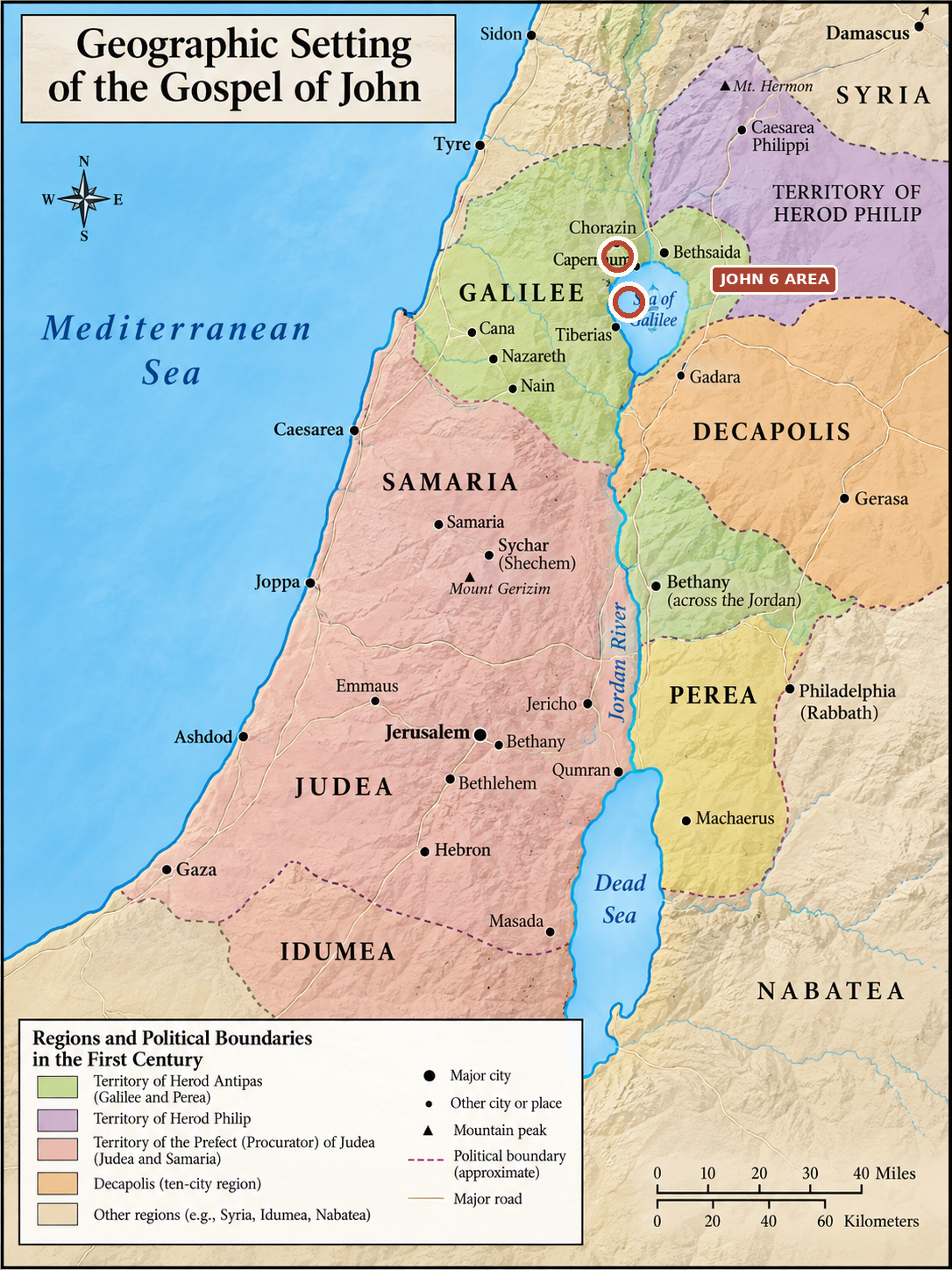
Regional location
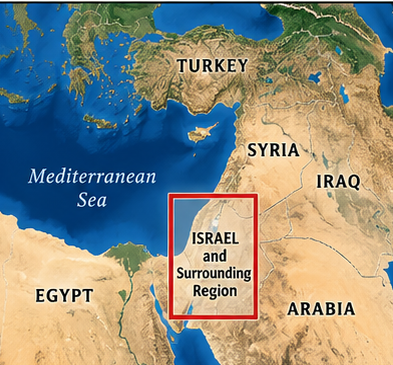
Red box locates the broader biblical atlas.
Locations in John 6
Sea of Galilee (6:1): Also called the Sea of Tiberias.
Capernaum (6:17, 24, 59): Boat destination and location of Jesus’ synagogue teaching.
Tiberias (6:23): Boats from this city approach the feeding area.
Uncertain location: The exact hillside and water route are not specified in John.
Reading the atlas
Pastel shading shows approximate first-century regions; shaded mountains suggest relief and blue identifies seas and rivers.
Closer look: the Sea of Galilee
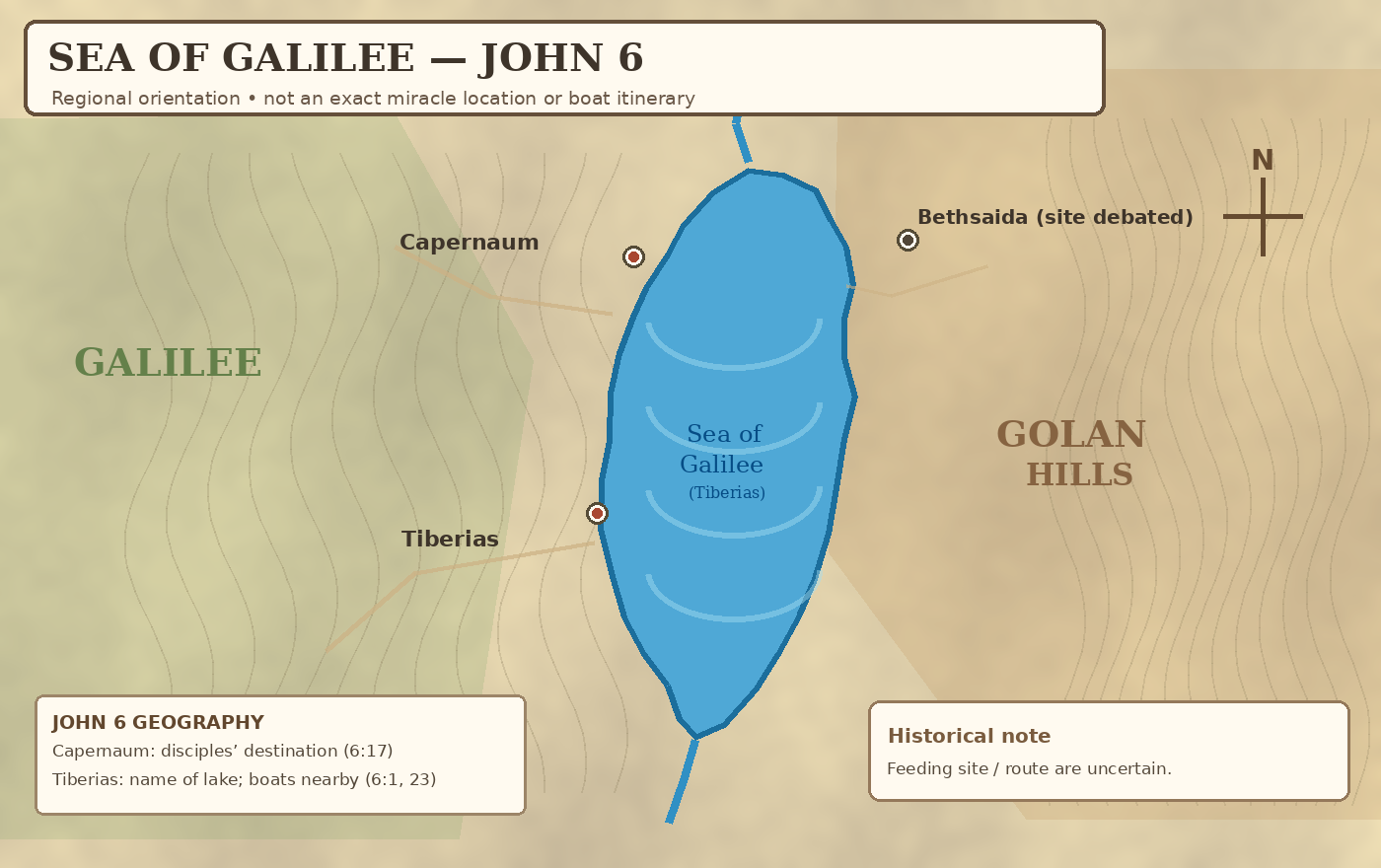
Schematic geographic orientation; not a surveyed map. John does not specify a precise feeding location or boat route.
Quick Study
Jesus said to them, “I am the bread of life. Whoever comes to me will not be hungry, and whoever believes in me will never be thirsty. John 6:35, WEB
Jesus feeds a multitude and comes to His disciples across the water. In Capernaum He reveals Himself as the Bread of Life, sent by the Father to give eternal life. His teaching about His flesh and blood divides the hearers, while Peter confesses that Jesus alone has the words of eternal life.
The Chapter’s Major Movements
A crowd and a need (6:1–4)
Jesus teaches by the Sea of Galilee as Passover approaches.
A sign of abundance (6:5–13)
He feeds about five thousand men with five loaves and two fish.
The wrong kind of king (6:14–15)
The crowd tries to make Jesus king by force, but He withdraws.
The sea and the Savior (6:16–21)
Jesus comes to His disciples over stormy water as they travel toward Capernaum.
Seeking the right bread (6:22–34)
Jesus redirects the crowd from temporary food to lasting life through faith.
Bread from heaven (6:35–51)
Jesus declares Himself the bread of life, sent by the Father.
His flesh for the world (6:52–59)
He speaks of giving Himself for life and of abiding in Him.
The decision to remain (6:60–71)
Some followers depart; Peter confesses that Jesus has the words of eternal life.
Quick Study Flow
Geographic and Translation Notes
John 6:20 prints “It is I” in WEB, with a footnote explaining that the Greek can also be rendered “I AM.” The exact feeding spot and the boat crossing route are not specified. We distinguish the text from later site traditions.
Important Bible Words
| Word / Phrase | Simple Meaning | Why It Matters |
|---|---|---|
| Sea of Galilee / Tiberias | Freshwater lake in northern Israel | Setting of the feeding sign, storm, and travel toward Capernaum. |
| Passover | Israel’s feast remembering deliverance from Egypt | Frames the discussion of bread and manna. |
| Sign | A miracle revealing Jesus’ person and mission | The feeding points beyond food to the life Jesus gives. |
| Manna | Bread-like provision for Israel in the wilderness | God’s temporary provision anticipates Christ the true bread. |
| Bread of Life | Jesus’ declaration of His unique saving sufficiency | Those who come and believe in Him receive eternal life. |
| Son of Man | Jesus’ self-designation, rooted in biblical imagery | The Son gives the food that endures and will raise believers. |
| Draw | The Father’s gracious work bringing people to the Son | Jesus connects saving faith with the Father’s initiative. |
| Flesh and Blood | Jesus’ emphatic description of receiving His life-giving self-gift | Highlights His real sacrificial death and the need to receive Him by faith. |
| Abide / Remain | To live in enduring relationship or union | Jesus speaks of believers dwelling in Him and Him in them. |
Translation Word Notes
Capitalized pronunciation syllables mark stress; pronunciations approximate classroom Biblical Greek. Full Scripture text remains WEB. NKJV, NIV, and NLT phrases are short comparisons.
| Verse | Greek / Pronunciation | NKJV | NIV | NLT | What It Means |
|---|---|---|---|---|---|
| 6:2 | sēmeionsay-MAY-on | signs | signs | miraculous signs | A sign points beyond a miracle to the identity of Jesus. |
| 6:11 | eucharisteōyoo-khah-ris-TEH-oh | given thanks | gave thanks | gave thanks | Jesus gives thanks to the Father before distributing the food. |
| 6:20 | egō eimieh-GOH AY-mee | It is I | It is I | I am here | Can mean “It is I”; its wording also echoes biblical “I AM” language. |
| 6:27 | menōMEH-noh | endures | endures | endures | The life Christ gives remains, unlike temporary food. |
| 6:29 | pisteuōpis-TYOO-oh | believe | believe | believe | Trusting Jesus, the One God sent, is central. |
| 6:35 | artos tēs zōēsAR-tohs tace zoh-AYS | bread of life | bread of life | bread of life | Jesus Himself is the essential provision for eternal life. |
| 6:44 | helkōhel-KOH | draws | draws | draws | The Father acts graciously to bring people to the Son. |
| 6:56 | menōMEH-noh | abides | remains | remains | Believers are described as living in enduring union with Christ. |
| 6:63 | pneumaPNEW-mah | Spirit | Spirit | Spirit | The Spirit gives life; Jesus’ words are spirit and life. |
| 6:68 | rhēmaRAY-mah | words | words | words | Peter recognizes Jesus’ words as the source of eternal life. |
The Gospel Connection
John 6 points beyond an extraordinary meal to the gift of Christ Himself. The Father has sent the true Bread from heaven, and Jesus gives His own flesh for the life of the world (6:51). The One who comes to Him and believes has eternal life, will not be cast out, and will be raised at the last day (6:35–40, 47). This salvation is received by faith, not purchased with good works or secured by simply repeating a ritual. Jesus’ words point forward to His real death and resurrection as the Savior who gives lasting life.
Reflection
Do I seek Jesus for temporary benefits, or do I trust Him for eternal life?
A Short Prayer from John 6
Father, thank You for the Bread of Life. Forgive me for seeking lesser gifts while neglecting Your Son. Help me believe Christ’s words, depend on His sacrifice, and remain faithful when His teaching stretches my understanding. In Jesus’ name, amen.
One Truth to Carry With You
Jesus is the Bread of Life. I receive the life He gives by trusting Him, and I can remain with Him because He alone has the words of eternal life.
Ready to Go Deeper?
SOAP means Scripture, Observation, Application, Prayer. Read the complete passage before considering the explanation. Scripture remains our final authority.
Read the entire WEB passage in context.
Notice what the chapter says about signs, bread, belief, the Father’s drawing, and eternal life.
Respond personally with faith, repentance, obedience, or thanksgiving.
Pray in response to the truth of the passage.
The Sign Begins with a Need
What does the passage say about Jesus, God, people, faith, salvation, or obedience?
John introduces the Sea of Galilee, also called the Sea of Tiberias, as the setting. A large crowd follows Jesus because of the healing signs they have seen. The Passover is near, adding the biblical background of God providing food to Israel.
Jesus sits with His disciples on a hillside. John does not identify the precise location of the coming feeding, so a map should show the broader lake region rather than a confidently pinned hillside.
The details prepare the reader to see not only the miracle of bread but the One who supplies life itself.
Am I seeking Jesus mainly for what He can give me, or because of who He is?
Father, help me look beyond signs and daily needs to recognize Your Son and listen to Him.
Jesus Feeds the Multitude
What does the passage say about Jesus, God, people, faith, salvation, or obedience?
Jesus asks Philip where food can be purchased, but John says He already knows what He will do. Philip calculates what cannot be bought; Andrew notices a boy’s five barley loaves and two fish but sees how little they are among the crowd.
Jesus gives thanks, distributes enough food for the people to eat as much as they want, and tells the disciples to collect the leftovers. Twelve baskets of fragments remain. John presents an actual miraculous provision, not merely an example of people sharing their lunches.
The sign shows Jesus’ abundant authority and compassion while anticipating His greater claim to be the bread of life.
Where do I let the size of a need overshadow the power and wisdom of Christ?
Lord Jesus, teach me to bring limited resources to You with thanks and trust.
Not a King on the Crowd’s Terms
What does the passage say about Jesus, God, people, faith, salvation, or obedience?
The crowd sees the miracle and identifies Jesus as the expected prophet. Yet they plan to seize Him and make Him king by force.
Jesus refuses to submit to their plan and withdraws by Himself. He is truly the promised King, but His mission is not controlled by popular pressure or the crowd’s political expectations.
This contrast matters throughout John: people may admire Jesus’ power without yielding to the salvation and kingship He came to bring.
Do I want Christ to fit my plans, or am I willing to follow His purposes?
King Jesus, correct my attempts to remake Your mission around my desires.
The Lord over the Storm
What does the passage say about Jesus, God, people, faith, salvation, or obedience?
The disciples travel by boat toward Capernaum as darkness and strong wind cover the lake. They have rowed a considerable distance when Jesus approaches them walking on the water.
Jesus tells them not to fear. The WEB reads “It is I,” with a footnote noting that the phrase can also be translated “I AM.” The text clearly presents Jesus’ authority over circumstances that frighten His followers.
John reports they receive Him willingly and soon reach their destination. No exact boat route should be drawn on the map.
In fear or uncertainty, how can I trust Jesus’ presence and word?
Lord Jesus, help me hear Your voice above my fear and trust Your care.
The Food That Lasts
What does the passage say about Jesus, God, people, faith, salvation, or obedience?
The crowd follows Jesus to Capernaum. He exposes their motive: they pursue Him because they ate and were filled, rather than understanding the deeper meaning of the sign.
Jesus contrasts perishable food with food that endures to eternal life, a gift the Son of Man gives. When asked what works God requires, He answers that the work of God is to believe in the One God sent.
Faith does not mean earning salvation by a new religious achievement. Jesus calls them to trust Him as the Father’s appointed Savior.
When I pray and serve, am I treating Jesus as a means to another goal—or as my life?
Father, teach me to rely on Christ for the life that perishable things cannot provide.
The Father Gives True Bread
What does the passage say about Jesus, God, people, faith, salvation, or obedience?
The people ask for another sign and appeal to the manna given to Israel in the wilderness. Even after the feeding miracle, they miss its full meaning.
Jesus redirects attention from Moses to the Father: God now gives the true bread from heaven, the One who gives life to the world. The wilderness manna anticipated this greater provision but could not give eternal life.
The crowd asks for that bread continually, not yet grasping that Jesus Himself is the gift.
Am I looking for repeated proof while neglecting the clear testimony about Jesus?
Father, open my eyes to see the gift of Your Son rather than demand another sign.
I Am the Bread of Life
What does the passage say about Jesus, God, people, faith, salvation, or obedience?
Jesus makes the central claim of the chapter: “I am the bread of life.” Coming to Him and believing in Him are parallel descriptions of receiving His saving provision.
He promises that He will never cast out the one who comes to Him. He also says He will keep those entrusted to Him and raise them up at the last day. These words unite present faith, the Father’s purpose, and future resurrection.
Protestant Evangelicals may differ over the relationship between divine election and human response, but the text clearly calls every hearer to believe Jesus and reassures those who come to Him.
Do I rest in Jesus’ promise to receive and keep those who come to Him?
Lord Jesus, thank You that Your promise to receive believers is more secure than my performance.
The Father Draws Us to the Son
What does the passage say about Jesus, God, people, faith, salvation, or obedience?
The hearers grumble at Jesus’ claim to have come from heaven. They know His earthly family, yet do not understand the unique heavenly origin He declares.
Jesus teaches that the Father draws people to Him and that everyone who believes in Him has eternal life. The prophets’ promise that people would be taught by God is fulfilled in the revelation the Father gives through the Son.
Evangelical Christians differ on whether this drawing is resistible, but agree that saving faith depends on God’s grace and calls the sinner to trust Jesus.
Will I receive Jesus’ claims even when they challenge my assumptions?
Father, teach me to listen to Your Son and receive Your saving work with humble faith.
The Living Bread Given for the World
What does the passage say about Jesus, God, people, faith, salvation, or obedience?
Jesus repeats His central claim: He is the Bread of Life. Israel’s ancestors ate manna and died, but the bread He gives leads to eternal life.
He declares that He will give His flesh for the life of the world, pointing ahead to His genuine self-giving death. The shocking image begins to explain why Christ’s sacrifice is essential to life.
Coming to and believing in Jesus are the responses He has already emphasized. His gift is not an invitation to physical violence, but to receive Him by faith.
Am I resting in the living Bread who gave Himself for my salvation?
Lord Jesus, thank You for giving Yourself for the life of the world. Keep my hope centered on You.
His Flesh for the Life of the World
What does the passage say about Jesus, God, people, faith, salvation, or obedience?
Jesus’ hearers struggle with His teaching about eating His flesh and drinking His blood. He does not retreat from the central claim: life comes only through receiving Him and His saving sacrifice.
In the context of John 6, coming and believing (6:35, 40, 47) help interpret the stronger eating-and-drinking imagery. Many Evangelicals also see a meaningful connection to the Lord’s Supper, but disagree on whether this passage directly teaches the sacrament.
We should not replace Jesus’ call to faith with a literalistic idea of consuming human flesh or with the claim that a ritual alone grants eternal life. John locates life in Christ Himself.
Am I relying on Christ’s sacrifice and union with Him, rather than on outward religious activity?
Lord Jesus, thank You for giving Yourself for the life of the world. Keep me abiding in You by faith.
Hard Teaching and Life-Giving Words
What does the passage say about Jesus, God, people, faith, salvation, or obedience?
Many disciples call Jesus’ words difficult. Jesus points them toward His heavenly origin and coming ascension, then explains that the Spirit gives life and His words are spirit and life.
His teaching exposes unbelief even among people who have followed Him outwardly. Merely walking with the group or hearing difficult sayings does not necessarily mean a person has saving faith.
The Father’s gracious work and Jesus’ life-giving words remain essential. The text invites reverent listening rather than simply discarding statements that unsettle us.
When Scripture challenges me, do I seek its faithful meaning or simply turn away?
Holy Spirit, give me a teachable heart to receive Christ’s words of life.
To Whom Would We Go?
What does the passage say about Jesus, God, people, faith, salvation, or obedience?
Many turn away, but Peter answers that Jesus alone has the words of eternal life. Peter confesses faith in Jesus as the Christ and Son of God.
Jesus reminds the Twelve that He chose them, yet one would betray Him. John identifies Judas. External position in a ministry does not guarantee inward trust; the reader is called to believe Christ Himself.
The chapter ends with a personal question: will we follow Jesus only when His teaching is easy, or because He alone has life?
Do I remain with Jesus because He alone is Lord, even when His word corrects me?
Jesus, where else could I go? Strengthen my faith in You, the Christ and giver of life.
Hard Questions
Where did Jesus feed the five thousand?
John 6 places the event across the Sea of Galilee and on a grassy hillside but does not name a precise spot. Traditions and geographic reconstructions vary. Our atlas identifies the sea and nearby towns, not an invented miracle coordinate.
Does 6:20 mean “It is I” or “I AM”?
The Greek phrase egō eimi can mean “It is I,” as the WEB prints, and may also evoke God’s self-identification. The phrase should be understood in context; the indisputable point here is Jesus’ presence and authority amid danger.
If Jesus fed the crowd, why did He criticize them?
The miracle itself was good, but Jesus exposes a motive that stops at satisfied hunger. The sign was meant to direct them to trust Him as the One who gives life rather than simply demand another meal.
Does “the work of God” mean we earn salvation by believing?
John 6:29 uses the word “work” in answer to the crowd’s question, but Jesus identifies belief in the One God sent—not an achievement that purchases salvation. Faith receives the gift of eternal life.
What does it mean that the Father draws people (6:44)?
The Father takes the initiative in bringing people to Jesus. Faithful Protestant Evangelicals differ over whether this drawing is always effectual or can be resisted. The passage affirms both the Father’s work and the invitation to believe the Son.
Does eating Jesus’ flesh and drinking His blood mean literal consumption?
John 6 repeatedly connects life with coming to and believing in Jesus. The startling image points to receiving Him and His self-giving sacrifice. Many Protestant readers also connect it to Communion, with differing interpretations, but the chapter does not endorse physical cannibalism or ritual-only salvation.
Is Jesus teaching that we will never suffer or die physically?
No. He promises eternal life and resurrection “at the last day.” Believers may die physically before that day, yet their hope rests on His life-giving promise.
Were the disciples who left in 6:66 necessarily saved believers?
The word “disciples” can identify people who follow or learn outwardly; the text says that some did not believe (6:64). We cannot know every individual’s heart, but John clearly distinguishes outward association from genuine faith.
Where am I tempted to value Jesus mainly for immediate benefits?
What does the feeding sign teach me about Christ’s compassion and sufficiency?
What changes when I hear Jesus say, “I am the bread of life”?
How does Jesus’ promise not to cast out those who come to Him encourage my trust?
When God’s Word is difficult, will I stay with Christ and seek understanding?
A Prayer to Follow the Bread of Life
Lord Jesus, You fed a hungry crowd and declared Yourself the living Bread from heaven. You know what I need before I can explain it, and Your grace is greater than what I can provide. Forgive my shallow desires and my unbelief. Help me receive Your saving sacrifice by faith, trust Your promise to raise believers at the last day, and stay close to You when the road is difficult. You alone have the words of eternal life. In Your name, amen.
Jesus is the Bread of Life. I receive the life He gives by trusting Him, and I can remain with Him because He alone has the words of eternal life.