John 7
Rivers of Living Water
Jesus teaches at the Feast of Booths in Jerusalem, calls for righteous judgment, and invites thirsty people to receive the Holy Spirit through faith in Him.
Scripture quotations: World English Bible (WEB)

John 7 — Geographic Setting
Jesus moves from Galilee to Jerusalem for the Feast of Booths. Our original atlas marks both regions but does not invent His itinerary through Samaria or an exact temple speaking spot.
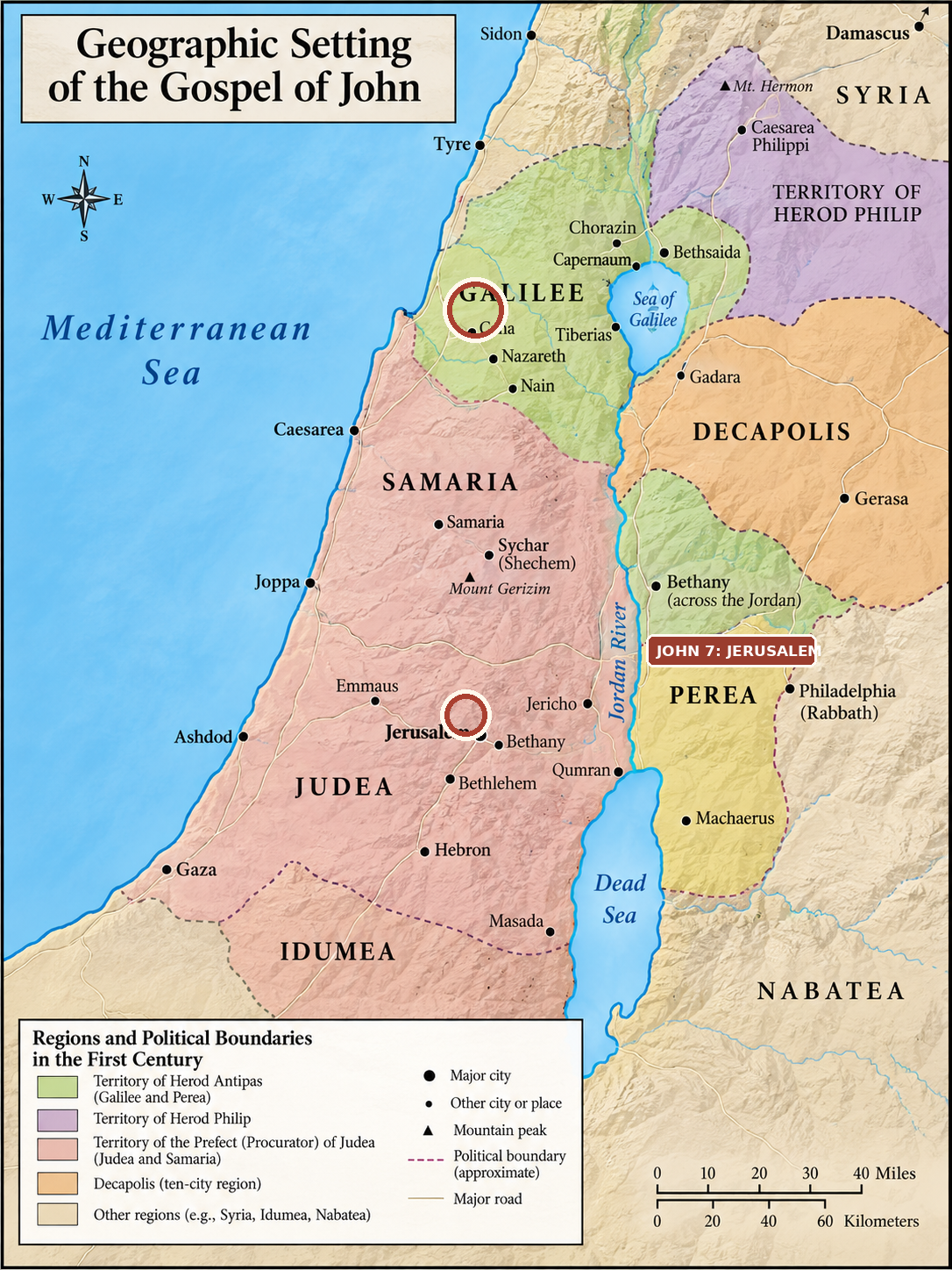
Regional location
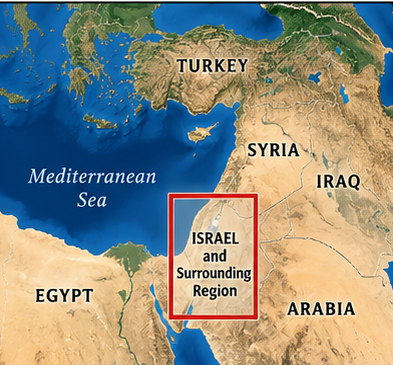
Red rectangle shows the wider map area.
Locations in John 7
Galilee (7:1, 9): Jesus remains there before going to the feast.
Jerusalem (7:10–52): The main setting, with the Feast of Booths, temple teaching, and conflict.
Temple (7:14, 28): Jesus teaches there, but the text does not identify a particular court.
Uncertain details: No exact travel route or precise location for the last-day invitation is given.
Reading the atlas
Pastel political areas, mountain relief, and blue rivers and lakes give surrounding biblical context. Historical boundaries are approximate.
Jerusalem and the Feast
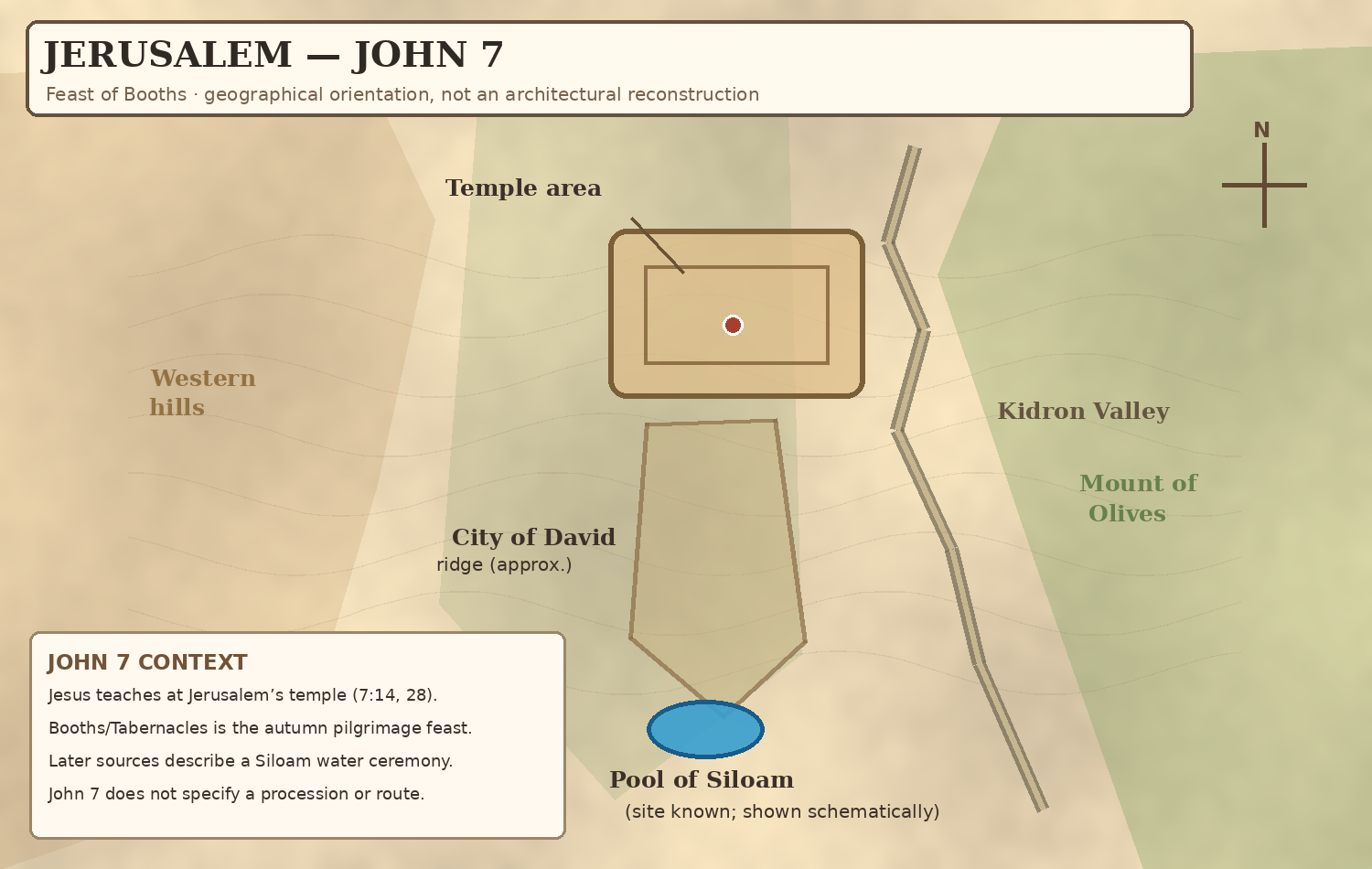
General ancient geographic relationship, not a surveyed temple map. John 7 does not specify a festival water procession or Jesus’ precise temple court.
Quick Study
Now on the last and greatest day of the feast, Jesus stood and cried out, “If anyone is thirsty, let him come to me and drink! He who believes in me, as the Scripture has said, from within him will flow rivers of living water.” John 7:37–38, WEB
Jesus goes from Galilee to Jerusalem for the Feast of Booths, teaches openly in the temple, and reveals that His teaching is from the Father. He calls for righteous judgment and offers living water to everyone who believes. John identifies this living water with the Holy Spirit. People divide over Jesus’ identity; Nicodemus urges a fair hearing.
The Chapter’s Major Movements
Pressure in Galilee (7:1–9)
Jesus’ brothers urge Him to seek publicity; He follows His Father’s timing.
Quiet arrival (7:10–13)
He comes to Jerusalem amid conflicting opinions and fear.
Teaching at the feast (7:14–19)
Jesus identifies the Father as the source of His teaching.
Righteous judgment (7:20–24)
He exposes inconsistent Sabbath judgments.
Questions and opposition (7:25–36)
People debate His identity as authorities seek to arrest Him.
Living water (7:37–39)
Jesus invites the thirsty; John identifies the promised gift as the Holy Spirit.
Division and resistance (7:40–49)
The crowd and authorities disagree about who He is.
Nicodemus and textual note (7:50–53)
A call for fair hearing closes the secure narrative; verse 53 begins a debated manuscript passage.
Quick Study Flow
Historical and Textual Notes
Later Jewish sources describe water-drawing rituals at the Feast of Booths, but John 7 does not explicitly place Jesus at a particular ceremony. John 7:53 begins the textually disputed story traditionally located at 7:53–8:11; many early manuscripts omit this passage. We print the WEB reading and distinguish manuscript evidence from accepted narrative details.
Important Bible Words
| Word / Phrase | Simple Meaning | Why It Matters |
|---|---|---|
| Feast of Booths / Tabernacles | Israel’s autumn pilgrimage festival remembering wilderness shelter | The setting for Jesus’ public temple teaching and living-water invitation. |
| The Hour / Time | The timing of Jesus’ mission under the Father’s purpose | Jesus refuses to be pressured into public self-display. |
| Temple | Center of Israel’s public worship in Jerusalem | Jesus teaches in the temple during a major festival. |
| Law of Moses | God’s law given to Israel through Moses | Jesus exposes inconsistent applications of the Sabbath command. |
| Messiah / Christ | God’s promised anointed king | The crowd argues about the identity and origins of Jesus. |
| Righteous Judgment | Evaluation according to truth and God’s standards | Jesus commands discernment rather than appearance-based condemnation. |
| Living Water | Jesus’ image for life given through the Spirit | John explains that believers would receive the Holy Spirit. |
| The Spirit | The Holy Spirit, giver of life | The promised Spirit is received in connection with Jesus’ glorification. |
| Nicodemus | A Jewish leader first introduced in John 3 | He speaks for due process rather than joining immediate condemnation. |
Translation Word Notes
Capitalized pronunciation syllables mark stress; pronunciations approximate classroom Biblical Greek. Full Scripture text remains WEB. NKJV, NIV, and NLT phrases are short comparisons.
| Verse | Greek / Pronunciation | NKJV | NIV | NLT | What It Means |
|---|---|---|---|---|---|
| 7:2 | skēnopēgiaskay-noh-PAY-gee-ah | Feast of Tabernacles | Festival of Tabernacles | Festival of Shelters | The festival of booths remembers the wilderness journey. |
| 7:6 | kairosKAI-ross | time | time | right time | Jesus’ mission unfolds according to divine timing. |
| 7:16 | didachēdee-dah-KHAY | doctrine | teaching | message | Jesus declares that His teaching comes from the Father. |
| 7:18 | doxaDOX-ah | glory | glory | honor | Jesus seeks the Father’s glory instead of self-praise. |
| 7:24 | dikaiosdee-KAI-oss | righteous | right | correctly | Judgment must be guided by truth, not appearances. |
| 7:37 | dipsaōdip-SAH-oh | thirsts | thirsty | thirsty | Jesus addresses genuine spiritual need. |
| 7:38 | hydōr zōnHOO-dor ZOHN | living water | living water | living water | Jesus promises spiritual life through His Spirit. |
| 7:39 | pneumaPNEW-mah | Spirit | Spirit | Spirit | John names the Holy Spirit as the promised gift. |
| 7:41 | Christoskhree-STOSS | Christ | Messiah | Messiah | The crowd debates whether Jesus is God’s Anointed One. |
The Gospel Connection
John 7 does not present Jesus as one more religious teacher seeking attention. He is the Son sent by the Father, revealing true judgment and inviting the thirsty to receive life. In John 7:37–39 He promises living water through the Spirit, a gift connected with His glorification. The Gospel of John leads us to His death, resurrection, and exaltation; eternal life comes through faith in Him. Public opinion cannot save us, and religious reputation cannot replace believing Christ.
Reflection
Will I come to Jesus for life and let His Word govern my judgments?
A Short Prayer from John 7
Father, thank You for sending Jesus, who speaks Your truth and welcomes thirsty people. Forgive my pride, my fear of others, and my habit of judging by appearances. Help me come to Christ in faith, obey His Word, and depend on the Holy Spirit. In Jesus’ name, amen.
One Truth to Carry With You
Jesus speaks with the authority of the Father and invites everyone who is spiritually thirsty to come to Him and believe. The Holy Spirit is God’s life-giving gift.
Ready to Go Deeper?
SOAP means Scripture, Observation, Application, Prayer. Read the complete passage before considering the explanation. Scripture remains our final authority.
Read the entire WEB passage in context.
Notice Jesus’ claims about the Father, His timing, righteous judgment, and living water.
Respond personally with faith, repentance, obedience, or thanksgiving.
Pray in response to the truth of the passage.
When Family Pressure Meets God’s Timing
What does the passage say about Jesus, God, people, faith, salvation, or obedience?
Jesus remains in Galilee because leaders in Judea want to kill Him. His brothers urge Him to go public at the Feast of Booths, but John plainly says they do not yet believe in Him. Family proximity to Jesus does not guarantee saving faith.
Jesus acts according to His Father’s purpose rather than pressure to seek attention. His reference to His “time” must be read with the unfolding story and the later arrival of His “hour,” not as a refusal to fulfill the Father’s mission.
The text also records opposition to Jesus because He exposes evil works. Faithfulness is not the same as popularity.
Where do I feel pressured to prove myself instead of obeying God’s timing?
Father, teach me to seek Your will instead of living for attention or approval.
A Quiet Arrival and Divided Opinions
What does the passage say about Jesus, God, people, faith, salvation, or obedience?
Jesus does go to Jerusalem for the feast, but not in the public manner His brothers urged. The crowds debate His character and mission; some call Him good, and others accuse Him of deception.
Fear of influential authorities keeps people from speaking openly. John portrays several Jewish groups and individual perspectives, not one uniform response by all Jewish people.
Public opinion does not determine who Jesus is. We must examine His own words and works.
Am I hiding my convictions about Jesus because I fear other people?
Lord Jesus, give me humility and courage to confess the truth about You.
Teaching That Comes from the Father
What does the passage say about Jesus, God, people, faith, salvation, or obedience?
At the middle of the feast Jesus teaches in the temple. His listeners wonder how He has such understanding without the expected formal education. Jesus answers that His teaching comes from the One who sent Him.
Jesus connects willingness to do God’s will with discernment about His teaching. The issue is not mere intellectual ability; humble obedience matters when confronting God’s revelation.
He seeks the Father’s glory rather than self-promotion and exposes the inconsistency of those claiming Moses’ law while seeking His death.
Do I approach Jesus’ teaching ready to obey, or only ready to evaluate it on my terms?
Father, make me willing to obey Your truth, not merely admire it.
Judge with Righteous Judgment
What does the passage say about Jesus, God, people, faith, salvation, or obedience?
The crowd disputes Jesus’ report of a plot against Him. Jesus points back to the Sabbath healing controversy of John 5. His argument shows that His opponents allow circumcision on the Sabbath while condemning a complete act of healing.
Jesus does not forbid every moral evaluation. He commands righteous judgment that considers God’s purposes rather than surface appearances or inconsistent standards.
This verse must not be used to excuse harshness; righteous judgment begins with submission to the Lord’s truth.
Where might I be judging by appearance instead of by God’s Word and justice?
Lord, correct my double standards and teach me to judge with humility and righteousness.
Where Does the Messiah Come From?
What does the passage say about Jesus, God, people, faith, salvation, or obedience?
People in Jerusalem wonder why Jesus speaks openly while leaders seem unable to arrest Him. They question His origins and speculate about whether He could be the Messiah.
Jesus declares that He did not come on His own initiative but was sent by the true Father, whom He knows. His earthly residence does not explain His divine mission.
John notes that no one arrests Him because His hour has not yet come. Others believe because of His signs. The responses remain mixed; the text does not tell us the inward state of every hearer.
Am I willing to let Jesus define His identity rather than reduce Him to what I already assume?
Lord Jesus, open my mind to Your testimony about the Father and Your mission.
You Will Seek Me
What does the passage say about Jesus, God, people, faith, salvation, or obedience?
The chief priests and Pharisees send officers to seize Jesus. He says He will remain a little while and then go to the One who sent Him.
His hearers misunderstand Him, imagining that He may travel to Jews scattered among Greek-speaking peoples. Yet Jesus is pointing beyond His present ministry toward returning to the Father through His death, resurrection, and exaltation.
The passage challenges people who delay their response to the Lord while assuming He will always be available on their terms.
What would it mean to take Jesus’ words seriously today rather than postpone faith and obedience?
Father, help me respond faithfully to Your Son while I hear His voice.
Come to Me and Drink
What does the passage say about Jesus, God, people, faith, salvation, or obedience?
On the feast’s last great day Jesus publicly invites the thirsty to come to Him and drink. The invitation is open to “anyone”; belief in Him is the response He calls for.
John himself interprets the rivers of living water as referring to the Spirit whom believers would receive. The wording “not yet given” concerns the coming outpouring following Jesus’ glorification, not the Spirit’s total absence in the Old Testament.
Traditions about water ceremonies at the Feast of Booths illuminate the setting, but John does not explicitly describe such a ceremony at the moment Jesus spoke. The sure truth is His promise of life through the Spirit.
Where do I look to satisfy spiritual thirst instead of coming to Christ?
Lord Jesus, thank You for inviting the thirsty. Fill me with Your Spirit and make me faithful to You.
The Crowd Divided over Christ
What does the passage say about Jesus, God, people, faith, salvation, or obedience?
Some identify Jesus as the prophet, others as the Messiah, and others object because they associate Him with Galilee. They appeal to promises connecting the Messiah with David and Bethlehem.
John has already shown how people can know some correct Scripture while misunderstanding Jesus. The synoptic Gospels identify Bethlehem as Jesus’ birthplace; John 7 reports the crowd’s debate without narrating His birth.
The division confirms that Jesus cannot be assessed merely through rumor or geography. Readers must reckon with His claims and the whole biblical testimony.
Am I forming my beliefs about Christ from Scripture or from incomplete assumptions and hearsay?
Lord, keep me rooted in the full counsel of Your Word.
No One Ever Spoke Like This Man
What does the passage say about Jesus, God, people, faith, salvation, or obedience?
Temple officers return without arresting Jesus and report His extraordinary speech. The religious leaders respond with scorn, arguing that influential people have not believed and condemning the crowd.
Their response exposes an appeal to status rather than careful hearing. Authority and learning can be blessings, but neither replaces the need to listen honestly to Jesus.
John distinguishes the particular leaders in this exchange from the Jewish people as a whole; Jesus and His first followers were Jewish too.
Do I evaluate Jesus’ words with humility, or let respected voices decide for me without study?
Father, keep me from pride and teach me to recognize Your truth.
Nicodemus Asks for a Fair Hearing
What does the passage say about Jesus, God, people, faith, salvation, or obedience?
Nicodemus, who appeared earlier in John 3, points out that the law calls for hearing a person before judging him. Others answer dismissively and invoke Galilee against him.
John 7:53 is printed in the WEB, but it begins the passage traditionally numbered John 7:53–8:11. That passage is absent from many early Greek witnesses and appears in different locations in manuscript traditions. We preserve the WEB text and clearly mark this textual question.
We can confidently learn from verses 50–52 that Nicodemus appeals to a fair hearing. We should not build a doctrine on disputed wording without discussing the manuscript evidence.
How can I practice fairness and careful listening when facing disagreement?
Father, help me hear truth honestly and speak with courage and charity.
Hard Questions
Why did Jesus say He was not yet going, then go?
In John 7:8 Jesus says He is “not yet going” (WEB Classic), and verse 10 says He later goes quietly. The sequence contrasts His timing and manner with His brothers’ demand for public self-display. Some manuscript traditions omit “yet” in 7:8; this is a textual variant that must be noted rather than concealed.
Does “the Jews” mean all Jewish people opposed Jesus?
No. John frequently uses this expression within a particular context for some Jerusalem authorities or other groups, and it does not describe every Jewish person. Jesus, His disciples, and many believers were Jewish. John portrays both opposition and faith among Jewish people.
Does John 7:17 teach salvation by obedience?
No. Jesus relates willingness to do God’s will to recognizing His teaching as from God, not to earning salvation. John repeatedly identifies life through believing in the Son (John 3:16; 6:40; 20:31). A teachable heart matters, but obedience does not purchase eternal life.
Is “Judge righteous judgment” permission to condemn others?
Jesus corrects distorted appearance-based judgment (7:24), especially inconsistent responses to Sabbath healing. He requires truthful and just discernment, not pride, unfairness, or self-righteousness. His other teachings about humility and mercy remain relevant.
What did water mean at the Feast of Booths?
The feast remembered Israel’s life in the wilderness. Later Jewish sources describe a water-drawing ceremony associated with Siloam and the temple. Such history can illuminate John 7:37–39, but John does not explicitly state that Jesus spoke during a particular water ceremony. His central promise concerns the Holy Spirit.
Was the Holy Spirit absent before Jesus was glorified?
No. The Old Testament records the Spirit’s activity. John 7:39 anticipates a new, promised gift of the Spirit to believers in the light of Jesus’ completed mission. Read it with John 14–16 and Acts 2 rather than as denying earlier activity of the Spirit.
How could the Messiah be from Galilee rather than Bethlehem?
The crowd discusses the Messiah’s Davidic descent and Bethlehem (7:42), but does not present complete information about Jesus’ birth. Matthew and Luke place His birth in Bethlehem, and John emphasizes His deeper heavenly origin. The crowd’s objection is reported, not endorsed as the final truth.
Is John 7:53 part of the original Gospel?
John 7:53 starts the passage traditionally placed at John 7:53–8:11. Many early and important Greek manuscripts omit it, and surviving manuscripts place it at different locations. The WEB Classic includes it, so we print and note it, but readers should not assume its original placement or build a distinctive doctrine on the disputed text.
What social pressure makes it harder for me to follow Jesus faithfully?
How can I judge with righteousness rather than by appearances?
What does Jesus’ invitation to spiritual thirst teach me about His sufficiency?
Where do I need the Holy Spirit’s help to obey the Word?
When I encounter disagreement, do I seek truth and a fair hearing?
A Prayer for Living Water and Truth
Lord Jesus, You stood during the feast and invited the thirsty to come to You. I confess how often I seek approval, easy answers, or outward religious respect instead of Your living truth. Teach me to judge rightly, to hear Your words faithfully, and to bear witness with courage and charity. Thank You for the promised Holy Spirit and for the life You give through Your saving work. Keep me close to You. In Your name, amen.
Jesus speaks with the authority of the Father and invites everyone who is spiritually thirsty to come to Him and believe. The Holy Spirit is God’s life-giving gift.