John 8
The Light of the World
Jesus is the Light of the World, the Son who gives freedom from sin, and the eternal “I AM.” He calls us to remain in His Word.
Scripture quotations: World English Bible (WEB)

John 8 — Geographic Setting
Jerusalem is central to this chapter; John also mentions the temple treasury and, in the traditional opening story, the Mount of Olives. The atlas marks the region, not an unrecorded itinerary or exact speaking location.
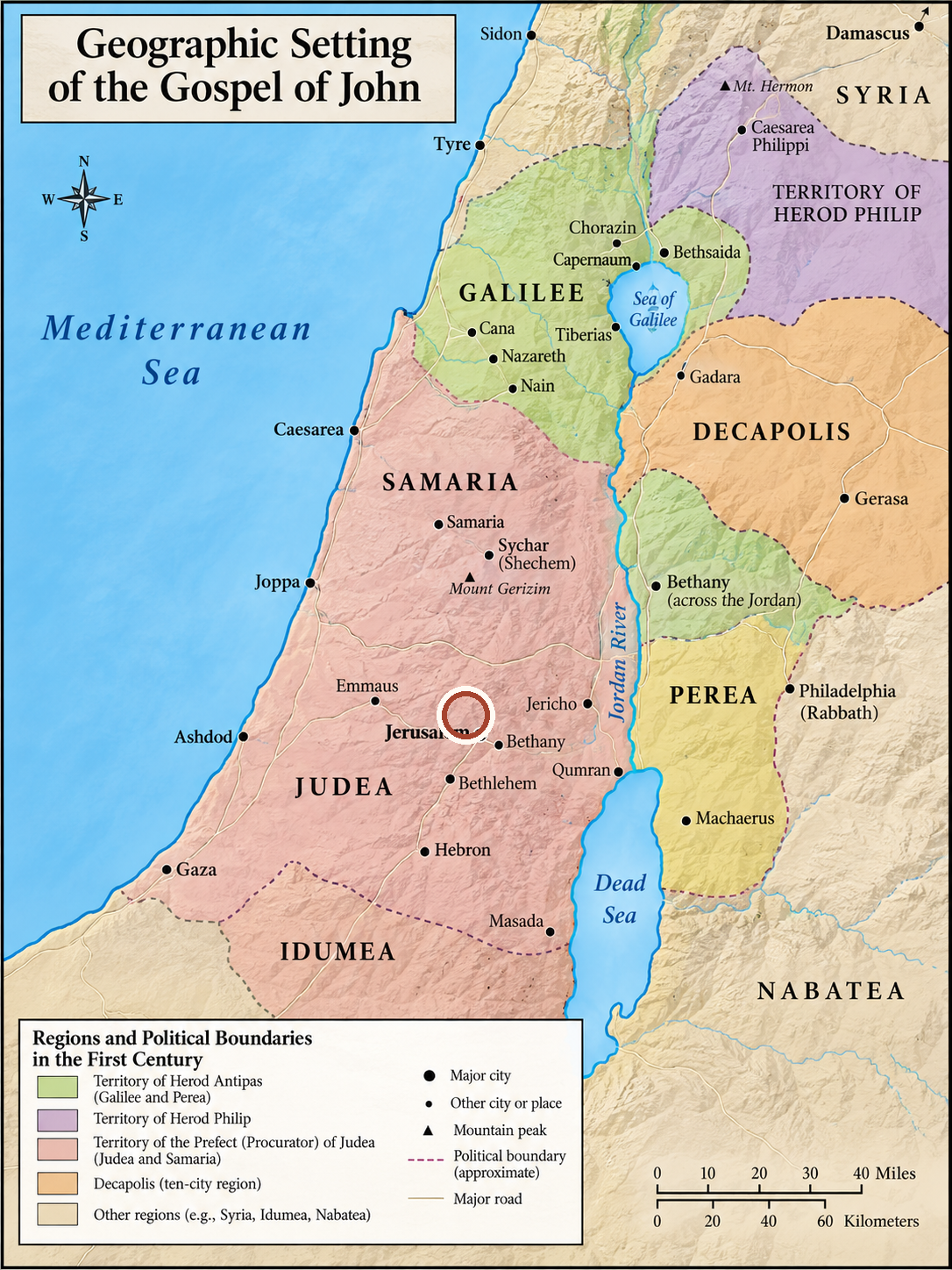
Regional location
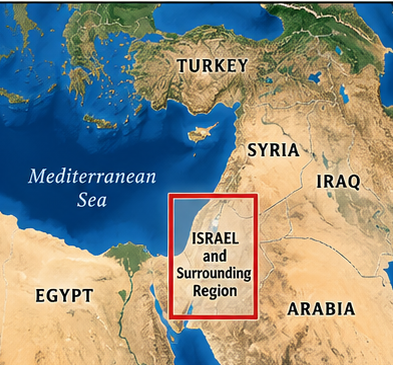
Red rectangle indicates the atlas’s wider geographic coverage.
Locations in John 8
Jerusalem: The chapter’s main setting, with Jesus teaching and disputing in the temple.
Mount of Olives (8:1): Named in the traditionally received story; the manuscript status of that account is disputed.
Treasury (8:20): A named area within the temple complex; no precise map coordinate is given.
Travel: The chapter does not give a route through Jerusalem.
Reading the atlas
Shaded historical territories, mountain relief, and blue waterways show general biblical context. Borders are illustrative, not surveyed boundaries.
Jerusalem: Temple and Mount of Olives
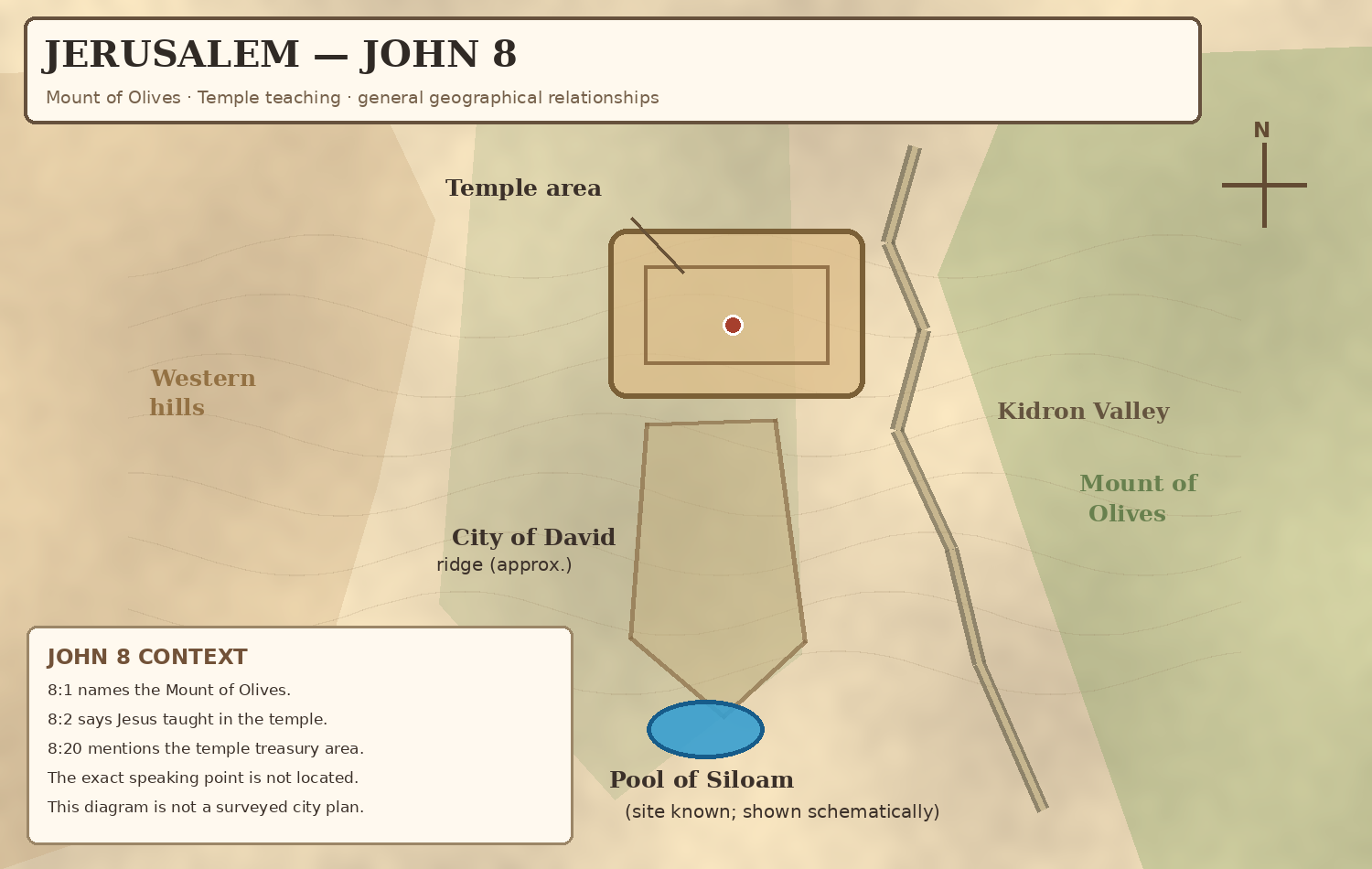
General geographic relationship, not a surveyed city or treasury map. The opening story’s textual uncertainty is discussed below.
Quick Study
Again, therefore, Jesus spoke to them, saying, “I am the light of the world. He who follows me will not walk in the darkness, but will have the light of life.” John 8:12, WEB
Jesus proclaims that He is the Light of the World. His teaching exposes darkness, unbelief, and slavery to sin. He offers true freedom to disciples who remain in His Word. The conflict ends with His declaration that He is the eternal “I AM.” The received opening story (8:1–11) is presented with a manuscript note.
The Chapter’s Major Movements
The Accused Woman (8:1–11)
The traditional account contrasts accusation and mercy while calling for repentance; its manuscript status must be explained.
The Light of the World (8:12–20)
Jesus declares Himself the source of light and life and explains His testimony with the Father.
Where I Am Going (8:21–30)
He warns that unbelief leaves people in sin and points forward to His being lifted up.
Truth and Freedom (8:31–36)
Continuing in Jesus’ Word is the mark of disciples; the Son alone frees from slavery to sin.
Children of Abraham? (8:37–41)
Jesus exposes the gap between inherited religion and receiving God’s truth.
Lies and Truth (8:42–47)
He distinguishes hearing the Father from rejecting the One He sent.
Greater Than Abraham (8:48–59)
Jesus promises eternal life and declares His existence before Abraham: “I AM.”
Quick Study Flow
Historical and Textual Notes
John 7:53–8:11: This traditional account is absent from many early Greek manuscripts and appears elsewhere in some later witnesses. It remains in WEB Classic, so we print it while clearly identifying the manuscript question. No central doctrine in this workbook rests on this account alone.
John 8:12–59: The temple treasury is mentioned (8:20), but the precise court and timing relative to a festival ceremony are not stated. The geography diagrams provide context rather than a reconstructed speaking point.
Important Bible Words
| Word / Phrase | Simple Meaning | Why It Matters |
|---|---|---|
| Light | God’s revelation and life in Christ | Jesus does more than enlighten ideas; He gives the light of life. |
| Darkness | Unbelief and sinful opposition to truth | Following Christ means turning toward His light. |
| Witness / Testimony | Evidence given about what is true | Jesus’ words and the Father’s witness reveal His identity. |
| Remain / Abide | Continue faithfully in Jesus’ word | Real discipleship is more than an initial positive reaction. |
| Truth | Reality revealed by God in Christ | Truth frees from the bondage of sin. |
| Bondservant / Slave | One under another’s mastery | Sin enslaves; the Son grants lasting freedom. |
| I AM | Jesus’ emphatic self-designation | John 8:58 unveils His eternal preexistence and divine identity. |
| Eternal life | Life through faith in Christ beyond physical death | Jesus’ promise rests on His identity and saving work. |
Translation Word Notes
Capitalized pronunciation syllables mark stress; pronunciations approximate classroom Biblical Greek. Full Scripture text remains WEB. NKJV, NIV, and NLT phrases are short comparisons.
| Verse | Greek / Pronunciation | NKJV | NIV | NLT | What It Means |
|---|---|---|---|---|---|
| 8:12 | phōsFOHSS | light | light | light | Jesus gives the light of life. |
| 8:13 | martyriamar-too-REE-ah | witness | testimony | testimony | Witness and the validity of testimony. |
| 8:24 | egō eimieh-GOH AY-mee | I am He | I am he | I Am | Emphatic “I am”; theological context matters. |
| 8:31 | menōMEH-noh | abide | hold to | remain faithful | Remain in Jesus’ teaching as a disciple. |
| 8:32 | alētheiaah-LAY-thay-ah | truth | truth | truth | Truth revealed by Christ brings freedom. |
| 8:34 | doulosDOO-loss | slave | slave | slave | Slavery to sin rather than political captivity. |
| 8:36 | eleutheroōeh-loo-theh-ROH-oh | makes free | sets free | sets free | The Son is the liberator. |
| 8:44 | pseustēspsew-STAYS | liar | liar | liar | A denial of truth. |
| 8:51 | amēn amēnah-MAYN ah-MAYN | most assuredly | very truly | I tell you the truth | Solemn double affirmation by Jesus. |
| 8:58 | egō eimieh-GOH AY-mee | I AM | I am | I AM | Strong claim to preexistence and divine identity. |
The Gospel Connection
The Gospel is more than information, heritage, or religious enthusiasm. In John 8, Jesus declares Himself the Light of the World, warns that refusing Him leaves people in sin, and promises true freedom through His Word. His being “lifted up” points to the cross, where He fulfills the Father’s saving purpose. The eternal Son, who existed before Abraham, gives life through faith in Him. Grace calls us out of darkness and into lasting discipleship.
Reflection
Am I relying on Jesus for freedom from sin and remaining in His Word?
A Short Prayer from John 8
Father, thank You for sending Jesus, the Light of the World. Forgive my sin, expose what I hide, and free me from trusting my own reputation. Help me remain in Your Son’s Word and receive His truth with humility. Teach me to love others while speaking honestly about sin. In Jesus’ name, amen.
One Truth to Carry With You
Jesus is the Light of the World. Those who continue in His Word know His truth, and the Son alone can make sinners truly free; He is the eternal “I AM.”
Ready to Go Deeper?
SOAP means Scripture, Observation, Application, Prayer. Read the complete passage before considering the explanation. Scripture remains our final authority.
Read the entire WEB passage in context.
Notice Jesus’ claims about the Father, His identity, truth, and freedom from sin.
Respond personally with faith, repentance, obedience, or thanksgiving.
Pray in response to the truth of the passage.
A Troubling Accusation and an Uncertain Text
What does the passage say about Jesus, God, people, faith, salvation, or obedience?
The traditional account opens with Jesus at the Mount of Olives, then teaching early in the temple. Religious opponents bring a woman accused of adultery and ask a question intended to trap Him. The passage does not explain the absence of the man involved, so we should not invent his circumstances.
IMPORTANT MANUSCRIPT NOTE: John 7:53–8:11 is missing from many of the earliest surviving Greek manuscripts and occurs in differing locations in some later witnesses. We print the WEB text in this study but do not use this disputed account alone to establish doctrine.
The story presents a confrontation between public accusation and the call to honest self-examination. The certainty of its placement in the original Gospel is debated.
How can I avoid using another person’s sin to hide my own need for repentance?
Father, help me be truthful about my own sin, fair toward others, and careful with Your Word.
Neither Condemnation Nor Permission to Sin
What does the passage say about Jesus, God, people, faith, salvation, or obedience?
In the received narrative Jesus challenges the accusers to consider their own sin; they leave. He tells the woman that He does not condemn her and directs her to stop sinning. Grace and moral seriousness belong together in the story.
The passage never says that wrongdoing is good or that repentance is optional. Neither does it invite us to claim Jesus’ words as authority to ignore justice in every situation.
Because its early manuscript evidence is disputed, connect these themes to undisputed passages such as John 3:17–21 and Romans 6:1–4 rather than basing teaching on this passage alone.
Where do I need both mercy for others and honesty about sin in my life?
Lord Jesus, lead me away from self-righteousness and toward repentance and mercy.
I Am the Light of the World
What does the passage say about Jesus, God, people, faith, salvation, or obedience?
Jesus declares that He is the light of the world. Following Him means no longer walking in darkness but possessing the light of life. His claim concerns salvation and revelation, not merely moral example or improved feelings.
His opponents challenge the validity of His testimony. Jesus answers that He knows His origin and destiny and that the Father also bears witness to Him. He speaks about a personal relationship with the Father that goes beyond ordinary human claims.
John locates this teaching in the temple treasury area; he does not identify a precise point on a modern map. Opposition remains, but His “hour” has not yet arrived.
What area of my life needs the light of Jesus’ truth rather than my own assumptions?
Jesus, the Light of the World, expose what is false in me and guide me in Your truth.
Unless You Believe That I Am He
What does the passage say about Jesus, God, people, faith, salvation, or obedience?
Jesus warns that refusing to believe in Him leaves people in their sins. He contrasts His heavenly origin with the worldliness of His challengers, making His identity central to the question of salvation.
The Greek expression translated “I am he” in verse 24 can also be rendered “I AM” in some contexts. John builds toward the unmistakably strong assertion of preexistence in verse 58; careful readers should attend to both the immediate argument and the wider Gospel.
His words are a call to faith in who He is, not a request for general religious optimism.
Am I trusting Jesus as He reveals Himself, or a more comfortable version of Him?
Father, help me believe Your Son and receive the truth that leads to life.
The Son of Man Will Be Lifted Up
What does the passage say about Jesus, God, people, faith, salvation, or obedience?
Jesus explains that His Father sent and taught Him and has not left Him alone. He speaks of being “lifted up,” a phrase John uses in connection with the cross and Jesus’ saving mission (compare John 3:14; 12:32–33).
The obedience of the Son is purposeful and loving. John also reports that many believed in Him while He spoke. The following verses test what persevering discipleship looks like.
The passage points us forward to Jesus’ crucifixion without explaining every future detail yet.
How does Christ’s willingness to obey the Father strengthen my trust in Him?
Lord Jesus, thank You for obeying the Father and going toward the cross for sinners.
The Truth Will Make You Free
What does the passage say about Jesus, God, people, faith, salvation, or obedience?
Jesus addresses people who had believed Him and says that remaining in His Word characterizes true discipleship. Spiritual freedom is inseparable from knowing the truth He teaches.
His listeners appeal to Abrahamic ancestry and insist they are not enslaved. Jesus redirects the conversation: the real bondage He identifies is slavery to sin. Only the Son can give freedom that lasts.
Christian freedom is not self-rule apart from God. It is liberation from sin’s mastery through Christ, resulting in faithful dependence on His Word.
What habit, fear, or false belief am I asking Jesus to free me from?
Jesus, keep me in Your Word and free me from the power of sin.
Abraham’s Children and the Works of Faith
What does the passage say about Jesus, God, people, faith, salvation, or obedience?
Jesus acknowledges the listeners’ physical descent from Abraham yet challenges their actions and rejection of His Word. Descent from a faithful ancestor does not automatically make one faithful to God.
Jesus measures spiritual kinship by whether people receive God’s truth and act in ways consistent with Abraham’s faith. The dispute concerns particular people who oppose Him in the narrative; it is not a condemnation of every Jewish person.
The passage exposes how religious heritage can become a substitute for responsive obedience.
Am I relying on my background or reputation more than on obedient faith?
Father, give me a living faith like Abraham’s rather than pride in spiritual credentials.
Whose Voice Will You Hear?
What does the passage say about Jesus, God, people, faith, salvation, or obedience?
Jesus tells hostile interlocutors that true love for God would lead them to love the One God sent. Their resistance to the truth exposes a deeper spiritual problem.
Verse 44 describes the devil as a liar and murderer and condemns the conduct of Jesus’ immediate opponents. It must never be taken as a statement about Jewish ethnicity or all Jewish people; Jesus and His first followers were Jewish.
Jesus does not flatter the crowd. He calls people to hear the Father’s words and submit to the truth He brings.
When God’s Word challenges me, do I resist it or humbly receive it?
God of truth, protect me from deception and teach me to receive Your Word.
Greater Than Abraham
What does the passage say about Jesus, God, people, faith, salvation, or obedience?
The dispute grows personal as opponents insult Jesus and accuse Him of having a demon. Jesus rejects the accusation and points to His Father, whose glory and judgment truly matter.
His promise that a person keeping His Word will not “see death” must be understood with the Gospel’s teaching on eternal life, rather than taken as a denial that believers physically die (see John 5:24–29; 11:25–26).
The hearers ask whether Jesus is greater than Abraham and the prophets. John is guiding readers toward His unique divine identity.
Does my confidence rest in Jesus’ promise of eternal life when I face mortality?
Lord Jesus, teach me to cling to Your Word in life and in death.
Before Abraham Was, I AM
What does the passage say about Jesus, God, people, faith, salvation, or obedience?
Jesus insists that He does not glorify Himself and that He knows and obeys the Father. He says Abraham rejoiced to see His day, revealing the scope of God’s redemptive promise.
His climactic declaration, “before Abraham came into existence, I AM,” distinguishes Jesus’ eternal existence from Abraham’s coming into being. In the context of John 1:1 and the attempted stoning, this is a profound claim about His divine identity.
The passage ends with an attempt to stone Him, but He leaves the temple. We should not assert a route or exact exit not given by Scripture.
What changes in my worship when I recognize Jesus as the eternal Son of God?
Lord Jesus, I confess that You are eternal and worthy of my worship. Strengthen my trust and obedience.
Hard Questions
Why is John 8:1–11 marked as disputed?
Many early Greek manuscripts do not contain John 7:53–8:11; some later manuscripts place the account elsewhere. It has been treasured in church reading for centuries, but its location in the original Gospel is disputed. The workbook includes it because it appears in WEB Classic and clearly flags the evidence. No central doctrine here depends on this disputed passage.
Does “Neither do I condemn you” mean Jesus treats sin as harmless?
No. In the received narrative He also says, “From now on, sin no more.” Across John, Jesus calls sinners into light and warns against remaining in sin (John 3:19–21; 8:24). Grace does not erase the call to repentance.
What does it mean that Jesus is the “light of the world”?
Jesus reveals the Father, exposes darkness, and gives life to believers. His claim is universal in scope, not limited to one ethnic or social group; it fits the opening prologue (John 1:4–9).
What does “I am he” mean in John 8:24?
The Greek words egō eimi can sometimes mean “I am he” with an implied complement. John 8:58 intensifies the claim by contrasting Abraham’s beginning with Jesus’ eternal existence. The immediate context and the entire Gospel guide interpretation.
Can “the truth will make you free” mean freedom to do whatever I want?
Jesus defines the bondage as slavery to sin (8:34). Continuing in His Word as disciples (8:31) and trusting the Son for liberation (8:36) are the context. The phrase is not a promise of moral autonomy apart from God.
Is Jesus condemning all Jewish people in John 8:44?
No. He rebukes specific hostile listeners resisting Him; the exchange does not justify prejudice toward Jewish people. Jesus, the apostles, and many early Christians were Jewish. We must read disputed references to “the Jews” in their specific narrative contexts.
How can followers of Jesus “never see death” if believers still die physically?
The Gospel distinguishes physical death from the eternal life Jesus gives. His people may die physically, yet He promises resurrection and life (John 5:24–29; 11:25–26).
What is Jesus claiming when He says “before Abraham … I AM”?
He contrasts Abraham’s coming into existence with His own continuing identity. In the wider Gospel (John 1:1; 8:58) the statement presents the eternal Son, and the hostile attempt to stone Him shows its seriousness. It resonates with biblical “I AM” language without flattening every linguistic nuance.
Which of Jesus’ claims in John 8 do I most need to believe and apply?
Where has spiritual pride or reliance on religious background interfered with my obedience?
How does remaining in Jesus’ Word lead me toward the freedom He promises?
How can I speak truth with humility and refuse hostility toward others?
A Prayer to Walk in the Light
Eternal Lord Jesus, You existed before Abraham and You are the Light of the World. I confess that I sometimes prefer the darkness of my own judgment and resist the truths I need to hear. Forgive my sin and set me free by Your grace. Keep me in Your Word when following You is difficult. Replace pride with faith, deception with truth, and fear with hope. Thank You for moving toward the cross so that sinners may have life. In Your name, amen.
Jesus is the Light of the World. Those who continue in His Word know His truth, and the Son alone can make sinners truly free; He is the eternal “I AM.”