John 9
Once I Was Blind, Now I See
Jesus opens a man’s eyes, and the man’s journey from receiving sight to worship reveals both genuine faith and the danger of spiritual pride.
Scripture quotations: World English Bible (WEB)

John 9 — Geographic Setting
The chapter takes place in Jerusalem and names the Pool of Siloam. The map explains the setting without inventing a precise route or the location of every encounter.
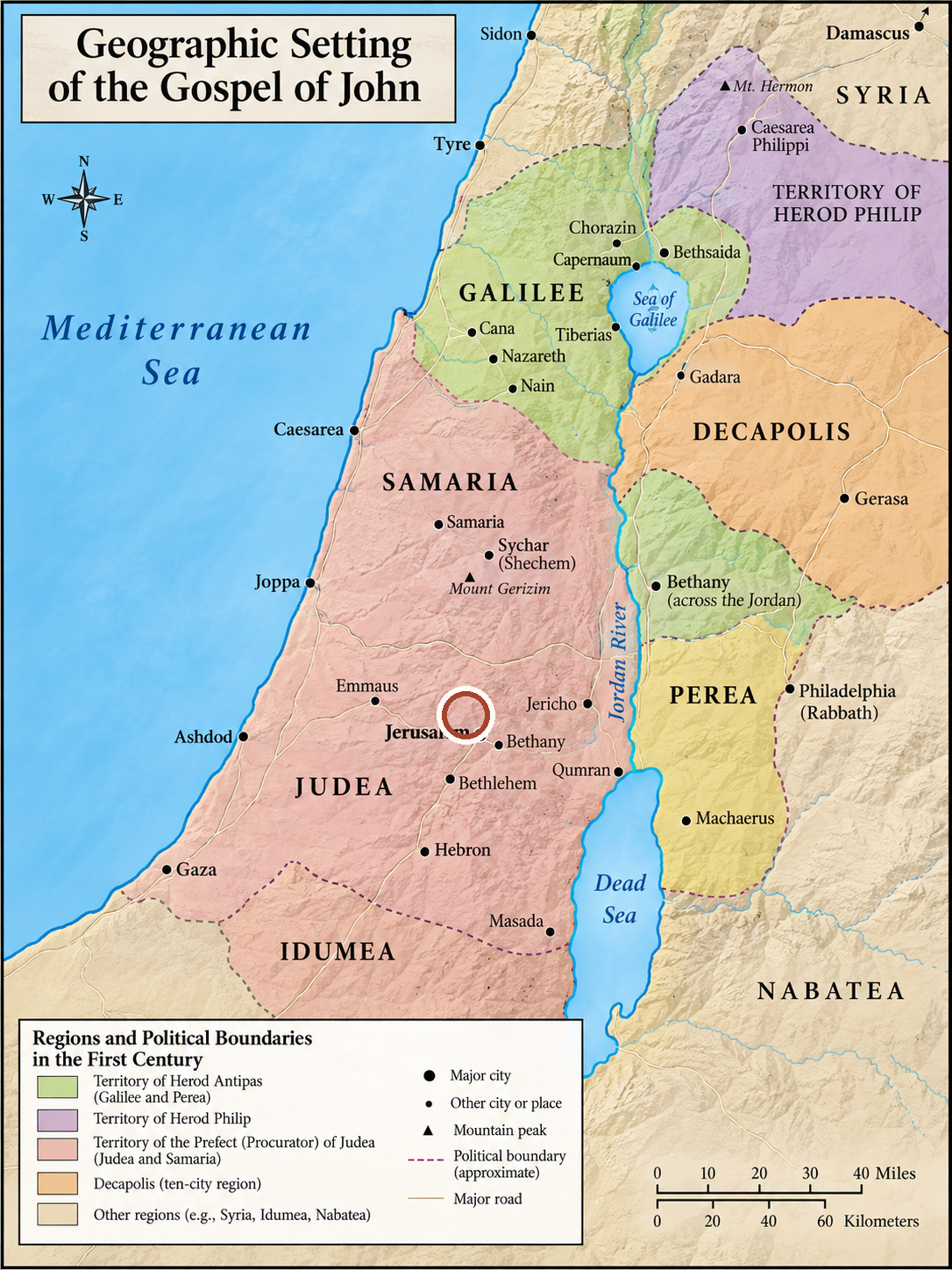
Regional location
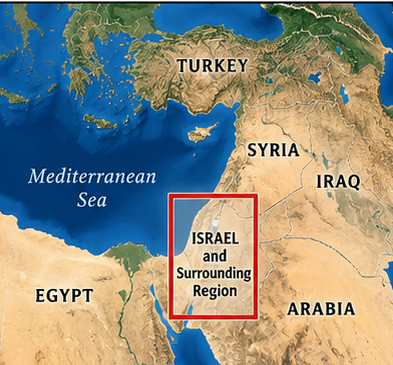
Red rectangle shows the wider biblical map’s coverage.
Locations in John 9
Jerusalem: The chapter’s city setting.
Pool of Siloam (9:7): The pool where Jesus told the man to wash; near the southern City of David area.
Synagogue (9:22): The parents fear exclusion; the specific building is not identified.
Reading the atlas
The regional colors, political borders, mountains and waterways provide orientation, not a claimed itinerary or exact ancient survey.
Jerusalem: Pool of Siloam and City of David
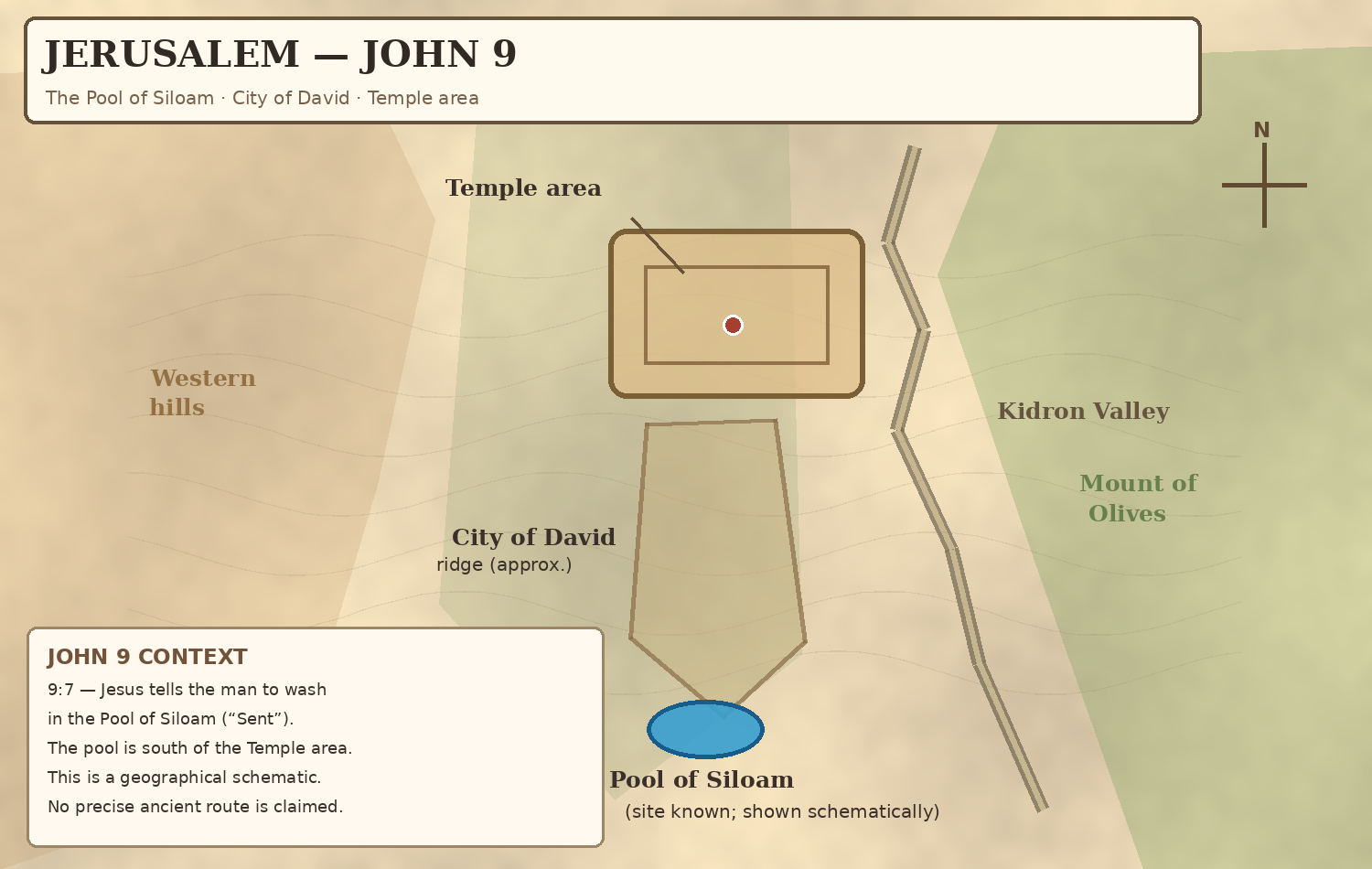
Historical context diagram, not a surveyed first-century street plan or route.
Quick Study
He therefore answered, “I don’t know if he is a sinner. One thing I do know: that though I was blind, now I see.” John 9:25, WEB
Jesus rejects the suggestion that a man’s congenital blindness proves a particular sin. He gives the man sight, and the man witnesses about what happened despite growing opposition. After being put out, Jesus finds him. The healed man believes and worships Jesus, while Jesus warns those who claim to see but reject Him.
The Chapter’s Major Movements
A Question about Suffering (9:1–5)
Jesus rejects a simplistic blame explanation and declares Himself the Light of the World.
The Man Is Healed (9:6–12)
Jesus sends him to wash in Siloam; the healed man tells what happened.
Dispute over the Sabbath (9:13–17)
Religious authorities divide over the sign and Jesus’ identity.
His Parents Are Questioned (9:18–23)
Fear of exclusion shapes the parents’ careful answer.
One Thing I Know (9:24–29)
The man stands by the truth of his healing, even under pressure.
The Man Is Cast Out (9:30–34)
His witness is rejected, exposing the leaders’ refusal to see.
Belief and Worship (9:35–38)
Jesus finds the man again; he believes and worships.
Spiritual Blindness (9:39–41)
Jesus warns that professed certainty can conceal a refusal to recognize Him.
Quick Study Flow
Historical and Textual Notes
Siloam: John names the pool and provides the meaning “Sent” (9:7). The city diagram is geographic context, not a reconstruction of the route taken.
John 9:35: The WEB Classic reads “Son of God.” Some Greek manuscripts read “Son of Man.” The workbook explains this variant without changing the WEB wording.
John 9:18–22: In this dispute, references to “the Jews” concern the specific authorities in the narrative, not all Jewish people. The man, his parents, Jesus and the disciples were Jewish.
Important Bible Words
| Word / Phrase | Simple Meaning | Why It Matters |
|---|---|---|
| Blind from birth | Unable to see since birth | John emphasizes the sign’s extraordinary nature and rejects easy blame. |
| Light of the world | Jesus reveals the Father and gives life | The sign illustrates Jesus’ larger claim in John 8:12 and 9:5. |
| Siloam / Sent | The name of the pool, meaning “Sent” | John draws attention to the Father’s sent Son. |
| Sign | A work that reveals Jesus’ identity | The healing calls for more than amazement; it calls for faith. |
| Sabbath | The seventh day set apart for rest | Debate over Sabbath actions becomes an occasion to consider Jesus’ authority. |
| Testimony | Truthful account of what happened | The healed man says only what he knows. |
| Son of God | A title bearing on Jesus’ unique identity | The healed man comes to faith and worship. |
| Spiritual blindness | Refusal to recognize God’s truth | Jesus warns the self-confident leaders at the end. |
Translation Word Notes
Capitalized syllables show approximate classroom-style Biblical Greek stress. All full Scripture quotations remain WEB; the NKJV, NIV, and NLT columns offer short translation comparisons, not complete quotations.
| Verse | Greek / Pronunciation | NKJV | NIV | NLT | Meaning |
|---|---|---|---|---|---|
| 9:2 | hamartanōhah-mar-TAH-noh | sinned | sinned | sinned | The disciples ask about supposed responsibility for blindness. |
| 9:3 | phaneroōfah-neh-ROH-oh | revealed | displayed | seen | God’s works are made visible in Jesus’ ministry. |
| 9:5 | phōsFOHSS | light | light | light | Jesus is the Light of the World. |
| 9:6 | pēlosPAY-loss | clay | mud | mud | Earthly material used by Jesus in the act of healing. |
| 9:7 | Silōamsee-LOH-am | Siloam | Siloam | Siloam | John explains the place-name as “Sent.” |
| 9:16 | sēmeionsay-MAY-on | signs | signs | miracles | The act points beyond itself to Jesus’ identity. |
| 9:22 | aposynagōgosah-poh-soo-nah-GOH-goss | put out | put out | expelled | Exclusion from the synagogue community. |
| 9:25 | typhlosTOO-floss | blind | blind | blind | The man contrasts his former condition with sight. |
| 9:35 | pisteuōpis-TEW-oh | believe | believe | believe | Faith in Jesus is the heart of the sign’s meaning. |
| 9:38 | proskyneōpross-koo-NEH-oh | worshiped | worshiped | worshiped | The healed man responds to Jesus with worship. |
The Gospel Connection
John 9 is more than a story about physical healing. The One who opens the man’s eyes is the Light of the World (9:5), the Son sent by the Father (9:7), and the Savior who finds the man again after he is rejected (9:35–38). The man’s growing confession shows the proper response to Jesus: hear His Word, speak truthfully, believe in Him, and worship. The Gospel exposes the blindness of sin and gives hope that Christ can bring us into the light of life (John 1:4–9; 8:12; 20:31).
Reflection
Am I willing to admit my need for spiritual sight and follow Jesus even when it costs me?
A Short Prayer from John 9
Father, thank You for sending Jesus, the Light of the World. Forgive my quick judgments and help me see people with compassion. Give me courage to tell the truth about Christ without pride. Open my eyes to Your Word and teach me to worship Your Son. In Jesus’ name, amen.
One Truth to Carry With You
Jesus, the Light of the World, opens blind eyes and calls us from proud certainty into humble faith, honest witness, and worship.
Ready to Go Deeper?
SOAP means Scripture, Observation, Application, Prayer. Read the complete passage before considering the explanation. Scripture remains our final authority.
Read the entire WEB passage in context.
Notice what Jesus reveals about suffering, the sign, testimony and spiritual sight.
Respond personally with faith, compassion, courage, repentance, or thanksgiving.
Pray in response to the truth of the passage, not to imagined details.
Not a Blame Game
What does this passage show about Jesus, God, people, faith, salvation, or obedience?
The disciples assume that congenital blindness must be caused by a particular person’s sin. Jesus refuses that choice: neither the man nor his parents sinned in the way they presume. Their question is too narrow for the reality before them.
Jesus directs attention to the works of God and calls His followers to participate in the Father’s work while it is day. The passage does not mean that people who suffer were created merely as objects for others’ lessons, nor that every illness has an identifiable moral cause.
Jesus again identifies Himself as the Light of the World (compare John 8:12). The healing that follows is a sign of who He is.
When I see another person suffer, do I rush to assign blame, or respond with compassion and faith?
Father, free me from careless judgments. Help me see suffering people with compassion and trust the work of Your Son.
Wash and See
What does this passage show about Jesus, God, people, faith, salvation, or obedience?
Jesus makes mud, applies it to the man’s eyes, and tells him to wash in the Pool of Siloam. John translates Siloam as “Sent,” drawing attention to the One whom the Father sent.
The man obeys Jesus’ instruction and returns able to see. The text records the action without suggesting that mud or water carries power apart from Jesus.
Neighbors argue about whether he is the same person. The man speaks plainly about his experience and acknowledges he does not yet know where Jesus is.
What clear instruction from Scripture do I need to obey even when I do not understand every detail?
Lord Jesus, help me obey Your Word and speak truthfully about what You have done, without exaggeration.
A Sign on the Sabbath
What does this passage show about Jesus, God, people, faith, salvation, or obedience?
The healing raises controversy because it occurred on the Sabbath. Some Pharisees treat Jesus’ actions as evidence against Him, while others ask how a sinner could do such a sign.
The healed man calls Jesus a prophet. His understanding is growing, but it is not yet the full confession he will make later.
John shows a contrast between the clear evidence of a transformed life and a debate that can miss the identity of the One who gave sight.
Do I let my assumptions prevent me from recognizing what Scripture says about Jesus?
God of truth, teach me to examine my assumptions and see the works of Jesus in the light of Your Word.
Fear in the Family
What does this passage show about Jesus, God, people, faith, salvation, or obedience?
The leaders question the parents, who confirm both their son’s identity and his blindness from birth. They say that he is old enough to answer for himself.
John explains that they fear expulsion from the synagogue. This is a real social cost in the narrative. The phrase “the Jews” here refers to the particular religious authorities in the scene and must not be taken as an accusation against all Jewish people.
Fear makes the parents cautious, but the text does not invite us to invent what they privately believed or felt beyond what John records.
Where does fear of social consequences make it difficult for me to speak plainly about Christ?
Father, give me wisdom and courage to tell the truth lovingly when obedience carries a cost.
One Thing I Know
What does this passage show about Jesus, God, people, faith, salvation, or obedience?
The authorities interrogate the man again and insist Jesus is a sinner. Rather than claim knowledge he does not possess, the healed man replies that he knows he was blind and now sees.
His testimony is a model of honest witness: report what is known, acknowledge what is not, and refuse pressure to deny the truth.
The leaders appeal to Moses, but John’s Gospel has already taught that Moses points toward Jesus (John 5:45–47). Faithfulness to Scripture must lead us to the One Scripture reveals.
Can I explain what Jesus has done without exaggerating or pretending to know more than I do?
Lord, give me a clear testimony, a humble spirit, and courage to remain truthful under pressure.
The Witness Is Cast Out
What does this passage show about Jesus, God, people, faith, salvation, or obedience?
The man argues that opening the eyes of one born blind is a remarkable work of God. His statement in verse 31 reflects the argument he makes in the dispute; it should not be turned into a simplistic universal formula for every prayer.
His interrogators respond with insults and throw him out. Their claim that he was “born in sins” echoes the mistaken assumption Jesus rejected at the beginning.
John makes the irony plain: the man has received physical sight and perceives more than his interrogators, whose confidence blinds them to Jesus.
How should I respond when other people dismiss a true witness or use shame instead of evidence?
Jesus, keep me faithful to truth without becoming proud or contemptuous toward others.
Jesus Finds Him Again
What does this passage show about Jesus, God, people, faith, salvation, or obedience?
After hearing of the man’s expulsion, Jesus seeks him out. The man learns that the One who healed him is the Son of God and responds with belief and worship.
The WEB Classic reads “Son of God” in verse 35; some Greek witnesses read “Son of Man.” We acknowledge this textual difference without changing the WEB quotation.
The fullest gift in the story is not restored sight alone; it is the man’s response of faith to Jesus Himself.
Does my gratitude for answered prayer lead me to worship the Giver more than the gift?
Lord Jesus, thank You for seeking those who are rejected. Strengthen my faith and receive my worship.
Those Who Say “We See”
What does this passage show about Jesus, God, people, faith, salvation, or obedience?
Jesus describes a spiritual division: people who recognize their need may receive sight, while those who insist they already see may remain blind to Him.
The rebuke is aimed at spiritual pride and unbelief, not at disability. Physical blindness must never be treated as proof of spiritual inferiority or of someone’s sin.
The final words expose the danger of refusing the Light when it stands before us. The proper response is humble faith, repentance, and obedience.
Where does my confidence in my own understanding keep me from listening humbly to Jesus?
Father, keep my heart teachable. Show me where I am spiritually blind and lead me into Christ’s light.
Hard Questions
Does John 9 teach that disability or illness is the result of personal sin?
No. The disciples raise precisely that assumption, and Jesus refuses it (9:2–3). Scripture teaches that suffering belongs to a fallen world but does not authorize us to identify someone’s condition as punishment for a particular personal offense. We should respond with compassion rather than blame.
Why did Jesus use mud and tell the man to wash?
John describes Jesus using mud and sending the man to wash in Siloam, but does not supply a complete explanation of why He chose these actions. The power belongs to Jesus, not to a ritual technique or to the mud itself. The narrative highlights trust and Jesus’ works.
Why is the Pool of Siloam important?
John explicitly translates “Siloam” as “Sent” (9:7). The pool was associated with Jerusalem’s water system, near the City of David. Archaeological work identifies an ancient Siloam pool, but the precise locations of every movement in this story are not documented.
Why did some Pharisees object to a healing on the Sabbath?
John says the sign happened on a Sabbath and that some authorities believed making mud and healing violated Sabbath observance. Other Pharisees questioned whether a sinner could perform such signs. John presents a real debate and invites readers to consider who Jesus is (see John 5).
What should we understand by “the Jews” in the parents’ story?
In 9:18–22, the phrase describes the religious authorities involved in this particular inquiry and the fear of exclusion. It does not mean every Jewish person. Jesus, His disciples, the healed man, and his parents were Jewish. The passage must never be used to promote hostility toward Jewish people.
Is the man’s statement “God doesn’t listen to sinners” an absolute rule?
It appears in the man’s argument in 9:31 rather than as a standalone teaching by Jesus. Scripture elsewhere presents repentance and God’s mercy toward sinners. We should interpret a speaker’s claim in its narrative context and not make it a universal formula.
Why do some Bibles say “Son of Man” in 9:35 rather than “Son of God”?
The early Greek manuscript evidence contains a textual difference at John 9:35. WEB Classic prints “Son of God,” which we retain in the Scripture text. Other translations follow witnesses reading “Son of Man.” Both titles are used of Jesus elsewhere in John; the chapter’s call to believe in Him remains clear.
Is spiritual blindness a criticism of people who are physically blind?
No. The physically blind man receives sight and faith; Jesus’ warning at the end confronts those who claim to see spiritually but refuse His truth. Physical disability is not equated with spiritual guilt.
How has John 9 challenged my assumptions about suffering and the people who experience it?
What can I learn from the healed man’s simple, truthful testimony?
How should I respond when following Jesus brings criticism or loss of approval?
Where might spiritual pride be keeping me from learning from Jesus?
A Prayer for Clear Sight and Faith
Lord Jesus, You saw the man whom others judged and passed by. Thank You that You bring light into darkness, seek the rejected, and call sinners to believe. Forgive me for the times I have confused religious confidence with true sight. Make me quick to listen, faithful in witness, compassionate toward those who suffer, and willing to obey when following You costs something. Keep me near Your Word. I believe; help me grow in faith and worship. In Your name, amen.
Jesus, the Light of the World, opens blind eyes and calls us from proud certainty into humble faith, honest witness, and worship.