John 10
The Good Shepherd
Jesus is the door and the Good Shepherd who lays down His life, gives eternal life, and is one with the Father.
Scripture quotations: World English Bible (WEB)

John 10 — Geographic Setting
John 10 records teaching about the Shepherd, a winter scene at the Feast of Dedication in Jerusalem, and a later stay beyond the Jordan. The maps show geographic relationships without inventing an exact route or disputed site.
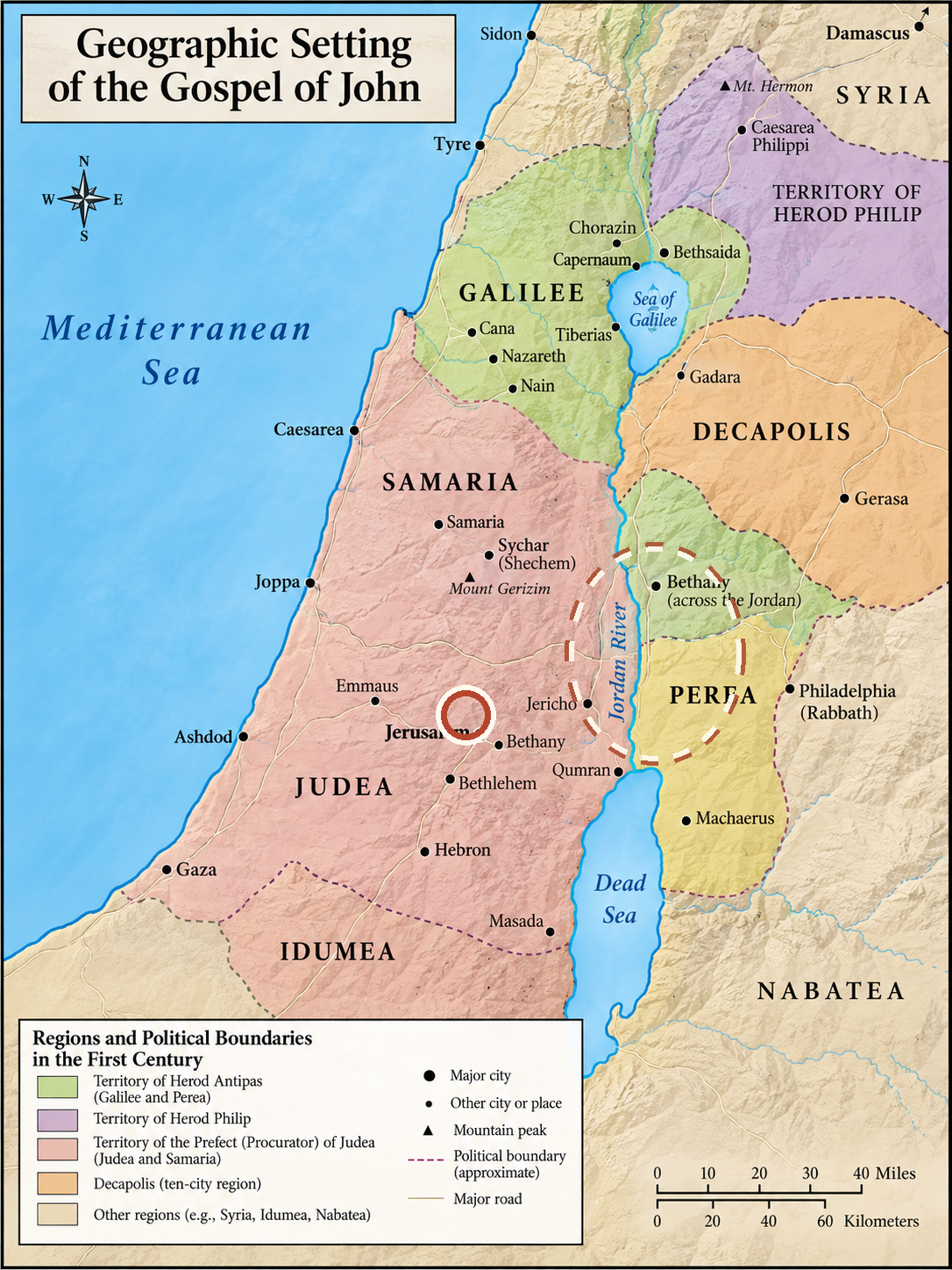
Regional location

Red rectangle shows the wider historical atlas coverage.
Locations in John 10
Jerusalem (10:22): The Feast of Dedication takes place in the city.
Solomon’s porch (10:23): A portico in the Temple precincts, traditionally associated with the east side. Its exact first-century form is not shown.
Beyond the Jordan (10:40): Jesus returns to the region of John’s early baptizing ministry; the precise site is uncertain.
Reading the atlas
Shaded territories, river, mountain relief and modern inset aid orientation. No exact travel itinerary is asserted.
Jerusalem: Feast of Dedication at the Temple
John 10:22–23 places Jesus at the Temple during the Feast of Dedication, specifically in Solomon’s porch. The master map provides the Temple’s relationship to surrounding Jerusalem landmarks.
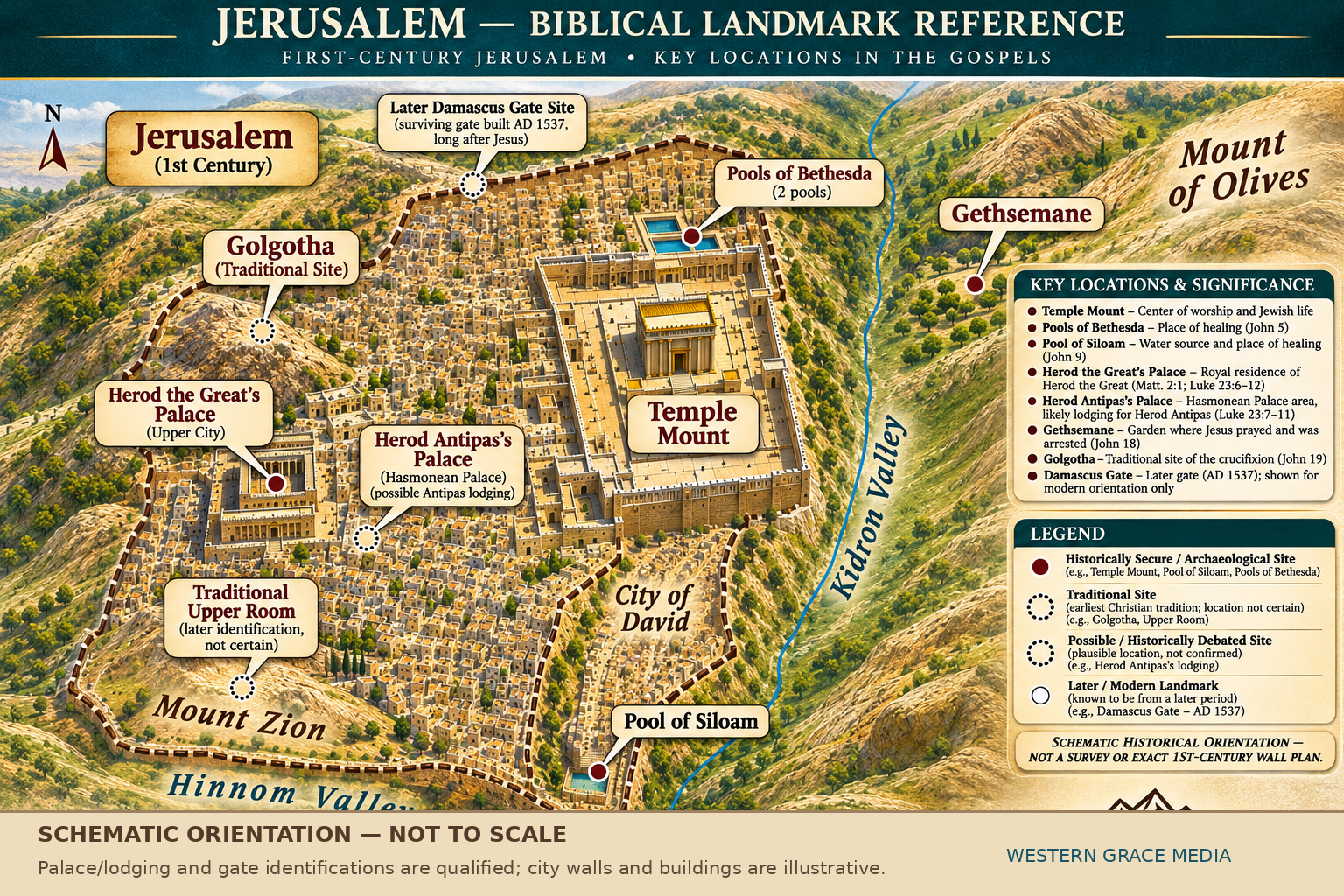
John 10 — locations to notice
Chapter focus: Temple and Solomon’s porch (10:22–23). For the later move beyond the Jordan (10:40), refer to the regional map.
Shared WGM Jerusalem schematic. The site status varies: the gate is later, the Upper Room and Golgotha are traditional, and Herod Antipas’s possible lodging is unconfirmed.
Quick Study
“I am the good shepherd. The good shepherd lays down his life for the sheep. John 10:11, WEB
Jesus is the door of salvation and the Good Shepherd who knows His sheep and lays down His life for them. His words divide His hearers. During the Feast of Dedication in Jerusalem He promises eternal life to His sheep and declares His oneness with the Father. After opposition, He goes beyond the Jordan, where many believe in Him.
The Chapter’s Major Movements
The Shepherd’s Voice (10:1–6)
Jesus knows and calls His own; His sheep know His voice.
The Door of Salvation (10:7–10)
Jesus is the door who grants salvation and abundant life.
The Good Shepherd (10:11–15)
Unlike a hired hand, Jesus gives His life for the sheep.
One Flock, One Shepherd (10:16–18)
Jesus gathers other sheep and willingly lays down His life.
Different Reactions (10:19–21)
His hearers are divided over His words and works.
Feast of Dedication (10:22–26)
In Jerusalem during winter, Jesus is confronted about His identity.
Eternal Security (10:27–30)
The Son gives eternal life; no one can snatch His sheep away.
The Father and the Son (10:31–39)
Jesus answers a blasphemy charge from Scripture and His works.
Beyond the Jordan (10:40–42)
John’s earlier testimony leads many to believe in Jesus.
Quick Study Flow
Historical and Interpretive Notes
Feast of Dedication: Also known as Hanukkah. John places the Temple conversation in winter (10:22–23). The diagram does not reconstruct Solomon’s porch precisely.
Beyond the Jordan: Verse 40 states where Jesus goes generally, but the exact archaeological site of John’s first baptizing area is disputed.
“One” (10:30): Jesus’ unity with the Father must be read alongside the distinction between Father and Son throughout John. This is foundational to traditional Trinitarian faith.
“You are gods” (10:34): Jesus quotes Psalm 82 as part of an argument about Scripture and His own identity. Do not treat the isolated phrase as saying humans are divine.
Important Bible Words
| Word / Phrase | Simple Meaning | Why It Matters |
|---|---|---|
| Shepherd | One who leads, protects, and tends sheep | Jesus reveals His personal and sacrificial care for His people. |
| Door / Gate | The proper entryway to safety and pasture | Jesus identifies Himself as the way of salvation. |
| Abundant life | Fullness of life from Jesus | Not a promise of riches or a trouble-free life. |
| Hired hand | Someone serving for wages | Contrasted with the Shepherd who gives His life for the sheep. |
| One flock | The people gathered under one Shepherd | Believers from different backgrounds belong to Christ. |
| Feast of Dedication | Hanukkah, Temple rededication remembrance | Establishes the Jerusalem winter setting in verse 22. |
| Eternal life | The life Jesus gives to believers | The Shepherd’s promise is grounded in His saving power. |
| Blasphemy | Speech judged as insulting or dishonoring God | The charge in verse 33 reveals how opponents hear Jesus’ claim. |
| One with the Father | Jesus’ unity with His Father | Read alongside His distinction from the Father in John 1 and 5. |
Translation Word Notes
Capitalized syllables show approximate classroom-style Biblical Greek stress. All full Scripture quotations remain WEB; the NKJV, NIV, and NLT columns offer short translation comparisons, not complete quotations.
| Verse | Greek / Pronunciation | NKJV | NIV | NLT | Meaning |
|---|---|---|---|---|---|
| 10:3 | phōnēfoh-NAY | voice | voice | voice | The sheep hear and recognize the Shepherd’s call. |
| 10:4 | akoloutheōah-koh-loo-THEH-oh | follow | follow | follow | Faith responds to Jesus by following Him. |
| 10:7 | thyraTHOO-rah | door | gate | gate | Jesus presents Himself as the entry to salvation. |
| 10:10 | perissospeh-ris-SOSS | abundantly | to the full | rich and satisfying | Abundant life describes His gift, not material luxury. |
| 10:11 | poimēnpoy-MAYN | shepherd | shepherd | shepherd | The central picture of Christ’s sacrificial care. |
| 10:11 | kaloskah-LOSS | good | good | good | Goodness fitting the faithful and true Shepherd. |
| 10:16 | poimnēpoym-NAY | flock | flock | flock | One flock under one Shepherd. |
| 10:22 | enkainiaen-KYE-nee-ah | Dedication | Dedication | Dedication | The winter festival also called Hanukkah. |
| 10:28 | aiōnioseye-OH-nee-oss | everlasting | eternal | eternal | Life from Christ that endures. |
| 10:30 | henHEN | one | one | one | The unity of Father and Son is central to this claim. |
| 10:33 | blasphēmiablahs-FAY-mee-ah | blasphemy | blasphemy | blasphemy | The accusation made against Jesus. |
| 10:35 | graphēgrah-FAY | Scripture | Scripture | Scriptures | Jesus affirms the enduring authority of Scripture. |
The Gospel Connection
John 10 joins salvation, personal care, and the cross. Jesus is the door by whom anyone enters and is saved (10:9), the Good Shepherd who lays down His life (10:11), and the risen Lord who has authority to take it up again (10:17–18). He gives eternal life to His sheep (10:28), and their security rests in the Son and the Father. Our response is not merely admiration of shepherd imagery but believing Christ, hearing His Word, and following Him. This is consistent with John’s purpose: that we may believe Jesus is the Christ, the Son of God, and have life in His name (John 20:31).
Reflection
Am I listening to Jesus through Scripture and trusting the Good Shepherd’s care?
A Short Prayer from John 10
Father, thank You for sending Jesus, the Good Shepherd. Forgive me when I follow competing voices or seek life apart from Him. Thank You that He laid down His life for sinners and gives eternal life. Help me listen to His Word, obey with joy, and trust Your faithful care. In Jesus’ name, amen.
One Truth to Carry With You
Jesus is the Good Shepherd and the door of salvation: He knows His sheep, lays down His life, gives eternal life, and calls us to hear and follow Him.
Ready to Go Deeper?
SOAP means Scripture, Observation, Application, Prayer. Read the complete passage before considering the explanation. Scripture remains our final authority.
Read the entire WEB passage in context.
Notice what Jesus says about salvation, His sheep, His sacrifice and the Father.
Respond personally with faith, obedience, gratitude, repentance, or confidence in Christ.
Pray in response to the truth of the passage, not to imagined details.
The Shepherd Calls His Own
What does this passage show about Jesus, God, people, faith, salvation, or obedience?
Jesus pictures a shepherd who enters rightly, knows his sheep, calls them by name, and leads them out. The sheep know his voice and do not follow a stranger. The contrast emphasizes the true Shepherd’s relationship with His people, not a method for identifying private voices or impressions.
This teaching follows the dispute over the man born blind in John 9. Jesus’ words challenge false spiritual leadership and call His hearers to recognize who He is. The imagery also recalls God’s promise to shepherd His flock in Ezekiel 34.
Verse 6 records that His listeners did not understand the illustration. Jesus therefore explains its meaning in the next section.
How can Scripture help me distinguish the true Shepherd’s teaching from competing voices?
Good Shepherd, teach me to recognize Your words in Scripture and to follow You faithfully.
The Door and Abundant Life
What does this passage show about Jesus, God, people, faith, salvation, or obedience?
Jesus identifies Himself as the door through which the sheep find salvation and pasture. He is not offering one option among many equal ways to God; His claim is personal and exclusive.
The thief comes to steal and destroy, but Jesus comes to give life abundantly. In John’s Gospel, this life begins in trusting Christ and extends to eternity; it is not a guarantee of luxury or freedom from hardship.
The warning about thieves describes false and destructive claimants to spiritual leadership, not every person who lived before Christ.
Am I looking for abundant life primarily in comfort, or in knowing and trusting Christ?
Lord Jesus, thank You for being the door of salvation. Shape my hopes around the life You give.
The Good Shepherd Lays Down His Life
What does this passage show about Jesus, God, people, faith, salvation, or obedience?
Jesus is the good Shepherd who willingly lays down His life for the sheep. The hired hand flees danger because his relationship is merely transactional; Jesus does not abandon His own.
The Shepherd’s care is personal: He knows His sheep and is known by them. Jesus compares that relationship—without making us equal to God—to the intimate knowledge between the Father and the Son.
The cross is already in view. Jesus’ death is not an accident that interrupts His mission; His self-giving love is central to it (see John 1:29 and Isaiah 53).
Where do I need to trust the Shepherd’s faithful care rather than my own ability to protect myself?
Jesus, thank You for laying down Your life for sinners. Help me rest in Your faithful care.
One Flock and a Willing Sacrifice
What does this passage show about Jesus, God, people, faith, salvation, or obedience?
The “other sheep” are not yet of this fold but will hear Jesus’ voice and join one flock under one Shepherd. In the wider New Testament, this points naturally to God gathering believers from the nations, without erasing the historical place of Israel.
Jesus says He lays down His life and takes it again by His own authority and in obedience to the Father. His sacrifice is voluntary, and His resurrection belongs to the saving mission He received.
The unity of the flock rests on Christ the Shepherd, not on cultural uniformity or an earthly organization.
How does the one Shepherd change the way I treat fellow believers from different backgrounds?
Father, thank You for gathering one flock through Your Son. Teach me to love those who belong to Him.
The Crowd Is Divided
What does this passage show about Jesus, God, people, faith, salvation, or obedience?
Jesus’ words produce a division. Some dismiss Him with hostile accusations; others ask whether such speech fits the sign of opening the blind man’s eyes.
John deliberately ties this response to the previous chapter. His readers should examine Jesus’ words and works rather than accept an accusation at face value.
The question is not whether Jesus will win everyone’s approval, but whether the evidence leads us to believe Him.
When others disagree sharply about Jesus, will I return to His words and works in Scripture?
God of truth, protect me from careless judgments. Help me weigh testimony in the light of Your Word.
Winter at the Temple
What does this passage show about Jesus, God, people, faith, salvation, or obedience?
John marks a new scene: winter during the Feast of Dedication (Hanukkah) in Jerusalem. Jesus walks in Solomon’s porch, an area of the Temple precincts. The season and festival are textual facts; an exact route is not given.
Some opponents ask Him to say plainly whether He is the Messiah. Jesus points back to His words and the works done in the Father’s name. Their refusal to believe is not simply a lack of information.
The festival commemorated the rededication of the Temple. John reports this setting without saying that Jesus was instituting a new Christian festival.
Do I seek more signs while overlooking what the Gospels already reveal about Jesus?
Lord Jesus, help me attend carefully to Your testimony and to believe what You have made known.
Known, Secure, and One with the Father
What does this passage show about Jesus, God, people, faith, salvation, or obedience?
Jesus describes His sheep as those who hear His voice and follow Him. He knows them personally and gives them eternal life. The promise is a gift from Jesus, not a reward earned by flawless performance.
No one can snatch the sheep from Jesus’ hand or the Father’s hand. Christians differ about how this assurance relates to warnings against falling away elsewhere in Scripture; the text here clearly emphasizes God’s saving strength and the Shepherd’s care.
“I and the Father are one” affirms a profound unity that His opponents regard as a claim to divine status. Read this with John 1:1–18, 5:18–23, and the teaching of the Trinity: Father and Son are distinct persons, not rival gods.
Does my assurance rest on the Shepherd’s faithfulness, and is that assurance leading me to follow Him?
Father, thank You that Your Son gives eternal life and knows His sheep. Strengthen my trust and obedience.
Scripture Cannot Be Broken
What does this passage show about Jesus, God, people, faith, salvation, or obedience?
Some of the people present pick up stones because they understand Jesus’ claim as blasphemy. Their charge that He makes Himself God is part of the narrative and shows the seriousness of the controversy.
Jesus cites Psalm 82:6 (“you are gods”) and reasons from Scripture. The psalm addresses human representatives who are accountable to God; faithful interpreters debate the precise referent. His argument challenges the inconsistency of the accusation, not the unique authority of the Son.
Jesus explicitly says “the Scripture can’t be broken.” Our conclusion should follow His full argument and the wider Gospel, not isolate the word “gods” as proof that humans share Jesus’ divine nature.
When a biblical phrase is difficult, do I study the full passage and its Old Testament context?
Lord, make me a careful reader of Your Word. Keep me from wrenching verses out of context.
Believe the Father’s Works
What does this passage show about Jesus, God, people, faith, salvation, or obedience?
Jesus again points to the works of the Father as testimony about who He is. The invitation to examine those works stands alongside His claim that the Father is in Him and He in the Father.
The leaders attempt to seize Jesus, but John says He escapes. The chapter does not explain the physical mechanics of His escape, and we do not need to invent them.
Jesus’ claims cannot be reduced to a lesson in kindness: He is revealing His unique identity and relationship with the Father.
What do Jesus’ works persuade me to believe about His identity and authority?
Father, help me see Your Son truly through the works and words You have given in Scripture.
Many Believe Beyond the Jordan
What does this passage show about Jesus, God, people, faith, salvation, or obedience?
Jesus goes beyond the Jordan to the place where John had first been baptizing. The Gospel does not give a universally confirmed archaeological coordinate for this site. The map identifies the general region only.
People remember John the Baptist’s truthful testimony even though John himself performed no sign. His witness prepares them to believe Jesus, just as John 1:19–34 showed.
The chapter closes with many people believing in Christ. Their faith centers on the One to whom the witness pointed.
Whom could I invite to consider what Scripture says about Jesus, rather than simply my opinion?
Lord, make my witness humble and true. Lead others to trust Jesus, the Good Shepherd.
Hard Questions
Does “abundant life” mean Jesus promises wealth and perfect health?
No. John 10:10 promises the life Jesus gives as Savior and Shepherd. The rest of John portrays suffering, rejection, the cross, and persevering faith. Abundance is rooted in knowing Christ, not in guaranteed comfort or money.
Who are the “thieves and robbers”?
In context, Jesus contrasts His care with deceptive or abusive spiritual leadership. He is not condemning Moses, the prophets, or everyone who came before Him. Read this in light of Ezekiel 34 and the religious dispute in John 9.
Who are the “other sheep” in verse 16?
A widely held Protestant Evangelical reading is that Jesus gathers people beyond the immediate Jewish fold, including Gentiles, into one flock. The passage does not name every group or describe an alternate way of salvation.
Can a genuine believer lose salvation if no one can snatch the sheep?
John 10:27–29 strongly grounds believers’ assurance in the Son and the Father. Evangelicals disagree over how this promise relates to biblical warnings against apostasy. The chapter itself joins the promise to hearing and following the Shepherd, without depicting salvation as a license for indifference.
What is the Feast of Dedication?
The Feast of Dedication, known today as Hanukkah, celebrates the rededication of the Jerusalem Temple following its desecration in the second century BC. John 10:22–23 identifies a winter setting and Solomon’s porch but not the exact position of every conversation.
Does “I and the Father are one” mean the Father and Son are the same person?
No. In John, the Father sends the Son and the Son speaks of the Father as distinct. Their oneness is profound and essential to Jesus’ divine claim, consistent with the traditional Christian doctrine of the Trinity: one God in three persons.
Why does Jesus quote “you are gods” from Psalm 82?
Jesus appeals to Scripture while answering a charge of blasphemy. Psalm 82 concerns those who are called gods yet stand under God’s judgment. The exact identification of those people is debated. Jesus’ argument does not teach that ordinary humans share His unique divine nature; read verses 34–38 together.
Why does John refer to “the Jews” when Jesus and His followers are also Jewish?
In the conflict scenes, John often uses the phrase for the particular opponents or leaders in the encounter, not the entire Jewish people. Jesus, His disciples, and many believers were Jewish. The passage must not be used to justify prejudice against Jews.
What voices or influences compete with the teaching of Jesus in my life?
How does the Shepherd laying down His life change my confidence in His love?
Where do I need both the assurance of His care and the obedience of following Him?
What can I learn from Jesus’ use of Scripture when answering difficult questions?
A Prayer to Follow the Good Shepherd
Lord Jesus, You are the door and the Good Shepherd. Thank You for knowing Your own, leading us in truth, and giving Your life for the sheep. Make me attentive to Your voice in Scripture and discerning toward teachings that pull me away from You. Teach me to rest in Your promise without taking grace lightly. Give me a heart for the one flock You gather, courage to confess who You are, and a humble spirit when Scripture challenges my assumptions. May my life bear witness to Your faithfulness. In Your holy name, amen.
Jesus is the Good Shepherd and the door of salvation: He knows His sheep, lays down His life, gives eternal life, and calls us to hear and follow Him.