John 11
The Resurrection and the Life
Jesus enters the grief of Mary and Martha, calls Lazarus from the tomb, and reveals that life and resurrection are found in Him.
Scripture quotations: World English Bible (WEB)

John 11 — Geographic Setting
John 11 moves from the setting beyond the Jordan (John 10:40) to Bethany near Jerusalem. Following Lazarus’s raising, Jesus withdraws toward Ephraim in the wilderness region. The maps show geographic relationships without inventing an exact travel route or an uncertain tomb site.
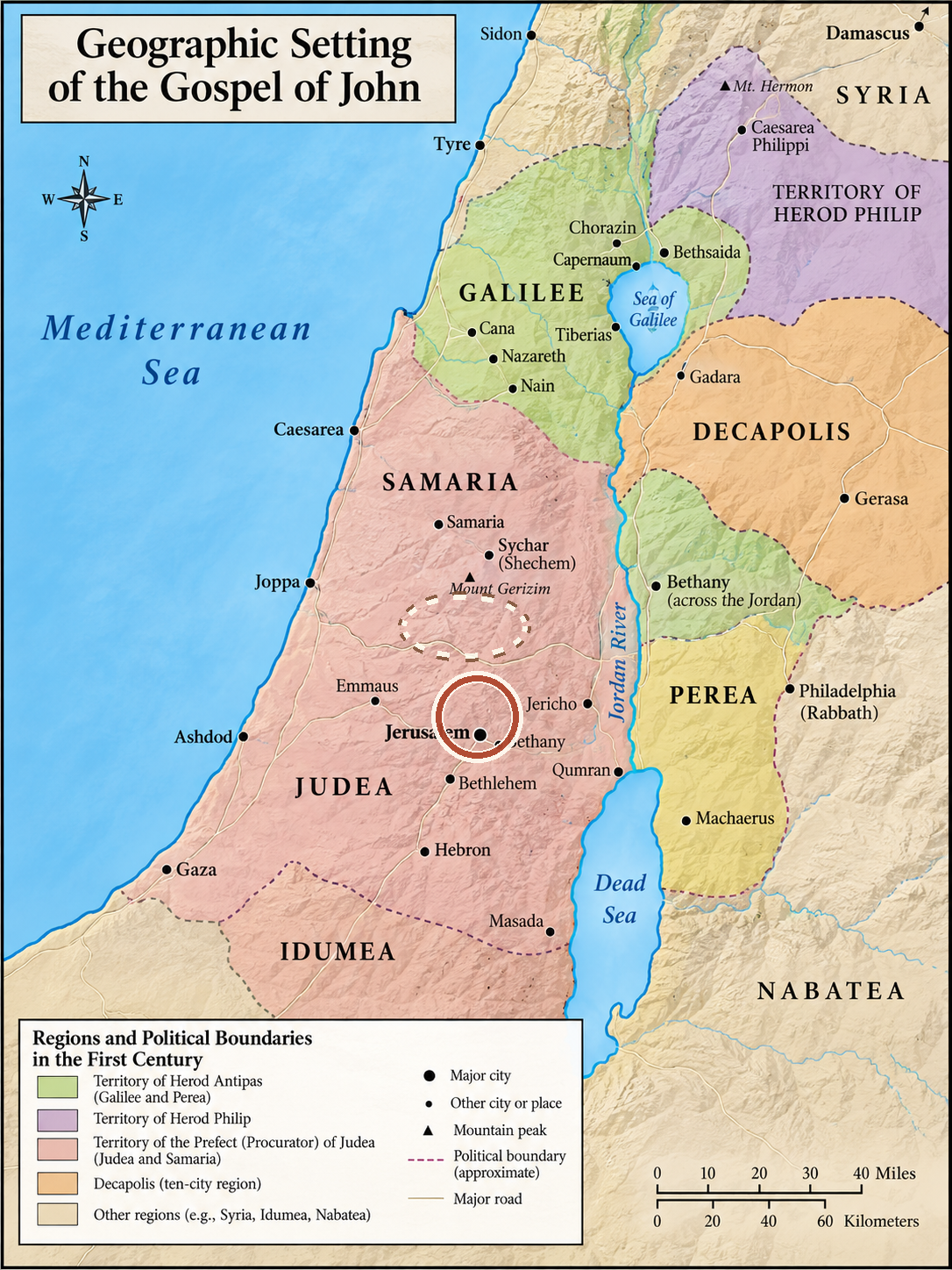
Regional location
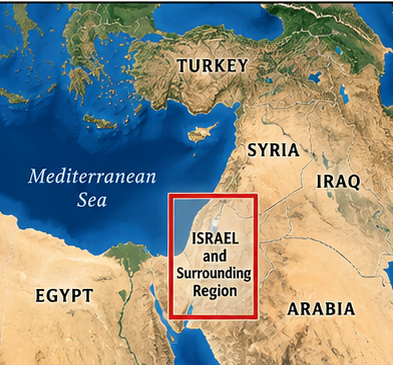
Red rectangle shows the wider atlas coverage.
Locations in John 11
Bethany (11:1, 18): Home of Mary, Martha, and Lazarus. About fifteen stadia, or 2.8 km / 1.7 mi, from Jerusalem.
Jerusalem (11:18, 55–57): Nearby city and the center of the approaching Passover observance.
Ephraim (11:54): The town near the wilderness has no universally confirmed archaeological identification. Only a broad possible region is shown.
The tomb: John describes a cave with a stone, not a reliably surveyed coordinate.
Reading the atlas
Political territories, relief shading and rivers support orientation; modern boundaries differ from ancient ones.
Bethany, Jerusalem and the Mount of Olives
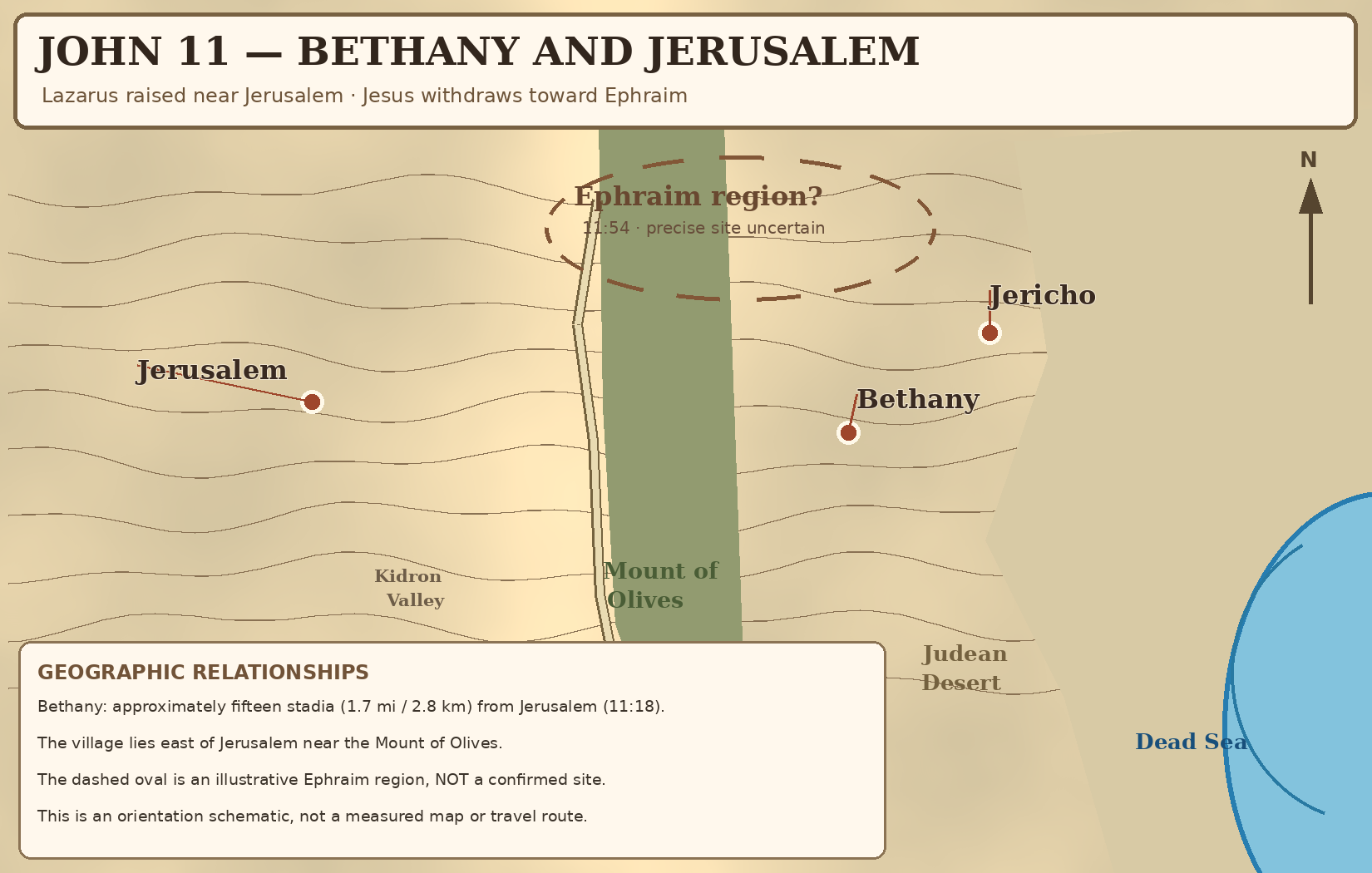
This geographic illustration is schematic and not a measured map of Jesus’ route, the tomb, or Ephraim.
Jerusalem Landmarks: Context for Bethany and Lazarus
Keep the preceding Bethany–Mount of Olives map for the Lazarus events. This additional Jerusalem master shows the nearby city of Jerusalem, the Temple, and its landmark relationships.
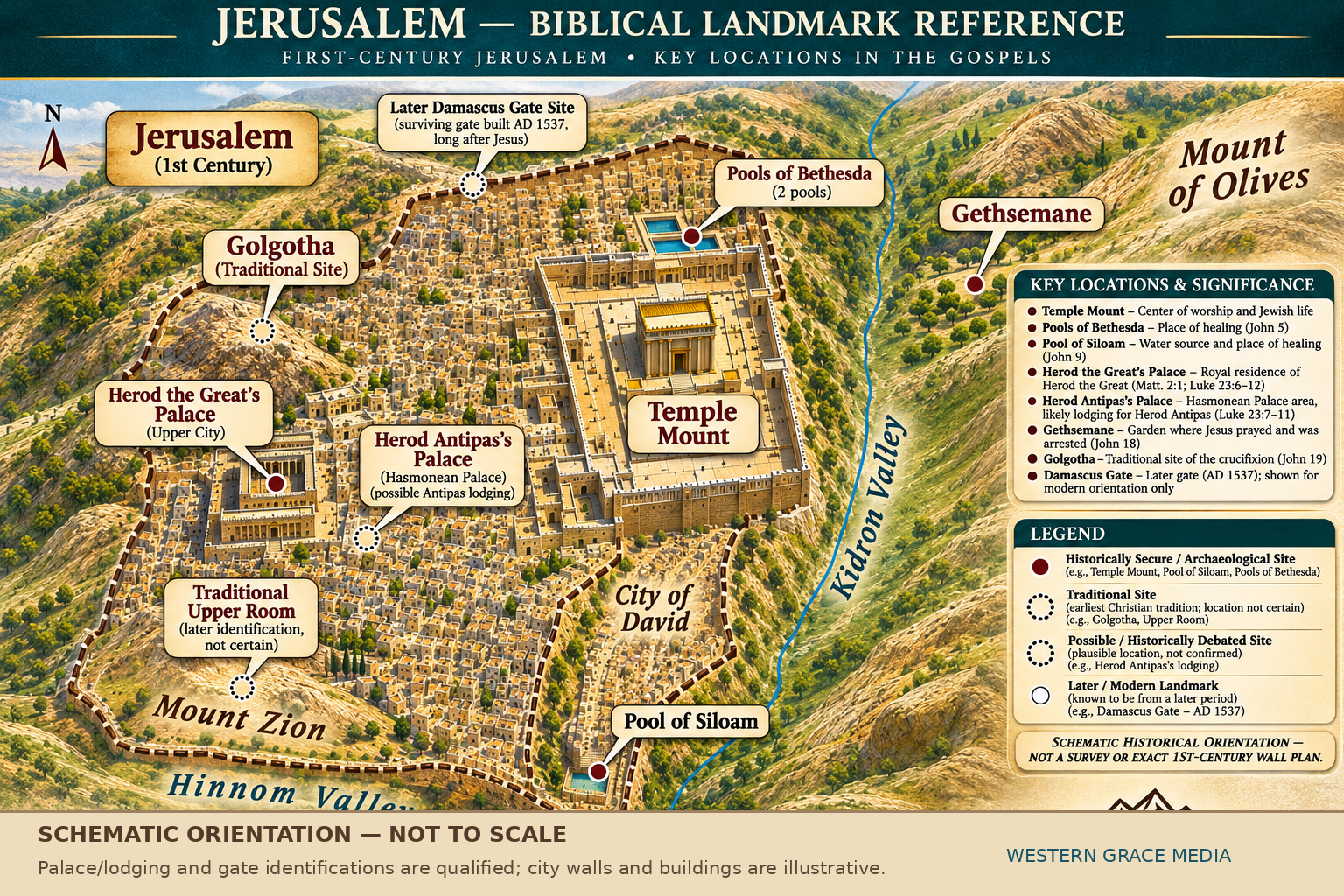
John 11 — locations to notice
This map is a supplemental city reference. Bethany and the uncertain Ephraim area remain shown on the preceding chapter-specific map.
Shared WGM Jerusalem schematic. The site status varies: the gate is later, the Upper Room and Golgotha are traditional, and Herod Antipas’s possible lodging is unconfirmed.
Quick Study
Jesus said to her, “I am the resurrection and the life. He who believes in me will still live, even if he dies. John 11:25, WEB
Jesus loves Mary, Martha, and Lazarus but arrives after Lazarus has died. In their grief He declares Himself the resurrection and the life, then raises Lazarus from the tomb. Many believe, yet leaders begin plotting His death. John shows both Jesus’ true compassion and divine authority over death as the final Passover approaches.
The Chapter’s Major Movements
Love and an Unexplained Delay (11:1–6)
Jesus loves the family and remains where He is for two days while Lazarus is sick.
A Dangerous Return (11:7–16)
The disciples fear a return to Judea, but Jesus resolves to go to Lazarus.
Resurrection Hope Meets Jesus (11:17–27)
Martha speaks honestly of loss and confesses Jesus as the Christ and the Son of God.
Jesus Enters the Grief (11:28–37)
Mary and the mourners weep; Jesus is deeply troubled and weeps.
The Tomb Is Opened (11:38–44)
Jesus calls Lazarus from the grave and reveals His life-giving authority.
Belief and Opposition (11:45–53)
Many believe, but leaders plan Jesus’ death; Caiaphas’s words foreshadow atonement.
Withdrawal and Passover (11:54–57)
Jesus withdraws toward Ephraim as the final Passover approaches.
Quick Study Flow
Historical and Interpretive Notes
Two places called Bethany: John 11 names Bethany near Jerusalem, not the uncertain Bethany beyond the Jordan from John 1:28.
Fifteen stadia: About 2.8 km (1.7 miles) from Jerusalem, as John 11:18 reports. A specific ancient walking route is not given.
Jesus and grief: His strong emotional response in 11:33, 38 may include indignation as well as sorrow. The precise focus is not stated.
Ephraim: John 11:54 records the town but not a securely established coordinate; the shaded map indicates a broad possible area only.
Resurrection: Lazarus is returned to mortal life. This sign points to Jesus’ authority and His greater resurrection victory.
Important Bible Words
| Word / Phrase | Simple Meaning | Why It Matters |
|---|---|---|
| Bethany | Village near Jerusalem where Mary, Martha, and Lazarus lived | John locates the sign within walking distance of the capital. |
| Glory of God | God’s greatness and character made known | The sign reveals the Son and points ahead to His mission. |
| Resurrection | God raising the dead to life | Jesus says this hope rests in Him personally. |
| Eternal life | Enduring life given by believing in the Son | Physical death does not undo life in Christ. |
| Jesus wept | Jesus truly entered human grief | The Son is fully human and compassionate. |
| Sign | An act revealing Jesus’ identity | Lazarus’s return points to the giver of life. |
| High priest | Leading priestly office in Jerusalem | Caiaphas speaks words John interprets as prophecy. |
| Passover | Biblical feast remembering deliverance from Egypt | The approaching feast frames Jesus’ final journey to the cross. |
Translation Word Notes
Capitalized syllables show approximate classroom-style Biblical Greek stress. All full Scripture quotations remain WEB; the NKJV, NIV, and NLT columns offer short translation comparisons, not complete quotations.
| Verse | Greek / Pronunciation | NKJV | NIV | NLT | Meaning |
|---|---|---|---|---|---|
| 11:4 | doxaDOHK-sah | glory | glory | glory | God’s glory revealed through the Son |
| 11:11 | koimaōkoy-MAH-oh | sleeps | fallen asleep | fallen asleep | Sleep here pictures physical death |
| 11:16 | DidymosDID-oo-moss | the Twin | Twin | Twin | Thomas’s Greek nickname means Twin |
| 11:25 | anastasisah-NAH-stah-sis | resurrection | resurrection | resurrection | Jesus is the source of resurrection life |
| 11:25 | zōēzoh-AY | life | life | life | Life is found in Christ |
| 11:26 | pisteuōpis-TEV-oh | believes | believes | believes | Faith means trusting Jesus |
| 11:33 | embrimaomaiem-bree-MAH-oh-my | groaned | deeply moved | deep anger | A strong emotional response; context matters |
| 11:35 | dakryōdah-KROO-oh | wept | wept | wept | Jesus truly cried with mourners |
| 11:43 | phōnēfoh-NAY | loud voice | loud voice | loud voice | Jesus calls Lazarus aloud |
| 11:47 | sēmeionsay-MAY-on | signs | signs | miraculous signs | His works reveal His identity |
| 11:51 | prophēteuōproh-fay-TEV-oh | prophesied | prophesied | prophesied | John interprets Caiaphas’s words prophetically |
| 11:52 | synagōsoo-NAH-goh | gather | bring together | gather | Christ unites His people |
The Gospel Connection
The raising of Lazarus points beyond one family’s restoration to the identity and saving work of Jesus. He is the resurrection and the life (11:25), and Martha confesses Him as the Christ and God’s Son (11:27). The sign leads some to faith and prompts leaders to plan His death. John then interprets Caiaphas’s words in the light of Jesus dying for His people and gathering believers into one (11:51–52). The gospel is not merely that grief will end immediately or that every faithful person will experience healing now. It is that the Son of God willingly dies for sinners, rises again, and gives eternal life to those who trust Him (John 20:31).
Reflection
Am I bringing grief to Jesus and trusting Him as the resurrection and the life?
A Short Prayer from John 11
Lord Jesus, thank You that You are the resurrection and the life. You know my grief and You are not indifferent to tears. Forgive me when fear or disappointment makes me forget Your promises. Help me believe Your Word, comfort those who mourn, and look toward the hope secured by Your death and resurrection. In Your name, amen.
One Truth to Carry With You
Jesus is the resurrection and the life. He enters our grief, calls us to believe in Him, and holds the power of life even in the face of death.
Ready to Go Deeper?
SOAP means Scripture, Observation, Application, Prayer. Read the complete passage before considering the explanation. Scripture remains our final authority.
Read the entire WEB passage in context.
Notice what Jesus says about grief, life, resurrection, belief, and the Father.
Respond personally with faith, obedience, gratitude, repentance, or confidence in Christ.
Pray in response to the truth of the passage, not to imagined details.
Love, Delay, and the Glory of God
What does this passage show about Jesus, God, people, faith, salvation, or obedience?
Lazarus is ill, and Mary and Martha send word to Jesus. John states explicitly that Jesus loves all three siblings. His decision to remain where He is for two more days must not be interpreted as indifference or a formula for how God will answer every prayer.
Jesus describes the coming event in terms of God’s glory and the Son’s glorification. He knows the outcome, but Mary and Martha do not. The story lets us see the difference between what the characters know and what Jesus knows.
John has already called Jesus the giver of life (1:4; 5:21; 6:40). The raising of Lazarus will become a public sign pointing to that identity and foreshadowing His own resurrection.
Where do I assume that a delay means God is absent? How does John 11 challenge that assumption without promising the outcome I prefer?
Father, help me trust Your wisdom when I cannot understand Your timing. Keep me near Your Word and near Your people.
Walking in the Light
What does this passage show about Jesus, God, people, faith, salvation, or obedience?
When Jesus proposes returning to Judea, the disciples remember that hostile people had recently tried to stone Him (10:31, 39). Their concern for His safety is understandable.
Jesus’ illustration about daylight teaches that He is acting within the time and purpose appointed for His mission. It is not a command to ignore ordinary danger or to make reckless decisions.
His return is deliberate. The path toward Lazarus also brings Jesus nearer the conflict that will lead to the cross.
What does it look like to obey God’s Word thoughtfully rather than let fear govern every decision?
Lord Jesus, help me follow Your truth with both courage and wisdom.
Lazarus Has Died
What does this passage show about Jesus, God, people, faith, salvation, or obedience?
Jesus uses sleep as an image for Lazarus’s death. The disciples understand it as ordinary rest, so Jesus states plainly that Lazarus is dead. The passage does not deny the real finality of physical death.
Jesus says the coming event will strengthen the disciples’ faith. He is not happy that His friend suffered; He is explaining the greater revelation of His power and identity that they are about to see.
Thomas speaks with determined loyalty, even while expecting danger. John presents the disciples as real people still learning who Jesus is.
When Jesus’ words are hard to understand, will I return to the passage and let Scripture clarify Scripture?
Jesus, teach me patient attention to Your words and faithful courage when obedience is costly.
Martha Meets the Lord
What does this passage show about Jesus, God, people, faith, salvation, or obedience?
By the time Jesus arrives, Lazarus has already been in the tomb four days. John gives this detail before narrating the sign; the family’s grief is neither imagined nor minimized.
Bethany lies about fifteen stadia from Jerusalem (11:18), approximately 1.7 miles or 2.8 km. Many mourners have come. Martha meets Jesus with both sorrow and continuing confidence in Him.
Martha believes in a future resurrection at the last day, a hope Jesus has already taught in John 5–6. The next verses show that the resurrection hope is inseparable from Jesus Himself.
Can I bring grief and honest questions to Christ while still confessing what I know to be true about Him?
Lord Jesus, meet me in sorrow and steady my faith in Your promises.
I Am the Resurrection and the Life
What does this passage show about Jesus, God, people, faith, salvation, or obedience?
Jesus does more than promise a future event: He identifies Himself as the resurrection and the life. Eternal life is grounded in His person and work, not in our ability to defeat death.
“Even if he dies” acknowledges physical death. “Will never die” speaks of the believer’s enduring life in Christ. Read the two statements together rather than pretending that Christians will never die physically.
Jesus asks Martha a personal question: “Do you believe this?” She responds with a confession that echoes the Gospel’s stated purpose in John 20:31: Jesus is the Christ and the Son of God.
How would I answer Jesus’ question, “Do you believe this?” What part of Martha’s confession can I make my own?
Lord Jesus, You are the resurrection and the life. Strengthen my trust in You beyond the fear of death.
Mary Brings Her Grief
What does this passage show about Jesus, God, people, faith, salvation, or obedience?
Martha calls Mary, who comes quickly. The mourners follow, believing she is going to weep at the tomb. The scene unfolds near Bethany, but John does not map a precise path between the home, meeting place, and tomb.
Mary falls at Jesus’ feet and voices the same painful thought Martha expressed: had He been there, Lazarus would not have died. John does not condemn her for speaking honestly.
Believers may tell Jesus what hurts without accusing themselves of having too little faith. Scripture invites lament alongside confident trust in the Lord.
What grief or unanswered question do I need to bring honestly before the Lord?
Compassionate Savior, hear my grief and help me cling to Your truth.
Jesus Wept
What does this passage show about Jesus, God, people, faith, salvation, or obedience?
Jesus sees the mourners weeping, is deeply troubled, and weeps Himself. The Son of God does not stand outside human sorrow; His compassion is part of the Gospel’s portrait of His true humanity.
The Greek description of His emotional response is strong and can include indignation as well as deep disturbance. The text does not explicitly settle whether that intensity is aimed at death, unbelief, or a mixture of grief and anger.
Some mourners recognize His love; others ask why He did not prevent Lazarus’s death. John holds both the reality of grief and Jesus’ power together. Avoid using this scene to tell grieving people that they should not cry.
How might Jesus’ tears reshape the way I comfort someone who is grieving?
Jesus, thank You for entering our sorrow. Make me patient, present, and compassionate toward those who mourn.
Lazarus, Come Out!
What does this passage show about Jesus, God, people, faith, salvation, or obedience?
At the cave tomb, Jesus commands that the stone be removed. Martha points to the reality of four days of death. John describes this as an astonishing act of divine power, not a symbolic trick or a near-death recovery.
Jesus prays aloud so that the bystanders will know the Father sent Him. His action reveals both His life-giving authority and His relationship with the Father.
Lazarus comes out alive, and Jesus tells the others to free him from the grave wrappings. This sign anticipates the hope of resurrection, but Lazarus’s return to mortal life is not identical to Christ’s own glorified resurrection.
Where do I need to trust Jesus’ authority rather than the limits of my expectations?
Lord Jesus, thank You for showing Your power over death. Give me a faith anchored in who You are.
A Sign That Divides
What does this passage show about Jesus, God, people, faith, salvation, or obedience?
Many of the witnesses believe after seeing what Jesus has done. Others report the event to the Pharisees. The same public sign produces different responses.
The leaders fear that a growing movement around Jesus might provoke Roman intervention and threaten their position and nation. John describes a specific political and religious calculation, not the motives of every Jewish person.
This confrontation teaches that fear of losing status or control can resist truth even when evidence is close at hand.
Am I more concerned with preserving approval or comfort than with responding to Jesus truthfully?
Father, give me courage to follow truth when it threatens my pride or my plans.
One Man for the People
What does this passage show about Jesus, God, people, faith, salvation, or obedience?
Caiaphas proposes that one man die for the people rather than that the nation perish. The evangelist interprets this statement as an unwitting prophecy pointing to Jesus’ saving death.
John adds that Jesus would die not only for the nation but also to gather into one the scattered children of God. His mission reaches beyond narrow national boundaries, while the story remains anchored in God’s covenant history.
The leaders’ plot is morally wrong, yet God’s saving purpose is not thwarted by it. Do not confuse Caiaphas’s calculation with a righteous motive or use this passage to assign collective guilt to the Jewish people.
How does God’s ability to accomplish salvation through human wrongdoing deepen my worship without excusing wrongdoing?
Father, thank You for the saving purpose accomplished through Christ’s death. Guard me from pride and unjust blame.
Toward the Passover
What does this passage show about Jesus, God, people, faith, salvation, or obedience?
Jesus withdraws to a town called Ephraim in the area near the wilderness. Its precise archaeological identification remains disputed, so the workbook map shows only a broad possible region.
Passover approaches, and pilgrims go up to Jerusalem for ceremonial preparation. The authorities have issued instructions to report Jesus’ whereabouts.
John’s story is moving deliberately toward the cross. The One who called Lazarus from the tomb is about to give His own life for sinners and rise again.
What has John 11 taught me about Jesus as I prepare to read the final days of His earthly ministry?
Lord, prepare my heart to study Your cross and resurrection with reverence, faith, and gratitude.
Hard Questions
Why did Jesus wait if He loved Lazarus?
John 11:5–6 explicitly joins Jesus’ love with His delay. The story shows His purpose to reveal God’s glory and strengthen belief. It does not give us permission to claim that every delayed answer to prayer will end in a visible miracle.
Does the phrase “not to death” mean Lazarus never died?
No. Jesus plainly says Lazarus died (11:14), and John says he had been in the tomb four days. Jesus speaks about the final outcome of this sickness under His power, not a denial of Lazarus’s real death.
Will believers never physically die (11:26)?
Jesus also says believers may die (11:25). Read both verses together: believers have eternal life in Him despite physical death, with future resurrection hope. John 5:28–29 and 6:39–40 support that reading.
Why does Jesus weep when He knows He will raise Lazarus?
Jesus’ tears show real grief and love. Knowledge of the coming miracle does not make suffering or loss unreal. Traditional Christian teaching understands Him as truly God and truly human.
Was Jesus angry in John 11:33 and 38?
The Greek expression translated “groaned” can suggest forceful indignation or deep agitation. Scholars differ about its focus. The safest reading notes the emotional intensity without pretending to know its single precise object.
Is Lazarus’s return the same as Jesus’ resurrection?
No. Lazarus is restored to earthly mortal life; Jesus’ resurrection is His decisive victory over death in a glorified state. Lazarus’s raising is a sign pointing to Jesus’ greater identity and mission.
Does Caiaphas’s prophecy justify his plot against Jesus?
No. John shows God’s providence working amid a morally wrong plan. Caiaphas seeks political advantage, while the evangelist recognizes a deeper meaning in the words “one man should die for the people.”
Does John 11 blame all Jewish people for Jesus’ death?
No. Jesus, Mary, Martha, Lazarus, many believers, and His disciples are themselves Jewish. John reports decisions by particular leaders. He does not authorize collective blame or hostility toward Jewish people.
Where exactly was Ephraim?
John 11:54 names the town and its wilderness region, but the archaeological identification is not certain. Many propose an area north-northeast of Jerusalem. Our map marks this as an approximate area only.
What did the fifteen stadia measure?
John 11:18 places Bethany about fifteen stadia from Jerusalem, approximately 2.8 kilometers (1.7 miles). The precise ancient walking route is not specified.
Are the Bethany in John 11 and “Bethany beyond the Jordan” the same place?
No. John 11 concerns Bethany near Jerusalem. The site named in John 1:28 is beyond the Jordan and its exact identification is disputed. The workbook maps distinguish them.
How is the raising of Lazarus connected to the gospel?
The sign reveals Jesus as the resurrection and life (11:25). It also brings opposition to a climax and prepares readers for the One who will give His life for sinners and rise again (John 20:31).
Where do I need to bring grief honestly to Jesus instead of hiding it?
How would I answer Jesus’ question, “Do you believe this?”
How can I show Christlike compassion to a grieving person this week?
What does the raising of Lazarus teach me about Jesus’ power and the hope of resurrection?
A Prayer of Resurrection Hope
Father, thank You for showing Your glory in Your Son. Jesus, You are the resurrection and the life, and You entered a grieving family’s pain with real compassion. Help me bring my sadness and questions honestly before You and remain anchored in what Scripture teaches. Teach me to love grieving people without offering easy explanations. Give me courage to confess that You are the Christ, the Son of God. Keep my hope rooted in Your cross, Your resurrection, and Your promise of eternal life. May I trust You until the day faith becomes sight. In Jesus’ name, amen.
Jesus is the resurrection and the life. He enters our grief, calls us to believe in Him, and holds the power of life even in the face of death.