John 12
The King and the Hour of Glory
Jesus is honored at Bethany, enters Jerusalem as King, and explains that His death will reveal the Father’s glory and bring life.
Scripture quotations: World English Bible (WEB)

John 12 — Geographic Setting
John 12 begins at Bethany before Passover and then moves toward Jerusalem. The area is shown on the original historical atlas. The extra Jerusalem close-up illustrates broad relationships, not a surveyed city plan or exact route of Jesus’ entry.
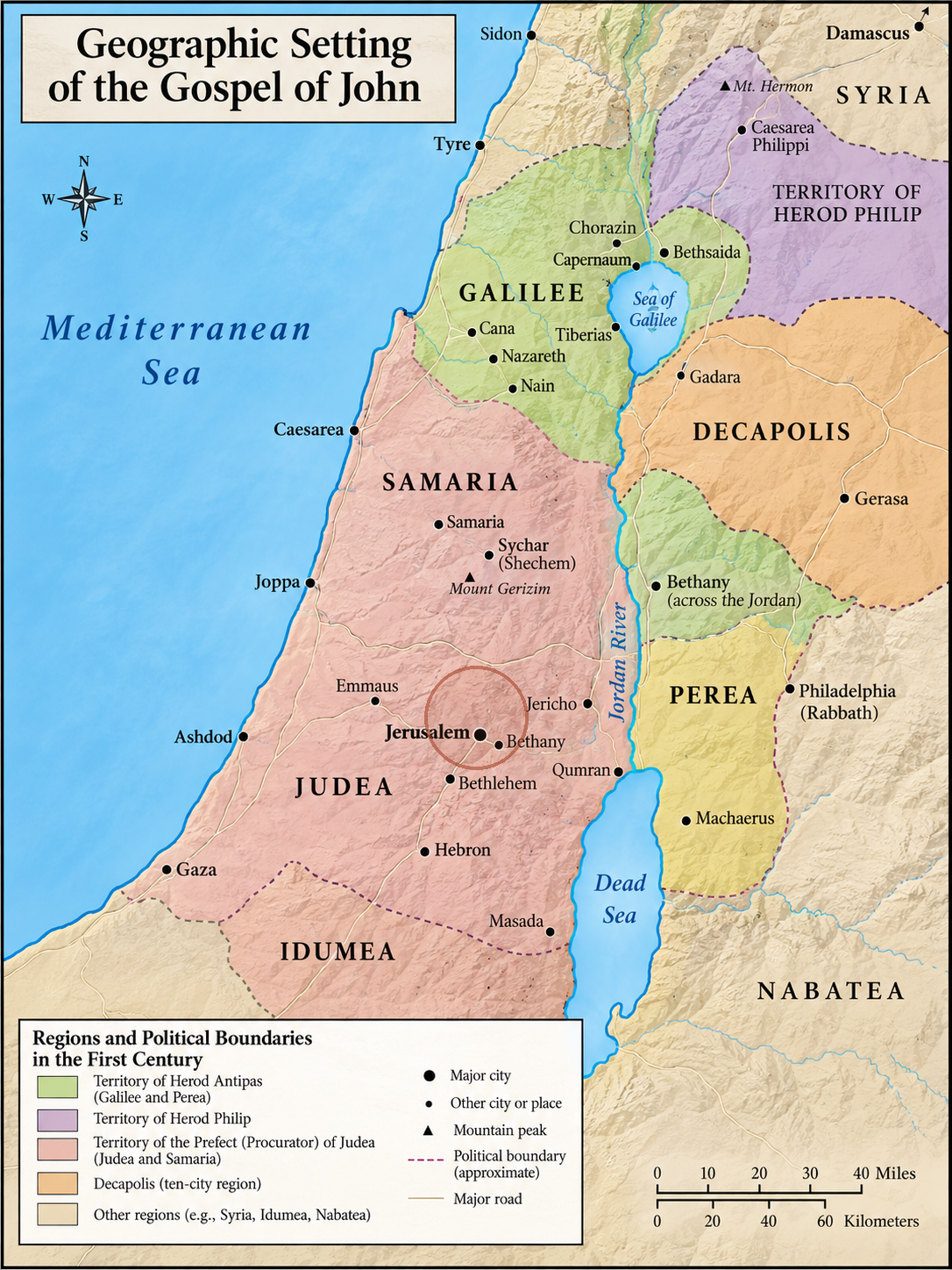
Regional location
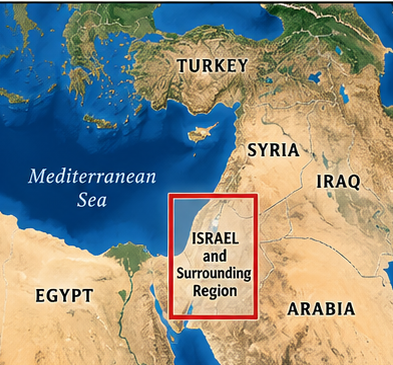
Red rectangle indicates the general main-map coverage.
Locations in John 12
Bethany (12:1–8): Mary anoints Jesus at a meal before Passover. John 11:18 places Bethany approximately 2.8 km / 1.7 miles from Jerusalem.
Jerusalem (12:12–19): Crowds greet Jesus as Israel’s King. John does not trace the exact entrance route.
Mount of Olives: The ridge east of Jerusalem offers regional orientation; John 12 does not name it. The Synoptic Gospels give more geographical details.
Greek visitors (12:20–22): They seek Jesus at the feast, but the text does not identify a specific meeting place.
Read the atlas
Pastel territories refer to first-century political regions; relief shading and blue waterways show the landscape. The locator is modern and does not show ancient boundaries.
Bethany and Jerusalem: closer view
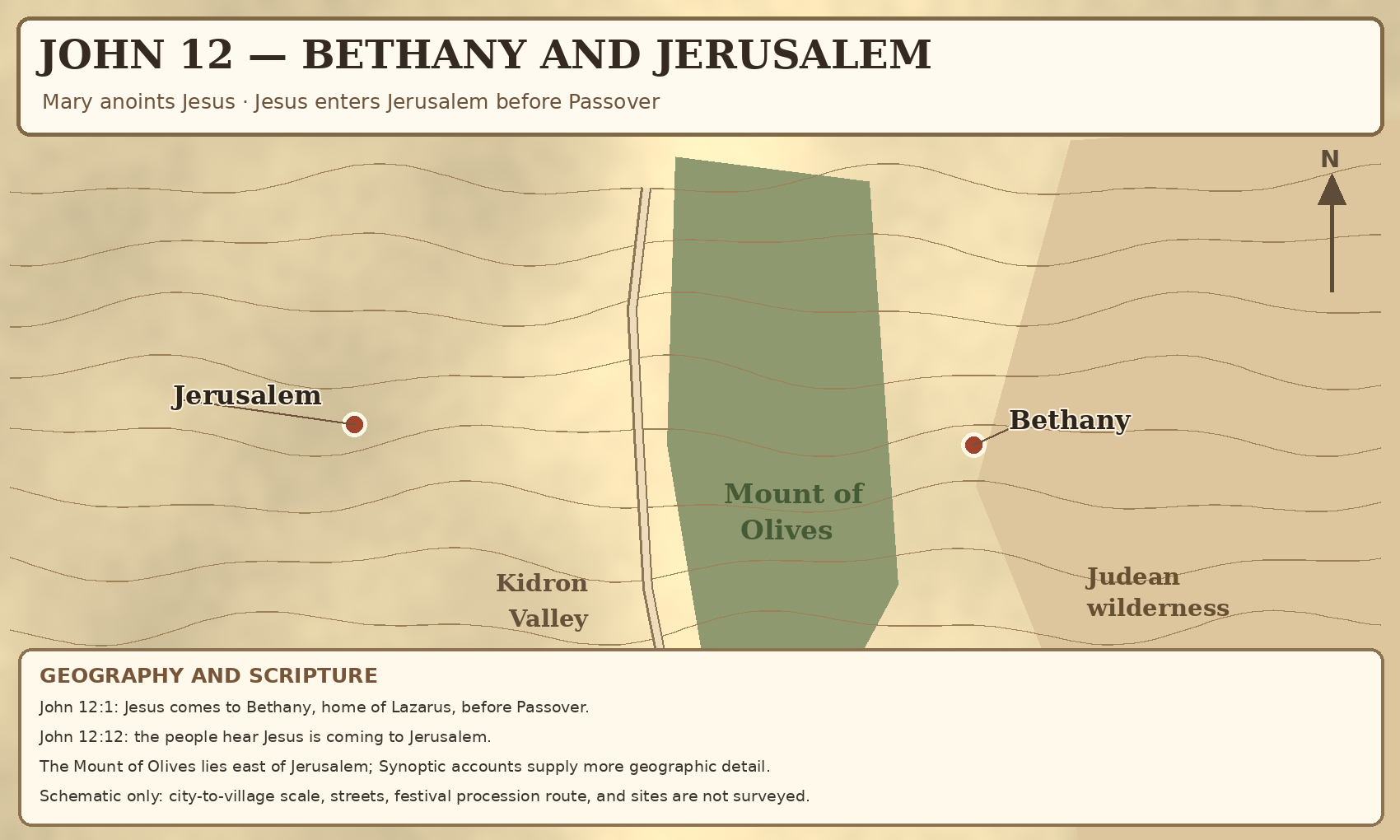
Original WGM orientation schematic. Distances, roads, city gates, exact supper setting, and entry route are not reconstructed.
Jerusalem Landmarks: Context for the King’s Entry
The preceding closer map shows Bethany and the Mount of Olives, while this Jerusalem reference supplies the Temple and broader city landmarks for readers following the events before Passover.
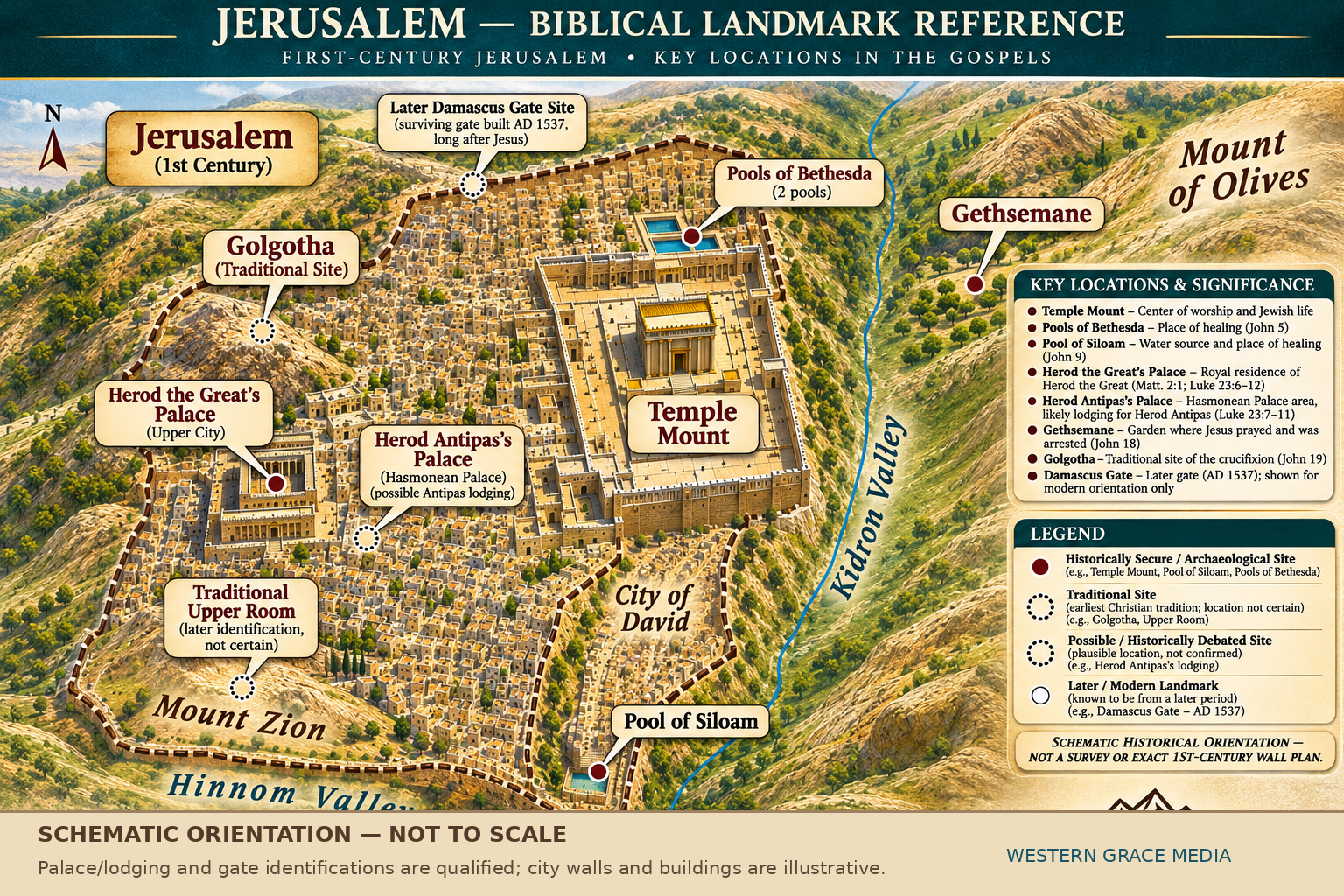
John 12 — locations to notice
This supplement complements the Bethany map. John 12 identifies Jerusalem and Bethany but not a surveyed procession route or a specific gate.
Shared WGM Jerusalem schematic. The site status varies: the gate is later, the Upper Room and Golgotha are traditional, and Herod Antipas’s possible lodging is unconfirmed.
Quick Study
I have come as a light into the world, that whoever believes in me may not remain in the darkness. John 12:46, WEB
Jesus is anointed before His burial, welcomed as King, and sought by Greek worshipers. He says His hour has come, describing death as the seed that bears fruit. He calls hearers to walk in the light and receive the Father’s life-giving word.
The Chapter’s Major Movements
A Costly Act of Worship (12:1–8)
Mary anoints Jesus in Bethany, and Jesus connects her act to His burial.
The Sign That Divides (12:9–11)
Lazarus draws many to believe while leaders plot against him.
The King Comes Humbly (12:12–19)
Jesus enters Jerusalem to public acclaim in a donkey-riding fulfillment of Scripture.
The Greeks’ Request (12:20–22)
Festival worshipers ask to see Jesus.
The Hour of Glory (12:23–33)
Jesus describes His death, costly discipleship, and the Father’s glory.
Walk in the Light (12:34–36)
Jesus calls the people to believe rather than remain in darkness.
Prophecy, Hardening, and Fear (12:37–43)
John interprets unbelief in light of Isaiah and exposes fear of people.
The Father’s Life-Giving Word (12:44–50)
Jesus declares that His saving word comes from the Father and carries eternal significance.
Quick Study Flow
Historical and Interpretive Notes
Passover: John names the approaching feast (12:1, 12). The chapter emphasizes the cross drawing near.
Bethany and Jerusalem: The two towns are well-established regional settings. John does not supply a procession road, a precise supper address, or a festival-day street plan.
Costly nard: A Roman pound of ointment was approximately 340 grams. Three hundred denarii was roughly a year of agricultural wages (WEB study notes).
Donkey and prophecy: John quotes Zechariah 9:9 and Psalm 118; the disciples understand more clearly after Jesus is glorified.
The Greeks: Their presence at the feast indicates a wider audience. The narrative does not identify their precise religious standing.
Isaiah quotations: John quotes Isaiah 53:1 and 6:10; read the hardening language with humility, never as permission for antisemitism or fatalism.
Important Bible Words
| Word / Phrase | Simple Meaning | Why It Matters |
|---|---|---|
| Anointing | Setting apart or honoring with costly ointment | Mary’s act honors Jesus and foreshadows His burial. |
| Hosanna | A cry asking God to save, used as praise | Crowds address Jesus as Israel’s King. |
| Son of Man | Jesus’ self-designation with Daniel 7 background | The Son of Man is glorified through the cross. |
| Glorified | God’s greatness and the Son’s identity displayed | John links Jesus’ glory with His death and victory. |
| Lifted up | Raised on the cross; also carrying a theme of exaltation | Jesus identifies how He will die. |
| Light / darkness | Jesus’ revelation and life contrasted with rejection | People are called to believe while the light is present. |
| Believe | Trust Jesus for who He is and what He says | Signs alone cannot replace a genuine response of faith. |
| Eternal life | Life from God through His Son, beginning now and lasting forever | The Father’s commandment is bound to the Son’s saving word. |
Translation Word Notes
Capitalized syllables show approximate classroom-style Biblical Greek stress. All full Scripture quotations remain WEB; the NKJV, NIV, and NLT columns offer short translation comparisons, not complete quotations.
| Verse | Greek / Pronunciation | NKJV | NIV | NLT | Meaning |
|---|---|---|---|---|---|
| 12:3 | nardosNAR-dos | spikenard | pure nard | nard essence | Expensive aromatic ointment; Roman pound was about 340 g. |
| 12:13 | hōsannahoh-SAH-nah | Hosanna | Hosanna | Praise God | Cry for salvation which becomes praise. |
| 12:23 | doxazōdok-SAH-zoh | glorified | glorified | glory | Shows the Son’s glory through the coming cross. |
| 12:24 | kokkosKOK-kos | grain | kernel | grain | Seed image illustrates life coming through death. |
| 12:25 | psychēpsoo-KHAY | life | life | life | Refers here to life/self in a strong allegiance contrast. |
| 12:26 | diakoneōdee-ah-koh-NEH-oh | serves | serves | serves | To serve or minister as Christ’s follower. |
| 12:31 | krisisKREE-sis | judgment | judgment | judgment | Divine reckoning connected with the cross. |
| 12:32 | hypsoōhoop-SOH-oh | lifted up | lifted up | lifted up | Used for Jesus’ crucifixion in context. |
| 12:35 | phōsFOHS | light | light | light | Jesus’ revelation calling people to believe. |
| 12:43 | doxaDOK-sah | praise | praise | praise | Honor or approval; God’s versus humans’. |
| 12:50 | zōē aiōnioszoh-AY eye-OH-nee-os | everlasting life | eternal life | eternal life | Life of the coming age given through Christ. |
The Gospel Connection
John 12 turns the reader toward the approaching cross. Mary anoints Jesus before His burial, the King enters Jerusalem in humility, and Jesus declares that His hour has come. Like a grain of wheat falling into the earth, He will die and bear much fruit (12:24). Being “lifted up” points to His crucifixion (12:32–33); the Son’s glory is not detached from His sacrifice. John invites people from beyond Israel to seek Him and calls all who hear to believe in the light. The gospel is not merely admiration for a moral example: God sends His Son to save sinners, and eternal life comes through faith in Christ (John 3:16; 20:31). His word carries both a genuine offer of salvation and a sober warning against rejection.
Reflection
Am I seeking the Father’s glory through faith in Christ rather than people’s praise?
A Short Prayer from John 12
Father, thank You for sending Jesus as the promised King and Savior. Jesus, You knowingly faced the cross for sinners, and Your death opened the way to eternal life. Forgive my fear of others’ opinions and my divided loyalties. Help me receive Your word, honor You sincerely, and walk in Your light. In Your name, amen.
One Truth to Carry With You
Jesus is the promised King who willingly goes to the cross. His death reveals God’s glory and gives life, and His word calls me to believe and follow Him in the light.
Ready to Go Deeper?
SOAP means Scripture, Observation, Application, Prayer. Read the complete passage before considering the explanation. Scripture remains our final authority.
Read the entire WEB passage in context.
Notice what John says about Jesus’ coming death, glory, belief, and the Father.
Respond personally with faith, obedience, gratitude, repentance, or confidence in Christ.
Pray in response to the truth of the passage, not to imagined details.
Mary Honors Jesus Before His Burial
What does this passage show about Jesus, God, people, faith, salvation, or obedience?
With Passover approaching, Jesus is welcomed at supper in Bethany. Mary’s costly anointing expresses extraordinary honor, and Jesus relates it directly to the coming burial. This chapter follows the raising of her brother Lazarus, yet John does not tell us every thought behind Mary’s act.
Judas objects in the language of caring for the poor, but John identifies his motive as theft. Jesus’ answer is not permission to neglect poor neighbors; He identifies a unique moment in His approaching death while the ordinary duty to care for the poor remains.
Jesus does not treat His death as a surprise. His coming sacrifice gives Mary’s costly devotion a larger meaning.
Where might I use respectable-sounding explanations to hide an unwillingness to honor Jesus with my whole life?
Lord Jesus, expose false motives in me and teach me worship that is sincere, generous, and faithful.
Lazarus and a Divided Crowd
What does this passage show about Jesus, God, people, faith, salvation, or obedience?
The raised Lazarus becomes a living witness to Jesus’ power. Many come to see him and believe in Jesus; some leaders respond by plotting to kill Lazarus as well as Jesus.
John does not portray every Jewish person as an opponent of Christ; many Jewish witnesses believe. Distinguish particular leaders’ plans from the response of the whole people.
Resurrection testimony brings both belief and opposition, setting the stage for the Passover events.
When a faithful witness makes me uncomfortable, do I listen carefully to the truth or try to silence it?
Father, make me courageous in honest testimony and careful not to stereotype others.
The King Enters Jerusalem
What does this passage show about Jesus, God, people, faith, salvation, or obedience?
Pilgrims greet Jesus with palm branches and a cry from Psalm 118. They identify Him as the King of Israel. The kingly welcome is real, yet their understanding of His mission remains incomplete.
Jesus rides a young donkey in fulfillment of the prophetic picture from Zechariah 9:9. His kingship is not founded on military display. John says the disciples understood these scriptural connections more clearly after Jesus was glorified.
The sign involving Lazarus helps explain the large crowd. Religious leaders fear they are losing influence, but the crowd’s enthusiasm is not by itself proof of saving faith.
Do I welcome the kind of Savior Scripture reveals, or only the kind of victory I would prefer?
King Jesus, correct my expectations and teach me to follow You with faith rather than crowd excitement.
Greeks Ask to See Jesus
What does this passage show about Jesus, God, people, faith, salvation, or obedience?
Some Greeks who have come to worship at the feast ask Philip for access to Jesus. John does not tell us whether they were proselytes, God-fearers, or other worshipers, so we should not claim more detail than the passage gives.
Their request comes as Jesus begins to speak about His hour of glorification. The wider reach of His mission emerges not through avoiding the cross but through His death and victory.
Philip and Andrew act as intermediaries in the narrative; the focus remains on seeing Jesus Himself.
How can I help someone truly encounter Jesus through Scripture rather than merely notice my religious activity?
Lord, use my words and conduct to point people to Your Son.
A Grain of Wheat and the Cost of Following
What does this passage show about Jesus, God, people, faith, salvation, or obedience?
Jesus declares that the hour has come for the Son of Man to be glorified. His comparison to a seed that dies to bear much fruit points first to His own death producing life for others.
Jesus then calls His servants to deny self-centered attachment to life in this world. “Hate” here is a strong contrast of ultimate allegiance, not permission to harm ourselves or despise the life God gives.
Following Christ means going where He leads, and the Father promises to honor those who serve His Son. Such service flows from grace; it does not purchase eternal life.
What comfort, status, or ambition am I treating as more important than faithful obedience to Jesus?
Lord Jesus, help me follow You in costly obedience and receive life from Your grace.
The Troubled Son and the Father’s Voice
What does this passage show about Jesus, God, people, faith, salvation, or obedience?
Jesus acknowledges genuine trouble in His soul while remaining committed to the purpose for which He came. His willingness to obey is not the absence of pain; it is holy resolve in the presence of suffering.
The heavenly voice declares the Father’s glory. The crowd responds differently, interpreting what they hear as thunder or an angel. Jesus says the voice came for their sake.
Jesus speaks of the world’s judgment, the defeat of its ruler, and being lifted up. John explicitly says that “lifted up” points to the manner of His death, the cross.
What does Jesus’ truthful expression of distress teach me about obedience when I am afraid or troubled?
Father, glorify Your name through my trust. Give me courage to obey Your Word in difficult seasons.
Believe While the Light Is Here
What does this passage show about Jesus, God, people, faith, salvation, or obedience?
The listeners struggle to reconcile a Messiah who remains forever with Jesus’ announcement that the Son of Man must be lifted up. Their question provides an opportunity to hear Jesus’ warning.
Jesus calls them to walk in and believe in the light while it is with them. John has described Jesus as the true light since the opening chapter, so the call concerns trusting and following Him.
The urgent warning is not a way to predict individual dates or demand emotional manipulation; it is a clear call not to reject the light God has given.
Am I postponing a clear response to Jesus because I expect to have unlimited opportunities?
Jesus, help me respond to Your light today and take Your words seriously.
Unbelief, Isaiah, and the Fear of People
What does this passage show about Jesus, God, people, faith, salvation, or obedience?
Even after many signs, there is widespread unbelief. John quotes Isaiah 53:1 and Isaiah 6:10 to locate rejection within the history of prophetic testimony and divine judgment.
The difficult language of hardening must be read alongside John’s repeated appeals to believe. It is not permission to declare that entire ethnic groups are rejected or to dismiss personal responsibility.
Some rulers believe but fear public confession because they value human approval. The passage shows that inward conviction and open allegiance can come into tension.
Where does the fear of people keep me from speaking and living according to what Scripture teaches?
Father, free me from craving approval more than truth. Give me humility and courage.
To See the Son Is to See the Father
What does this passage show about Jesus, God, people, faith, salvation, or obedience?
Jesus identifies faith in Him with faith in the Father who sent Him. His unity with the Father is central to John’s witness about His identity and mission.
The light is given so that believers will not remain in darkness. Spiritual light is not private insight detached from Scripture; it is revelation centered on the person of Jesus Christ.
This continues the theme first announced in John 1:4–14: God reveals Himself in His Son.
Does my picture of God match what Jesus reveals about the Father?
Father, help me know You through the Son and walk in His light.
The Saving Word and the Last Day
What does this passage show about Jesus, God, people, faith, salvation, or obedience?
Jesus distinguishes the purpose of His first coming—to save the world—from the real accountability facing those who reject His words. John does not erase future judgment; Jesus explicitly speaks of judgment on the last day.
Jesus does not offer an independent message. His words come from the Father, whose commandment is eternal life. The Son faithfully speaks all the Father gives Him.
John closes this major public teaching section by putting the reader before the authority and promise of the Son’s word.
Am I merely familiar with Jesus’ sayings, or do I receive them as the Father’s life-giving truth?
Lord Jesus, give me a believing heart and teach me to receive and obey Your word.
Hard Questions
Why would Jesus defend an expensive gift instead of giving its value to the poor?
John exposes Judas’s dishonest motive and connects Mary’s act with Jesus’ unique approaching burial (12:6–8). Jesus is not canceling God’s commands to care for poor people (Deuteronomy 15:11).
Does Mary in John 12 have to be the woman in the other Gospel anointing accounts?
The Gospels describe more than one anointing scene. Some details overlap, while settings and emphases differ. John explicitly names Mary of Bethany; avoid making identifications beyond what the passages establish.
Why did Jesus enter on a donkey rather than a warhorse?
John connects the donkey to a prophetic picture of Zion’s king (Zechariah 9:9). The Messiah’s kingship is not the militarized political triumph some expected.
Were the Greeks believers, converts, or outsiders?
John says only that they came to worship at the festival and sought Jesus through Philip (12:20–22). We should not claim a more precise religious status.
What does the grain of wheat teach?
In context the grain points first to Jesus’ death bearing much fruit (12:23–24), then to disciples following Him in costly loyalty (12:25–26). This is not a command to hurt oneself.
Why was Jesus troubled if He came to die?
Jesus truly experiences anguish (12:27) and knowingly obeys the Father’s saving purpose. Human emotion and faithful obedience are not opposites.
Who is the prince of this world?
Within John’s Gospel the expression points to the evil ruler who opposes God (compare John 14:30; 16:11). His downfall is bound to the decisive work of Jesus’ cross.
Does “draw all people” mean everyone will be saved automatically?
John 12:32 speaks of the wide reach of Christ’s crucified-and-exalted ministry, and the presence of Greek seekers underscores that breadth. John also describes real unbelief and judgment (12:37, 48); the verse does not by itself teach automatic salvation of every person.
How can Isaiah say God hardened hearts, yet people are accountable?
John quotes Isaiah’s judgment oracle to explain persistent rejection in the face of revelation. It is a serious theological question involving divine judgment and human unbelief; faithful Evangelicals disagree on some details, but the text does not warrant ethnic hostility or fatalism.
Does John condemn Jewish people as a whole?
No. Jesus, His apostles, Mary, Martha, Lazarus, and many believers in John were Jewish. John records divisions and particular opposition among people and leaders, not guilt assigned to an ethnicity.
How can Jesus say He came to save rather than judge while warning of judgment?
John 12:47 describes the saving purpose of His coming; 12:48 also warns of future judgment for rejection of His word. These statements address different aspects of His mission.
Why do some leaders believe privately but not confess Jesus?
John 12:42–43 identifies fear of exclusion and love of human praise. The narrative warns against protecting status at the expense of public faithfulness.
Where is Jesus calling me to costly but sincere devotion?
How does Jesus’ triumphal entry challenge the kind of success I expect from Him?
What does the cross teach me about life, glory, and true freedom?
Whose approval most often determines whether I will speak openly of Christ?
A Prayer of Faith in the Light
Lord Jesus, You are the light of the world and the King who entered Jerusalem in humility. You were troubled in soul, yet willingly obeyed the Father for the salvation of sinners. Thank You for Your cross and for the life Your sacrifice brings. Teach me to love You more than comfort, reputation, or the applause of people. Help me read Your word carefully, respond to Your invitation with living faith, and point others to You. Guard me from careless judgment of others, and make my witness truthful and gracious. May the Father be glorified in all I do. In Jesus’ name, amen.
Jesus is the promised King who willingly goes to the cross. His death reveals God’s glory and gives life, and His word calls me to believe and follow Him in the light.