John 13
The Servant King and the New Commandment
Jesus washes His disciples’ feet, faces betrayal, and teaches His followers to love one another by His own example.
Scripture quotations: World English Bible (WEB)

John 13 — Geographic Setting
Jesus washes His disciples’ feet during a supper before Passover. The surrounding narrative provides a Jerusalem setting, but John does not name the house, street, or exact room. The regional atlas shows the city vicinity; the closer map explains broad terrain relationships without inventing a precise site.
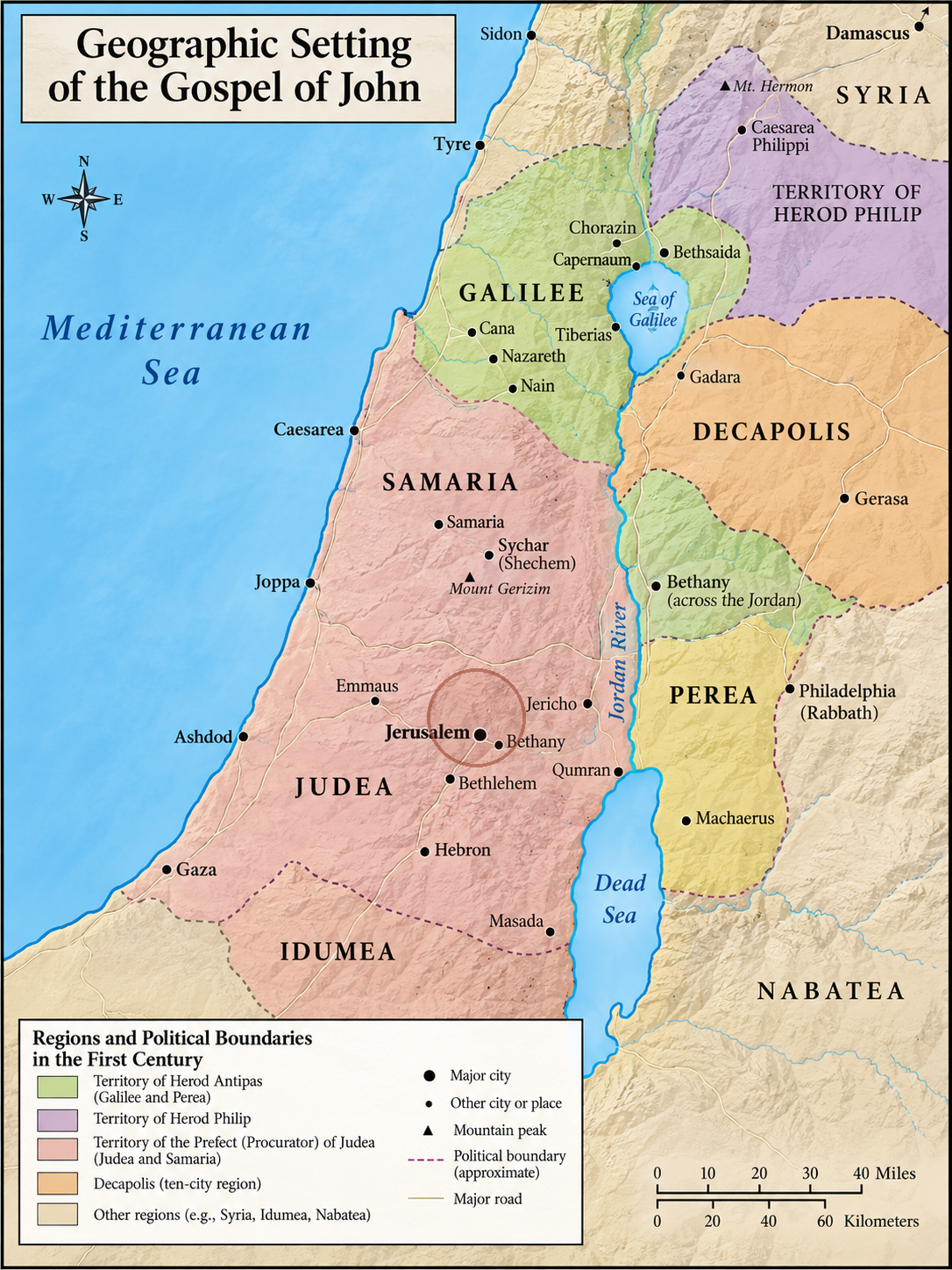
Regional location

The red rectangle indicates the approximate wider atlas coverage.
Where does John 13 take place?
Passover setting: The chapter opens before the feast (13:1) and describes a meal (13:2).
Jerusalem vicinity: The surrounding chapters position the events in the Jerusalem context, but John 13 provides no building address.
Upper room tradition: The Gospels place the final meal in a furnished room, but a precise ancient site should not be assigned from John 13.
Map caution: The schematic is for geographic orientation and is not a surveyed ancient street map.
Map symbols
Pastel shading marks approximate first-century territories, terrain relief shows hills and valleys, and blue marks water. The small locator shows modern geography.
Jerusalem: biblical landmark reference
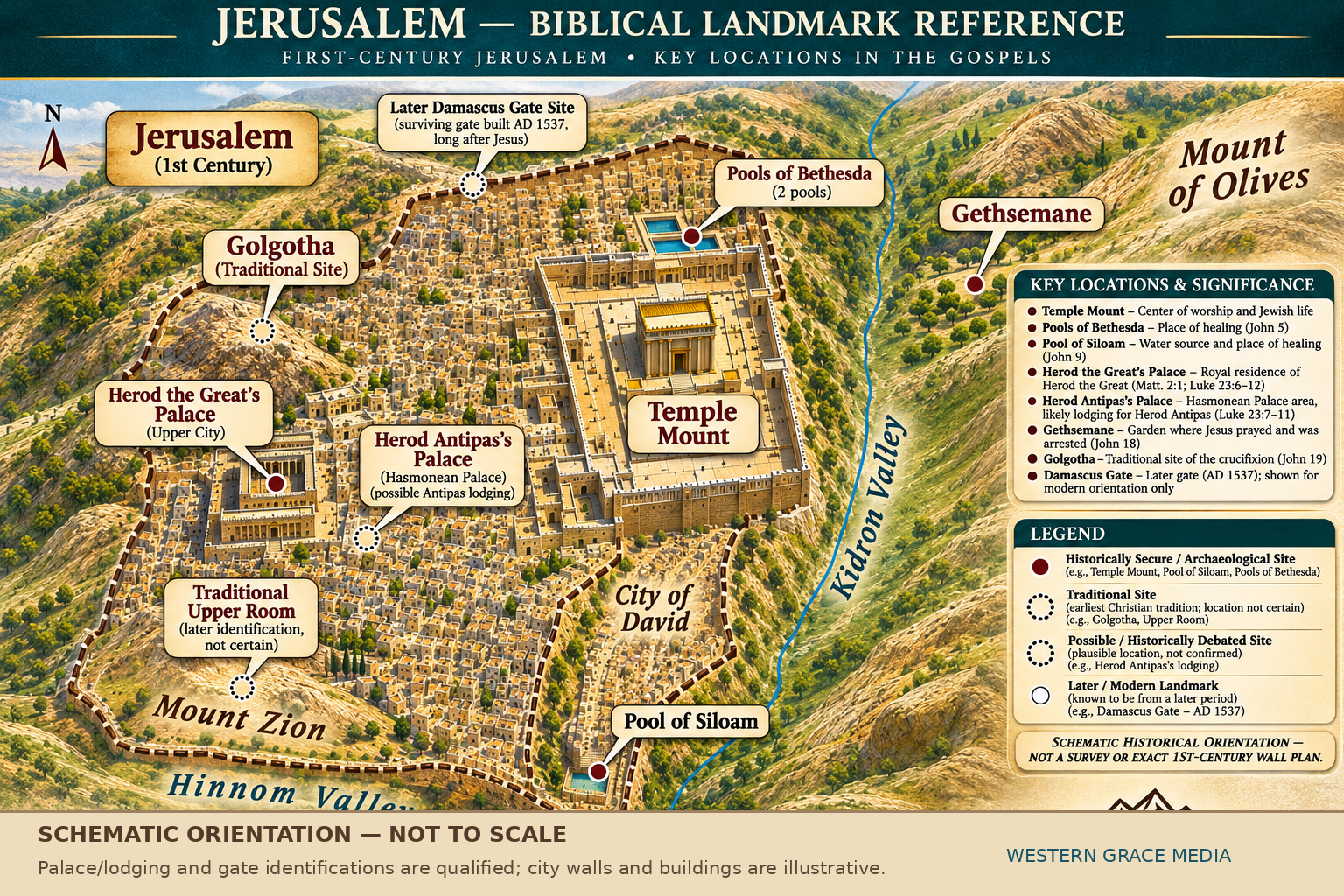
Original WGM schematic landmark map, not to scale. Bethesda is north of the Temple; Siloam is south of the City of David. Herod the Great's western palace is distinguishable from the old Hasmonean palace, a possible but unconfirmed lodging place for Herod Antipas. Damascus Gate is a later landmark shown for orientation, not a first-century gateway. The supper room is not identified by John 13, and Golgotha and Mount Zion Upper Room markers are traditional identifications.
John 13 focus: Chapter focus: an unidentified supper room in the Jerusalem setting. The traditional Mount Zion Upper Room must not be presented as confirmed.
Quick Study
A new commandment I give to you, that you love one another. Just as I have loved you, you also love one another. John 13:34, WEB
The Lord Jesus washes His disciples’ feet, tells Peter to receive His washing, and commands His followers to serve one another. He faces betrayal with foreknowledge and gives a new commandment to love as He has loved. Peter receives a warning against overconfidence.
The Chapter’s Major Movements
Jesus Loves to the End (13:1–5)
Knowing His hour and authority, Jesus washes His disciples’ feet.
Peter Needs to Receive (13:6–11)
Jesus insists that Peter needs His washing and warns that not all are clean.
The Lord Gives an Example (13:12–17)
The Teacher and Lord commands humble service among His followers.
A Betrayer Foretold (13:18–20)
Scripture is fulfilled, and Jesus prepares His disciples to believe.
Troubled at the Table (13:21–25)
Jesus names the approaching betrayal, and the disciples are perplexed.
Judas Leaves (13:26–30)
The betrayer receives the morsel and goes out into the night.
Love as Jesus Has Loved (13:31–35)
Jesus connects His glory with a new commandment of sacrificial love.
Peter Will Deny Him (13:36–38)
Peter offers courageous promises; Jesus warns of his coming failure.
Quick Study Flow
Historical and Interpretive Notes
Passover: Jesus knows that His hour has come before the feast (13:1). Questions about the chronology of the last meal across the Gospels require careful comparison.
Foot washing: Washing dusty feet was a humble act of hospitality and service. Jesus’ lowly action comes from His authority, not in place of it.
The supper location: The broader context suggests Jerusalem, but John does not give a room, street, or precise house location.
Psalm 41:9: Jesus cites the betrayal of a close companion, preparing His followers for what will occur.
The beloved disciple: Christian tradition commonly identifies him as John; this particular scene does not name him.
The new commandment: Jesus’ love provides the decisive pattern for discipleship (13:34–35), without cancelling the Old Testament command to love one’s neighbor.
Peter’s denial: The warning exposes human weakness and prepares for the events of John 18 and restoration in John 21.
Important Bible Words
| Word / Phrase | Simple Meaning | Why It Matters |
|---|---|---|
| The hour | Jesus’ appointed time of departure and the cross | His suffering unfolds within His mission. |
| Foot washing | A lowly act of hospitality and service | The Lord models humility and cleansing. |
| Clean | Purity and belonging to Christ | Jesus contrasts true cleanness with hidden betrayal. |
| Teacher and Lord | Jesus’ recognized authority and identity | His authority gives weight to His service command. |
| Example | Pattern for faithful conduct | Knowing the truth should lead to action. |
| Betrayal | Disloyal handing over of a close companion | Jesus faces sin without being surprised by it. |
| Glory | The Son’s identity and Father’s greatness displayed | The approaching cross is not defeat. |
| New commandment | Love shaped by Jesus’ own love | Christians are known by their conduct toward one another. |
| Denial | Disowning a relationship or allegiance | Peter’s confidence alone cannot keep him faithful. |
Translation Word Notes
Capitalized syllables show approximate classroom-style Biblical Greek stress. All full Scripture quotations remain WEB; the NKJV, NIV, and NLT columns offer short translation comparisons, not complete quotations.
| Verse | Greek / Pronunciation | NKJV | NIV | NLT | Meaning |
|---|---|---|---|---|---|
| 13:1 | telosTEH-los | to the end | to the end | to the very end | The full extent or completion of Jesus’ love. |
| 13:5 | niptōNEEP-toh | wash | wash | wash | Physical washing that models humble care. |
| 13:8 | merosMEH-ros | part | part | belong to | Share or participation with Christ. |
| 13:10 | katharoskah-thah-ROS | clean | clean | clean | Cleansing and purity, with context pointing to Judas. |
| 13:15 | hypodeigmahoo-poh-DAYG-mah | example | example | example | A pattern to imitate, not a way to earn salvation. |
| 13:16 | doulosDOO-los | servant | servant | slave | A bondservant, not above his master. |
| 13:17 | makariosmah-KAH-ree-os | blessed | blessed | blessed | Favorable standing expressed in obedience. |
| 13:21 | tarassōtah-RAHS-soh | troubled | troubled | deeply troubled | Jesus experiences genuine distress. |
| 13:31 | doxazōdok-SAH-zoh | glorified | glorified | glorified | The Father and Son’s glory revealed. |
| 13:34 | entolēen-toh-LAY | commandment | command | commandment | An authoritative direction from Christ. |
| 13:34 | agapaōah-gah-PAH-oh | love | love | love | Love shaped by Jesus’ sacrificial example. |
| 13:38 | arneomaiar-NEH-oh-my | deny | disown | deny | Repudiate an allegiance or relationship. |
The Gospel Connection
John 13 takes place as Jesus’ hour approaches. The Lord who came from God and returns to God voluntarily takes a servant’s towel and washes His disciples’ feet. Peter must learn to receive before he can imitate. The foot washing points to Jesus’ humble love and anticipates the self-giving that will reach its climax at the cross. Even as Judas plans betrayal, Jesus remains faithful. He announces that the Son of Man will be glorified and commands His people to love one another as He has loved them. The good news is not that our own service makes us clean; Jesus saves sinners by His gracious work, and those who belong to Him are called to reflect His love in obedient action (John 3:16; 13:8, 34–35; 20:31).
Reflection
Am I receiving Jesus’ grace and loving other believers through humble service?
A Short Prayer from John 13
Lord Jesus, You knew Your hour had come, yet You knelt to serve. Thank You for loving Your people to the end. Forgive my pride, resistance, and empty promises. Teach me to receive Your grace, serve with humility, and love other believers in ways that show You are Lord. In Your name, amen.
One Truth to Carry With You
The Lord of all stooped to serve me; because He has loved me, I must receive His grace and love others as He has loved me.
Ready to Go Deeper?
SOAP means Scripture, Observation, Application, Prayer. Read the complete passage before considering the explanation. Scripture remains our final authority.
Read the entire WEB passage in context.
Notice how Jesus acts with authority, serves, speaks truth, and commands His disciples to love.
Respond personally with faith, obedience, gratitude, repentance, or confidence in Christ.
Pray in response to the truth of the passage, not to imagined details.
The Lord Takes the Servant’s Towel
What does this passage show about Jesus, God, people, faith, salvation, or obedience?
Jesus knows His hour has arrived and loves His own to the end. His deliberate action comes from full knowledge of His divine mission, not from uncertainty about His authority.
He rises from the meal, lays aside His outer clothing, and washes His disciples’ feet. In this setting foot washing was ordinarily a lowly task; the Lord assumes a servant’s place.
John sets the humility of Jesus against the approaching betrayal. The chapter invites us to see His majesty and His service together.
What task of humble love am I avoiding because it seems beneath me?
Lord Jesus, You possess all authority and yet chose to serve. Give me a humble heart and willing hands.
Peter Resists the Washing
What does this passage show about Jesus, God, people, faith, salvation, or obedience?
Peter is stunned that his Lord would wash his feet. Jesus tells him that the significance of His action will become clearer later and that Peter must receive His washing to have a part with Him.
The distinction between being bathed and having feet washed illustrates cleanness and ongoing need, though John does not provide a complete sacramental system here. Jesus also warns that not everyone in the room is clean, pointing to betrayal.
Faith must receive Christ’s gracious work. We cannot make ourselves clean by religious pride or insist that Christ serve us only in ways we understand.
When have I resisted receiving grace because I wanted to remain in control?
Father, teach me to receive the cleansing only Christ can provide and to trust Him beyond my understanding.
The Example of the Teacher and Lord
What does this passage show about Jesus, God, people, faith, salvation, or obedience?
After washing the disciples’ feet, Jesus resumes His place and asks if they understand. They call Him Teacher and Lord, and He confirms that both titles are true.
Because the Lord served them, His followers ought to serve one another. The command has the weight of His example: knowing humble love is insufficient without practicing it.
The passage gives an ethical pattern for Christian fellowship; the example does not imply that our service can purchase salvation.
How will I put Jesus’ servant-hearted example into practice with a specific person this week?
Lord, help me turn knowledge into acts of patient, practical love.
Scripture and the Sender
What does this passage show about Jesus, God, people, faith, salvation, or obedience?
Jesus distinguishes His knowledge of His chosen disciples from the betrayal that fulfills the Scripture about a close companion who turned against the speaker (Psalm 41:9).
He tells them ahead of time so that, when betrayal takes place, they may believe His identity and confidence in God’s purpose.
Receiving those truly sent by Jesus is connected with receiving Jesus and the Father. This is not permission to treat any modern leader as unquestionable; true messengers remain accountable to Christ’s word.
How does Jesus’ knowledge of events strengthen my confidence without making me excuse sinful choices?
Father, strengthen my trust in Your faithful word and keep me discerning about those who claim to speak for You.
Troubled in Spirit at the Table
What does this passage show about Jesus, God, people, faith, salvation, or obedience?
Jesus is deeply troubled and openly testifies that one of the disciples will betray Him. The disciples are confused about who He means.
John identifies one disciple by the description “whom Jesus loved.” Tradition often identifies this disciple as John, but the narrative does not name him here.
Jesus is not emotionally indifferent to betrayal. His truthful warning takes place amid the fellowship of a shared meal.
How can I respond faithfully to painful truth without pretending it does not hurt?
Lord Jesus, You understand betrayal and grief. Help me to speak truth with patience and courage.
Judas Goes Out into the Night
What does this passage show about Jesus, God, people, faith, salvation, or obedience?
Jesus identifies the betrayer by giving a dipped piece of bread to Judas. John then reports Satan entering into Judas. Jesus tells him to do quickly what he is about to do.
The other disciples still misunderstand the exchange and assume it may concern purchases for the feast or alms for the poor.
Judas departs, and John adds, “It was night.” This is a real time marker that also resonates with the Gospel’s theme of darkness and rejection; the text does not remove Judas’s responsibility.
Where must I resist secret compromise before it develops into open betrayal?
Lord, search my motives and lead me away from hidden sin toward repentance and truth.
The New Commandment of Love
What does this passage show about Jesus, God, people, faith, salvation, or obedience?
After Judas leaves, Jesus announces the glorification of the Son of Man and of God. The approaching cross is not an accident but the path through which His glory is displayed.
He speaks tenderly to the disciples as “little children” and gives them a new commandment: love one another as He has loved them.
The newness lies in the measure and pattern of love revealed in Jesus. Such love becomes a recognizable mark of His disciples, rather than an optional religious ornament.
Who needs Christlike love from me, even if it requires an inconvenient sacrifice?
Jesus, teach me to love others by Your example, with truth and sacrifice rather than mere sentiment.
Peter’s Confidence and Jesus’ Warning
What does this passage show about Jesus, God, people, faith, salvation, or obedience?
Peter promises that he will lay down his life for Jesus. Jesus warns that Peter will deny Him three times before the rooster crows.
Peter’s willingness sounds sincere, but confidence in our own courage is not the same as perseverance. Jesus understands Peter’s weakness before it is exposed.
The scene leads toward Peter’s failure and eventual restoration later in John. It warns us against pride while keeping our eyes on the faithful Savior.
Where am I trusting my promises more than Jesus’ sustaining grace?
Lord, free me from overconfidence. Teach me to depend on Your strength when my own resolve falters.
Hard Questions
Why did Jesus wash the disciples’ feet when He knew He was their Lord?
John 13:3–5 emphasizes His full awareness of His authority. His humility expresses rather than contradicts His identity. His followers are to serve others without abandoning truth or responsibility.
Does foot washing become a command for every Christian to perform the same ritual?
Jesus commands His followers to imitate His humble service (13:14–17). Some evangelical churches practice literal foot washing; others emphasize the underlying example. Both should make Christlike love visible rather than treat it as a way to earn salvation.
What does “If I don’t wash you, you have no part with me” mean?
Peter must receive what Jesus gives rather than assert self-sufficiency. Evangelicals see cleansing and participation in Christ here. The passage does not lay out a full baptismal or sacramental doctrine on its own.
Why does Jesus say that not everyone is clean?
John explicitly connects the warning to His knowledge of Judas’s betrayal (13:10–11). It is not an excuse to speculate about the hidden state of ordinary people.
Did Scripture force Judas to betray Jesus?
Jesus cites Psalm 41:9 while knowing betrayal will occur (13:18–19). The text affirms fulfillment without calling Judas innocent or inviting fatalism about our choices.
Why was Jesus troubled in spirit?
John 13:21 records His genuine grief before betrayal. The eternal Son is also truly human; faithful obedience does not require emotional numbness.
Who is the disciple whom Jesus loved?
John 13:23 does not name him. Christian tradition commonly identifies him with the apostle John, but the identification is a historical inference rather than an explicit detail here.
What does “Satan entered into him” mean?
John reports spiritual evil working through Judas’s betrayal (13:27). The passage does not provide a detailed mechanism or deny Judas’s responsibility for what he does.
Why does John say “It was night”?
The phrase identifies the time of Judas’s departure (13:30) and fits John’s recurring light-and-darkness imagery. Treat the symbolic resonance as interpretation, not as a claim the time reference was fictional.
What is new about the command to love?
The Old Testament already teaches love (Leviticus 19:18). Jesus provides the decisive pattern and measure: “Just as I have loved you” (13:34). His self-giving love defines discipleship.
Does Christian love mean approving everything someone does?
No. John places love alongside truth, cleansing, and faithfulness. Jesus Himself gives honest warnings and exposes betrayal while continuing to act in love.
Why would Peter deny Jesus after promising to die for Him?
Peter overestimates his own strength (13:37–38). Jesus knows this weakness and later restores Peter (John 21). Our confidence belongs in the faithful Lord, not merely our promises.
Which act of humble service would best reflect Jesus’ example in my home or church?
Where do I need to receive Christ’s grace instead of defending my pride?
How would others recognize Christ’s love in the way I treat fellow believers?
What can Peter’s warning teach me about humility and dependence on God?
A Prayer to Love as Jesus Loved
Lord Jesus, You are Teacher and Lord, yet You washed the feet of Your disciples. Thank You for Your patient, self-giving love and for the saving work toward which this chapter points. Forgive me for insisting on my own strength when I need Your cleansing. Give me discernment about hidden sin, humility when I am corrected, and courage to practice love when it costs me. Protect my heart from betrayal and careless confidence. Make our churches places where Your truth is spoken and Your love is seen. May people recognize Your disciples by the way we serve one another. In Your precious name, amen.
The Lord of all stooped to serve me; because He has loved me, I must receive His grace and love others as He has loved me.