John 18
The King on Trial
The willing arrest of Jesus, Peter’s denials, and the innocent King before Pilate.
Scripture quotations: World English Bible Classic (WEB)

John 18 — Geographic Setting
John 18 crosses the Kidron valley to a garden and then follows Jesus through priestly questioning and Roman interrogation. The first-century Jerusalem master map shows the city and garden vicinity without claiming an exact travel route or judgment-room location.
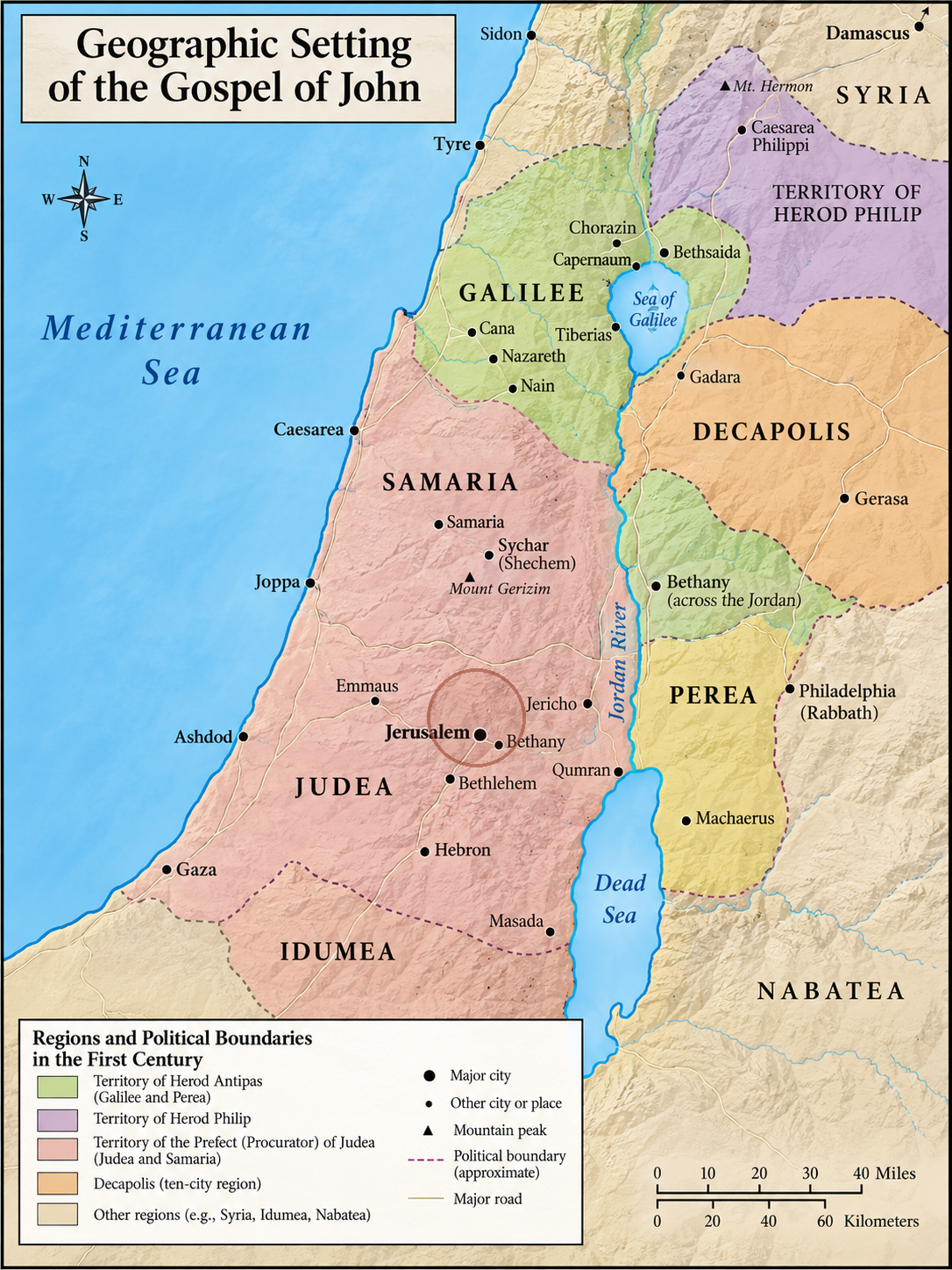
Regional location
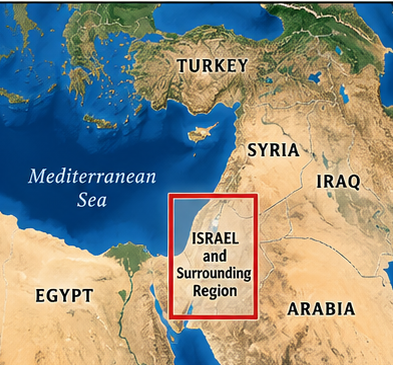
The outlined box locates the wider regional atlas.
Places in John 18
Kidron and garden (18:1): Jesus and the disciples crossed east of Jerusalem into a garden.
Gethsemane: The Synoptic Gospels identify the arrest location by this name; John simply says garden.
Annas and Caiaphas (18:13, 24): Leaders are named, but their exact residences are not established.
Praetorium (18:28): A debated site, with Herod’s western palace and the Antonia area commonly proposed.
Routes: No exact sequence of streets or travel times is asserted.
Jerusalem: Garden, Priestly Questioning, and the Governor
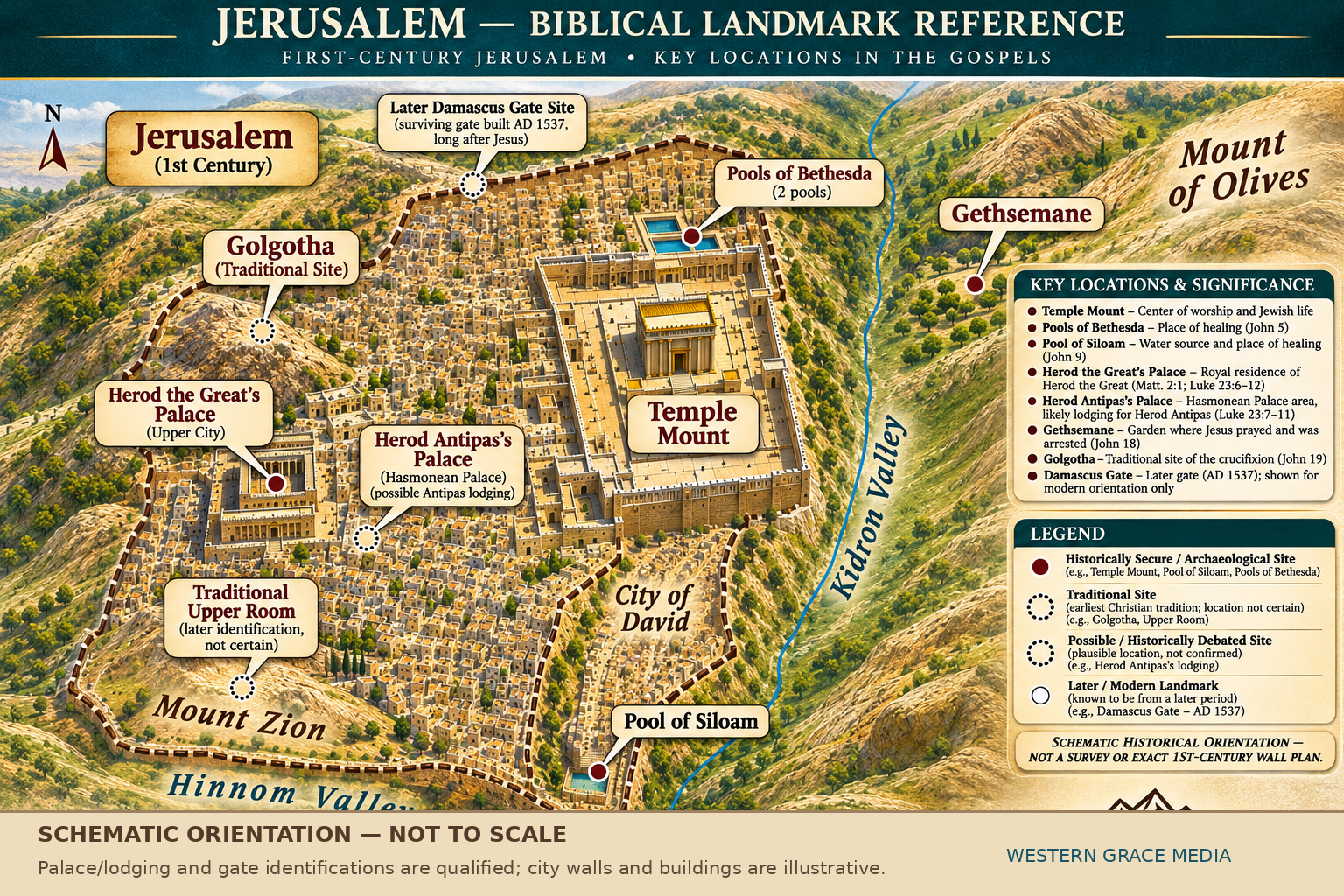
Shared WGM historical orientation. The Praetorium and priestly residence locations are uncertain; do not infer a precise arrest-and-trial route.
Quick Study
Jesus answered, “My Kingdom is not of this world. If my Kingdom were of this world, then my servants would fight, that I wouldn’t be delivered to the Jews. But now my Kingdom is not from here.” John 18:36, WEB
Jesus voluntarily meets those who arrest Him, protects His followers, receives the Father’s cup, and faces questioning without deceit. Peter denies Him; Pilate hears His witness to the truth and His kingdom; the crowd prefers Barabbas. The innocent King continues toward the cross.
The Chapter’s Major Movements
Across the Kidron (18:1–6)
Judas comes with armed officers, but Jesus steps forward knowing what awaits.
Jesus Protects His Disciples (18:7–11)
He stops Peter’s sword and accepts the cup given by the Father.
Annas and Caiaphas (18:12–14)
Jesus is bound and taken into the high-priestly proceedings.
Peter’s First Denial (18:15–18)
Fear leads Peter to deny the Lord at a courtyard fire.
Jesus Speaks Openly (18:19–24)
He calls for honest testimony despite being struck.
Peter’s Second and Third Denials (18:25–27)
The rooster crows as Jesus’ warning is fulfilled.
Before the Roman Governor (18:28–32)
Jesus is brought to the Praetorium as the charge progresses toward execution.
The King and the Truth (18:33–38)
Jesus describes a kingdom not sourced from the world and His witness to truth.
The Crowd Chooses Barabbas (18:39–40)
The innocent King is rejected in favor of another prisoner.
Quick Study Flow
Historical and Interpretive Notes
Garden east of the Kidron: John names a garden; Gethsemane is named in Matthew and Mark.
Jesus’ willingness: He knows what is coming and voluntarily receives the cup from His Father.
Peter: His denials fulfill Jesus’ prediction in John 13:38 and prepare the reader for the restoration in John 21.
High priests: Annas is a former high priest and Caiaphas is the acting high priest; the exact locations of their homes are not known with confidence.
Praetorium: Herod’s western palace and the Antonia area are both proposed; no certain street address is given by John.
The kingdom: Jesus is a true King, but His reign is not founded on worldly violence or political manipulation.
Truth: Jesus came to testify to the truth; Pilate’s response does not change what is true.
Responsibility: John names particular Judean leaders and the Roman governor; avoid collective blame toward Jewish people.
Important Bible Words
| Word / Phrase | Simple Meaning | Why It Matters |
|---|---|---|
| Kidron | Valley and watercourse east of ancient Jerusalem | Jesus crosses it into a garden before His arrest. |
| Garden | A place Jesus often visited with disciples | Judas knew it; the exact planted area is not specified. |
| Cup | Figure for the suffering accepted by the Son | Jesus refuses to evade His Father’s will. |
| High priest | Jewish priestly leadership office | Annas and Caiaphas appear in the proceedings. |
| Denial | Refusal to acknowledge known allegiance | Peter denies following Jesus three times. |
| Praetorium | Roman governor’s headquarters in Jerusalem | Exact historical building remains debated. |
| Kingdom | Royal rule and authority | Jesus’ kingdom does not originate from this world. |
| Truth | God’s reality revealed faithfully in Jesus | Jesus came to testify to truth, not to please power. |
| Passover | Israel’s festival remembering redemption | The narrative takes place amid Passover observance. |
| Barabbas | The prisoner released instead of Jesus | Illustrates the rejection of the innocent King. |
Translation Word Notes
Capitalized syllables show approximate classroom-style Biblical Greek stress. All full Scripture quotations remain WEB; the NKJV, NIV, and NLT columns offer short translation comparisons, not complete quotations.
| Verse | Greek / Pronunciation | NKJV | NIV | NLT | Meaning |
|---|---|---|---|---|---|
| 18:1 | cheimarroskhay-MAR-ros | brook | valley | stream | A seasonal watercourse in the Kidron valley. |
| 18:1 | kēposKAY-pos | garden | garden | olive grove | The place Jesus enters with His disciples. |
| 18:3 | speiraSPAY-rah | detachment | detachment | contingent | Organized soldiers accompany the arresting party. |
| 18:5 | egō eimieh-GOH AY-mee | I am He | I am he | I AM | Jesus openly identifies Himself to those seeking Him. |
| 18:11 | potērionpoh-TAY-ree-on | cup | cup | cup | The suffering Jesus accepts in obedience. |
| 18:13 | archiereusar-khee-eh-REWS | high priest | high priest | high priest | Priestly office held by Caiaphas. |
| 18:17 | arneomaiar-NEH-oh-my | denied | denied | denied | Peter disowns his connection to Jesus. |
| 18:20 | parrēsiapar-ray-SEE-ah | openly | openly | openly | Jesus teaches publicly rather than secretly. |
| 18:28 | praitōrionpry-TOH-ree-on | Praetorium | palace | governor’s headquarters | Roman official headquarters; location debated. |
| 18:36 | basileiabah-see-LAY-ah | kingdom | kingdom | kingdom | Royal rule whose source is not this world. |
| 18:37 | alētheiaah-LAY-thay-ah | truth | truth | truth | Jesus bears witness to what is true. |
| 18:40 | lēstēsLAY-stays | robber | bandit | criminal | Barabbas is described with a term for a robber/bandit. |
The Gospel Connection
John 18 moves from the garden and Peter’s failure to the questioning of Jesus and His appearance before Pilate. The innocent King refuses to resist the Father’s saving purpose with violence. He accepts the cup, speaks openly, and testifies to truth while others betray, deny, and condemn Him. The people choose Barabbas, yet Jesus continues toward the cross by His own willing obedience. The Gospel of John does not describe His death as an accident of politics; the Shepherd lays down His life for the sheep (John 10:11, 18). His sacrifice will provide forgiveness and reconciliation for sinners who trust Him, not because anyone deserves His mercy, but because He is the Savior sent by the Father.
Reflection
Am I following the true King, confessing Him under pressure, and refusing to trade truth for approval?
A Short Prayer from John 18
Lord Jesus, I praise You for walking into danger willingly and choosing the Father’s will. Forgive my fear and denial. Help me confess You openly, reject violence and falsehood, and trust You as my true King. Amen.
One Truth to Carry With You
Jesus willingly accepted arrest and injustice as the innocent King, bearing witness to truth and moving toward the cross to save sinners.
Ready to Go Deeper?
SOAP means Scripture, Observation, Application, Prayer. Read the complete passage before considering the explanation. Scripture remains our final authority.
Read the entire WEB passage in context.
Notice Jesus’ willing obedience, Peter’s weakness, the contrasting responses to truth, and what the text says about His kingdom.
Respond personally with faith, obedience, gratitude, repentance, or confidence in Christ.
Pray in response to the truth of the passage, not to imagined details.
The Garden and the Betrayer
What does this passage show about Jesus, God, people, faith, salvation, or obedience?
Jesus crosses the Kidron into a garden familiar to Judas. Jesus is not surprised by the arrest; John emphasizes that He knows what is coming and steps forward to face it.
The arresting party includes armed soldiers and officers. The Lord’s calm question contrasts with their preparations and the betrayal by someone who knew Him closely.
Jesus answers “I am he.” The phrase also recalls John’s repeated emphasis on Jesus’ identity; the text reports that those confronting Him fall backward, but does not explain a mechanism.
How does Jesus’ willingness to face what He knew was coming strengthen my trust in Him?
Lord Jesus, thank You that You did not turn away from Your mission. Keep me faithful when obedience is costly.
The Shepherd Protects His Own
What does this passage show about Jesus, God, people, faith, salvation, or obedience?
Jesus asks that His disciples be allowed to leave. His action fits the caring Shepherd pictured earlier in John 10 and the words about keeping those given to Him.
Peter draws a sword and wounds Malchus. Jesus stops him; the gospel is not advanced by violence or a human attempt to rescue the Savior from the Father’s purpose.
The “cup” points to the suffering Jesus accepts from His Father. His obedience is voluntary, purposeful, and central to our salvation.
When have I tried to defend a right cause with the wrong spirit or method?
Father, teach me to follow Jesus with courage and without violence or pride. Help me trust His obedience for my salvation.
Jesus Bound and Taken to Annas
What does this passage show about Jesus, God, people, faith, salvation, or obedience?
The officers bind Jesus and bring Him first to Annas, the former high priest and father-in-law of Caiaphas, the high priest named for that year.
Caiaphas previously argued that one man should die for the people (John 11:49–53); John invites us to see a deeper saving purpose beyond the leaders’ intentions.
John does not establish the precise addresses of Annas’ and Caiaphas’ residences. The map shows Jerusalem landmarks without inventing a transfer route.
What does it mean that God can fulfill His saving purpose even through unjust human decisions?
Sovereign Lord, help me trust Your purposes without excusing the wrong choices people make.
Peter at the Courtyard Fire
What does this passage show about Jesus, God, people, faith, salvation, or obedience?
A disciple known to the high priest facilitates entry into the courtyard. The text does not identify this other disciple by name.
Peter, who promised loyalty, denies being Jesus’ disciple when questioned at the entrance. The contrast with Jesus’ open confession exposes how fear can silence us.
The charcoal fire and cold night make the scene concrete. John will return to a charcoal fire in the account of Peter’s restoration (John 21:9).
Where am I tempted to hide my allegiance to Jesus because I fear another person’s opinion?
Lord Jesus, forgive my fear and give me grace to acknowledge You humbly.
Truthful Testimony under Injustice
What does this passage show about Jesus, God, people, faith, salvation, or obedience?
Jesus tells the high priest that His teaching was public. He does not appeal to hidden knowledge but to witnesses who heard His words in synagogues and the Temple.
An officer strikes Jesus, yet Jesus answers with a measured demand for truthful evidence. He neither answers abuse with abuse nor concedes that a wrong accusation is true.
Annas sends Jesus bound to Caiaphas. John does not narrate every proceeding included in the other Gospels, so our study should not manufacture a complete minute-by-minute sequence.
How can I respond truthfully and without retaliation when I am treated unfairly?
Jesus, give me courage to speak truth clearly and patience to refuse revenge.
Peter Denies Him Again
What does this passage show about Jesus, God, people, faith, salvation, or obedience?
Peter is questioned again by people at the fire, including someone related to the man he wounded. His denials intensify despite the personal connection to the garden.
The rooster crow confirms Jesus’ warning in John 13:38. The narrative is sober about sin even in a devoted disciple.
Peter’s failure does not make denial harmless. Read it together with Jesus’ later restoration of Peter in John 21 for the gospel’s hope of repentance and grace.
What failure do I need to confess rather than rationalize or conceal?
Merciful Lord, expose my denial and lead me to honest repentance and steadfast trust.
The Praetorium and an Unjust Charge
What does this passage show about Jesus, God, people, faith, salvation, or obedience?
Jesus is brought to the Roman governor’s headquarters, called the Praetorium. Its precise Jerusalem location is debated, with Herod’s western palace and Antonia Fortress proposed.
The concern about ceremonial defilement appears beside the move toward execution, a disturbing contrast between outward religious procedure and the moral weight of rejecting the innocent Son.
John connects the situation to Jesus’ own predictions about the manner of His death. The Roman legal setting points toward crucifixion rather than a death arranged solely by local authorities.
How can outward religious observance distract me from justice, mercy, and the truth about Christ?
Father, keep me from honoring rituals while neglecting righteousness. Help me recognize Jesus as the innocent Savior.
The King Whose Kingdom Is Not from Here
What does this passage show about Jesus, God, people, faith, salvation, or obedience?
Pilate asks whether Jesus is the King of the Jews. Jesus exposes the difference between the governor’s political categories and the nature of His reign.
“Not of this world” describes the source and character of His kingdom, not an absence of authority or a command to ignore ordinary responsibilities.
Jesus refuses a kingdom defended by His servants’ violence. His reign advances through truth, sacrificial obedience, and the Father’s purpose.
Do I let political expectations define Jesus rather than allowing His own words to define His kingdom?
King Jesus, rule my heart and reshape my loyalties by Your word rather than worldly power.
Born to Bear Witness to the Truth
What does this passage show about Jesus, God, people, faith, salvation, or obedience?
Jesus clearly speaks of His kingship and His mission to testify to the truth. Listening to His voice is a mark of those who belong to the truth.
Pilate asks, “What is truth?” The narrative does not tell us the exact tone of his question, so we should resist claiming to know his private motive.
Pilate announces that he finds no basis for a charge. The narrative highlights Jesus’ innocence while exposing how political pressure can undermine judgment.
Whose voice shapes my beliefs about truth when Jesus’ teaching challenges my assumptions?
Lord Jesus, make me a listener to Your voice. Help me love truth and act justly.
Barabbas Instead of Jesus
What does this passage show about Jesus, God, people, faith, salvation, or obedience?
Pilate proposes releasing Jesus under a Passover custom, but the crowd calls instead for Barabbas, described in the WEB as a robber.
The innocent King is rejected while a guilty man is preferred. This scene anticipates the greater substitutionary significance of Jesus’ death, explained throughout Scripture.
John identifies participants in Jerusalem; he does not assign collective guilt to all Jewish people then or now. Roman and local leaders share responsibility for the injustice, while the saving purpose of the cross reaches sinners from every nation.
How does the rejection of the innocent Jesus make His gracious sacrifice more personal to me?
Savior, thank You that You were rejected yet willingly went to the cross for sinners. Teach me gratitude and mercy.
Hard Questions
Did John say the garden was Gethsemane?
John names a garden across the Kidron but does not call it Gethsemane. Matthew and Mark identify Gethsemane in the arrest setting. The map uses the familiar landmark for orientation without claiming the ancient garden boundary is precisely known.
Does “I am he” in verse 5 mean Jesus is claiming divinity?
The phrase is an ordinary way of identifying oneself but also recalls John’s larger presentation of Jesus’ identity, including the “I am” sayings. Read it in the full Gospel rather than forcing the phrase to carry every theological conclusion by itself.
Why did the arresting party fall backward?
John reports that they fell backward when Jesus spoke, without explaining the physical mechanism. It displays the striking confrontation; we should not invent details the text leaves unstated.
Why did Jesus stop Peter from using a sword?
Jesus was deliberately accepting the Father’s appointed cup. Peter’s violence could not advance or protect the saving mission. Jesus’ kingdom is not established through coercion.
Did Jesus endorse injustice by allowing Himself to be bound?
No. He freely submitted to accomplish His saving mission while still challenging unlawful violence and asking for truthful evidence. His acceptance of suffering does not make abuse morally good.
Why is Annas questioned if Caiaphas was high priest?
Annas had held the office earlier and remained influential. Caiaphas was his son-in-law and high priest at the time. The exact physical layout and order of proceedings cannot be plotted with confidence from John alone.
Why does Peter deny Jesus after promising loyalty?
His fear exposes human weakness even in a sincere disciple. John neither excuses the denials nor treats them as beyond grace; John 21 will show Jesus restoring him.
Where was Pilate’s Praetorium?
It may have been associated with Herod the Great’s western palace or the Antonia Fortress area north of the Temple; scholars debate the evidence. Our map identifies those broader landmarks as proposals, not a confirmed judgment room.
What does “My Kingdom is not of this world” mean?
Jesus explains that His kingdom does not take its origin or methods from the world. He is truly King, but His rule cannot be reduced to Roman politics or maintained by followers’ swords.
What did Pilate mean by “What is truth?”
John records the question but not Pilate’s inner tone or motive. The contrast is between the King who testifies to truth and a governor who has not grounded his decisions in it.
Does John 18 blame all Jewish people for Jesus’ death?
No. The term translated “the Jews” can refer to specific Judean leaders or groups in context. Jesus, His disciples, and many early believers were Jewish; Rome’s role also appears. Collective blame is both historically careless and contrary to biblical teaching.
How does Barabbas connect to the gospel?
The crowd rejects the innocent King and chooses Barabbas. The scene illustrates injustice and anticipates the greater truth that Jesus voluntarily bears sin for others, as Scripture explains in passages such as Isaiah 53 and 1 Peter 3:18.
How has Jesus’ obedience in the garden deepened my trust in Him?
Where have fear or social pressure led me to deny or hide my allegiance to Christ?
How can I bear truthful witness with courage and humility rather than with anger or coercion?
What does it mean to follow a King whose kingdom is not rooted in worldly power?
A Prayer for Courage, Truth, and Trust
Holy Father, thank You for sending Your Son to bear our sin. Lord Jesus, You crossed the Kidron knowing what was coming and did not turn away. You protected Your disciples, stopped the sword, and accepted the cup. Forgive me for hiding my allegiance to You, relying on force or human power, or treating truth as optional. Give me a tender conscience when I fail, like Peter; lead me to repentance and renewed faith. Guard me from blaming groups of people for the sins of particular leaders, and teach me to speak about Your suffering with accuracy, humility, and love. Make me truthful under pressure and patient amid injustice. I confess You as King and trust the cross and resurrection for my salvation. In Your name, amen.
Jesus willingly accepted arrest and injustice as the innocent King, bearing witness to truth and moving toward the cross to save sinners.