John 19
It Is Finished
The innocent King is crucified, finishes His saving work, and is buried in a nearby tomb.
Scripture quotations: World English Bible Classic (WEB)

John 19 — Geographic Setting
John 19 centers on Jerusalem, the governor’s judgment seat, Golgotha near the city, and a new tomb in a nearby garden. The familiar shaded regional atlas provides orientation; the Jerusalem master supplies landmark relationships without asserting an exact crucifixion or burial coordinate.
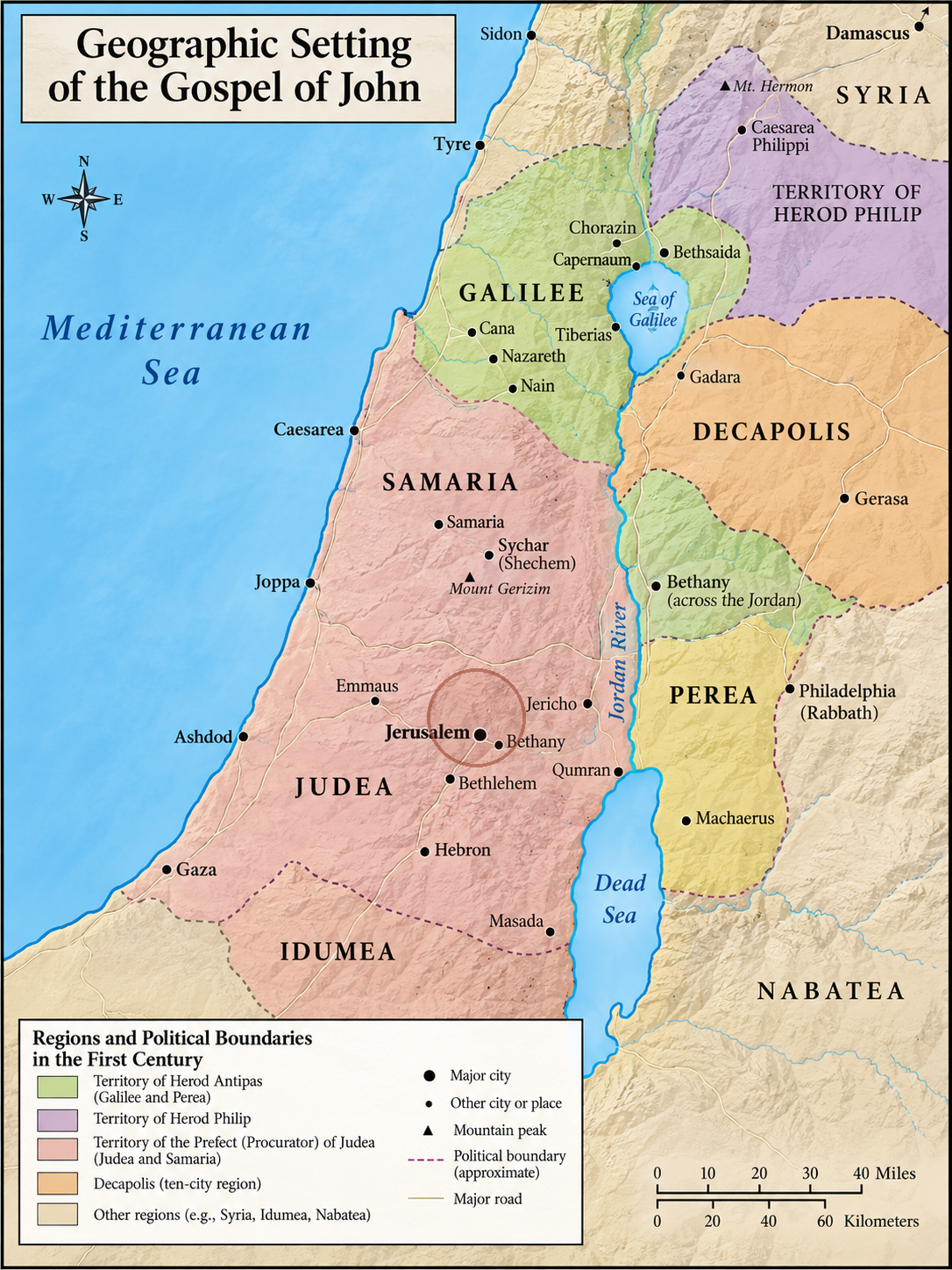
Regional location
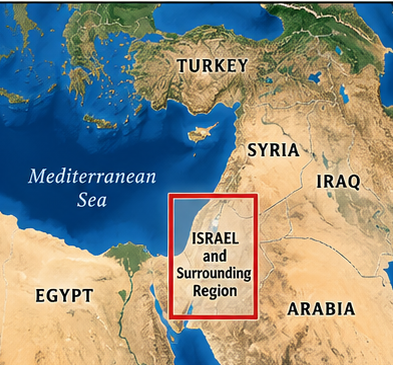
The outlined box locates the wider regional atlas.
Places in John 19
Praetorium / Pavement (19:13): The judgment-seat area is called Gabbatha, but the ancient building remains disputed.
Golgotha (19:17–20): The Place of a Skull. John places it near the city, not at a supplied modern coordinate.
Garden and new tomb (19:41–42): John says the tomb stood near the crucifixion site, but does not fix its exact location.
Traditional Holy Sepulchre area: A longstanding traditional identification and valuable historical reference, not a Scripture-certified coordinate.
Map caution: The old city walls and actual route of the condemned Jesus are not reconstructed with surveyed precision.
Jerusalem: Golgotha and the Nearby Garden Tomb
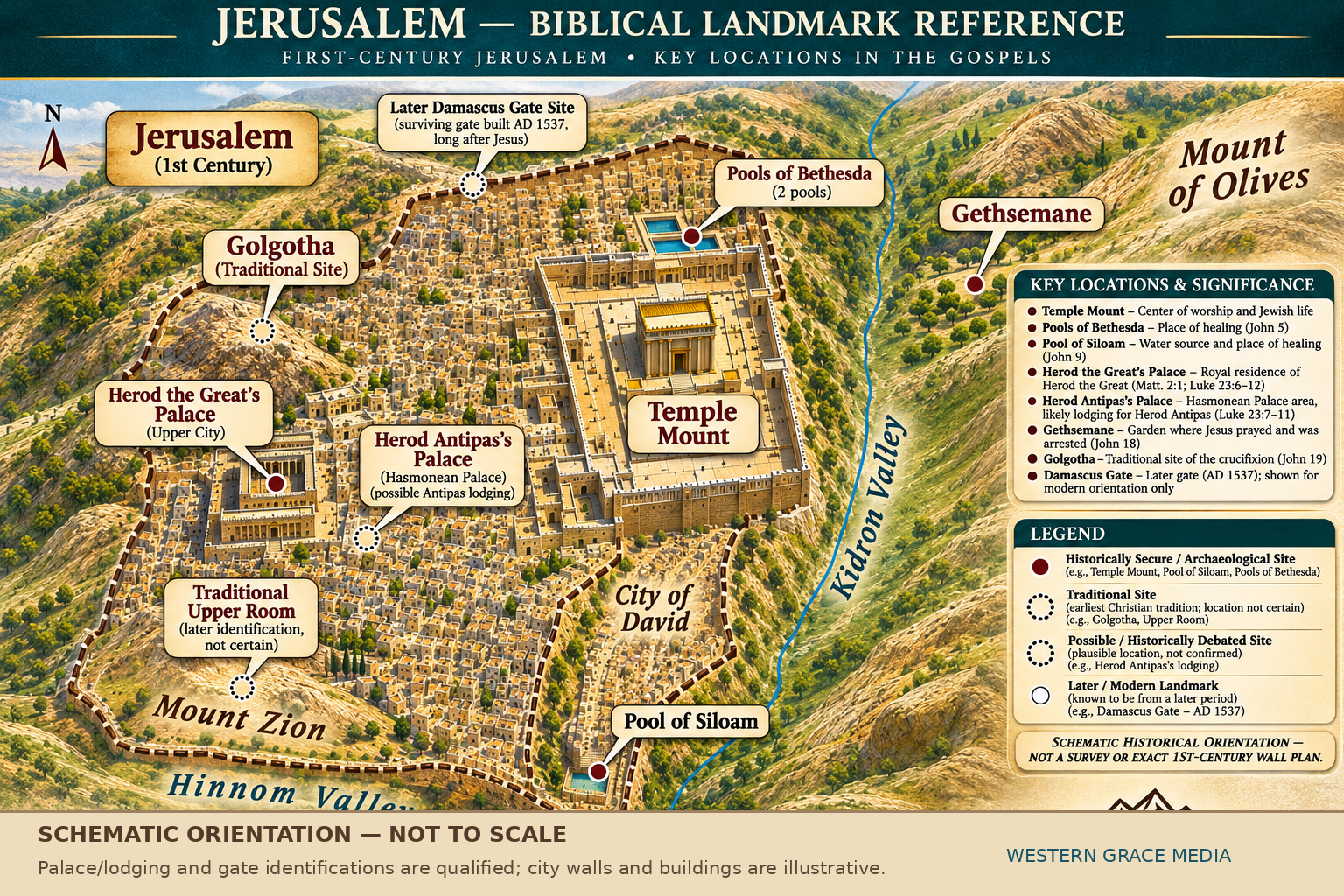
Shared WGM landmark atlas. John 19 describes a garden tomb near the cross; the exact tomb location is not established. The traditional Golgotha and proposed Praetorium sites are labeled accordingly.
Quick Study
When Jesus therefore had received the vinegar, he said, “It is finished!” Then he bowed his head and gave up his spirit. John 19:30, WEB
Jesus is mocked and condemned despite Pilate’s testimony to His innocence. At Golgotha, Scripture is fulfilled as He cares for His mother, announces “It is finished,” and truly dies. Joseph and Nicodemus bury Him in a new garden tomb close to the cross. His saving work prepares for the resurrection.
The Chapter’s Major Movements
The King Mocked (19:1–5)
Jesus is flogged, crowned with thorns, mocked, and declared innocent by Pilate.
Power from Above (19:6–11)
Under pressure to condemn Jesus, Pilate hears that his authority is not ultimate.
The Judgment Seat (19:12–16)
Fear of Caesar’s displeasure prevails over justice; Jesus is delivered to be crucified.
The Cross at Golgotha (19:17–22)
The King is crucified near the city, with His title displayed in three languages.
Scripture Fulfilled (19:23–24)
Soldiers divide garments and cast lots in fulfillment of Psalm 22.
Love from the Cross (19:25–27)
Jesus cares for His mother and entrusts her to the beloved disciple.
It Is Finished (19:28–30)
Jesus completes His mission, truly suffers, and gives up His spirit.
Witness to His Death (19:31–37)
Unbroken bones, a pierced side, and eyewitness testimony confirm the reality of His death.
The Burial (19:38–42)
Joseph and Nicodemus bury Jesus in a new garden tomb near the place of crucifixion.
Quick Study Flow
Historical and Interpretive Notes
Innocent King: Pilate repeatedly says he finds no basis for a charge yet sentences Jesus to die.
Authority and responsibility: Jesus says Pilate’s power was granted from above, while still speaking about human guilt.
Gabbatha: The Pavement or judgment seat is named, but its exact archaeological location is disputed.
Hours and Passover: The WEB notes different possible timekeeping systems for John 19:14. Do not turn a debated chronology into a settled claim.
Golgotha and garden: John places the execution near the city and a new tomb close by. The Holy Sepulchre identifies a traditional site.
Scripture fulfilled: John cites Psalm 22:18 and passages about unbroken bones and a pierced one.
“It is finished”: Jesus declares the completion of His appointed saving work, not a defeat.
Witness: John emphasizes the reality of Jesus’ death and testimony offered so readers may believe.
Responsibility: Particular religious leaders and Roman officials are involved; do not assign collective blame to all Jewish people.
Important Bible Words
| Word / Phrase | Simple Meaning | Why It Matters |
|---|---|---|
| Flogging | Roman corporal punishment | Jesus endures real suffering despite being innocent. |
| Crown of thorns | Mock crown made from thorny branches | The soldiers ridicule His kingship. |
| Son of God | Title tied to Jesus’ unique relation to the Father | The charge reveals conflict over His identity. |
| Praetorium | Roman governor’s headquarters | The precise Jerusalem location remains disputed. |
| Gabbatha | Name of the Pavement or judgment-place | John gives its name, not coordinates for a map. |
| Golgotha | Place of a Skull; location of the cross | A traditional site is known; John specifies “near the city.” |
| King of the Jews | Title displayed above the cross | The mocked King is truly the saving Messiah. |
| Scripture fulfilled | God’s Word brought to pass | Events at the cross echo Psalms and prophecy. |
| Preparation Day | Day of preparation before Sabbath observance | Explains the urgency surrounding burial. |
| Garden tomb | New tomb close to the execution site | Jesus is truly buried before the resurrection account. |
Translation Word Notes
Capitalized syllables show approximate classroom-style Biblical Greek stress. All full Scripture quotations remain WEB; the NKJV, NIV, and NLT columns offer short translation comparisons, not complete quotations.
| Verse | Greek / Pronunciation | NKJV | NIV | NLT | Meaning |
|---|---|---|---|---|---|
| 19:1 | mastigoōmahs-tee-GOH-oh | scourged | flogged | flogged | Jesus receives severe Roman punishment. |
| 19:2 | akanthaah-KAN-thah | thorns | thorns | thorns | The mock crown dishonors the King. |
| 19:7 | huios theouHOO-ee-os theh-OO | Son of God | Son of God | Son of God | The identity at issue before Pilate. |
| 19:11 | exousiaehk-soo-SEE-ah | power | power | power | Authority delegated from above. |
| 19:13 | lithostrōtoslee-thoh-STROH-tos | Pavement | Stone Pavement | stone pavement | A named judgment setting, not a certain excavation site. |
| 19:17 | kranionKRAH-nee-on | Skull | Skull | Skull | Name meaning the place of a skull. |
| 19:17 | staurosSTOW-ros | cross | cross | cross | The instrument of Roman crucifixion. |
| 19:19 | titlosTEET-los | title | notice | sign | The public written charge over the cross. |
| 19:23 | chitōnkhee-TOHN | tunic | undergarment | robe | Jesus’ seamless garment. |
| 19:28 | dipsōdeep-SOH | I thirst | I am thirsty | I am thirsty | Jesus speaks from real physical suffering. |
| 19:30 | tetelestaiteh-TEH-les-tie | It is finished | It is finished | It is finished | The mission is brought to completion. |
| 19:41 | mnēmeionmnay-MAY-on | tomb | tomb | tomb | A newly unused burial place near Golgotha. |
The Gospel Connection
John 19 shows Jesus, the Son sent by the Father, rejected, mocked, and crucified as the innocent King. Though human authorities act unjustly, God’s promise and purpose stand. Scripture is fulfilled as Jesus suffers, and His final declaration “It is finished” announces that His appointed work is complete. He truly dies and is reverently buried. The cross is not an unfortunate interruption of His mission: it is the place where the Shepherd lays down His life for the sheep (John 10:11, 18). Jesus is the Lamb of God who takes away the sin of the world (John 1:29). Salvation is God’s gift to sinners who trust in Christ, not a reward earned by their works. The resurrection of John 20 will vindicate the crucified Lord.
Reflection
Am I resting in the finished work of Christ, and showing gratitude through obedient love?
A Short Prayer from John 19
Lord Jesus, thank You for enduring shame and the cross as the innocent King. Teach me to stand for truth, care for others, and rely on Your finished work rather than trying to earn Your favor. Amen.
One Truth to Carry With You
The innocent King finished His saving work on the cross; His real death, faithful witness, and burial prepare the way for the hope of the resurrection.
Ready to Go Deeper?
SOAP means Scripture, Observation, Application, Prayer. Read the complete passage before considering the explanation. Scripture remains our final authority.
Read the entire WEB passage in context.
Notice Jesus’ innocence, fulfilled Scripture, caring love, real death, and the burial that prepares for His resurrection.
Respond personally with faith, obedience, gratitude, repentance, or confidence in Christ.
Pray in response to the truth of the passage, not to imagined details.
The Mocked King
What does this passage show about Jesus, the meaning of His cross, and faithful response?
Pilate orders Jesus flogged. Soldiers crown Him with thorns and dress Him in purple to mock His kingship; their cruelty exposes human sin, not a weakness in Jesus’ royal identity.
Pilate again declares that he finds no basis for a charge. John repeatedly contrasts the innocence of Jesus with the brutality and expediency of those judging Him.
The cry “Behold, the man!” invites the reader to see the suffering Messiah. Read this in light of Isaiah 53 and the King presented across John’s Gospel.
Where do I treat Jesus’ kingship as a religious idea rather than surrendering to Him as Lord?
Lord Jesus, forgive my pride and indifference. Give me eyes to see the righteous King who endured humiliation for sinners.
Authority from Above
What does this passage show about Jesus, the meaning of His cross, and faithful response?
The chief priests and officers demand crucifixion. Pilate insists he finds no charge, yet refuses to act consistently with that conclusion.
When Pilate claims the power to release or crucify Jesus, Jesus answers that any authority he holds is granted from above. God remains sovereign even as human officials remain morally responsible.
Jesus speaks of “greater sin,” not the absence of sin in Pilate. The passage does not authorize blaming all Jewish people; John names particular leaders and a Roman governor.
How can I respect rightful authority while remembering that every ruler is accountable to God?
Father, give me humility before Your sovereignty and courage to reject injustice without hatred.
The Judgment Seat and the Compromised Verdict
What does this passage show about Jesus, the meaning of His cross, and faithful response?
The accusation shifts toward political loyalty to Caesar. Pilate yields to pressure despite his earlier claims of Jesus’ innocence.
The Pavement (Gabbatha) names the place of the judgment seat, but its precise first-century Jerusalem location is debated; no map can settle the dispute.
“Behold, your King!” is deeply ironic. John exposes the collision between the true King and political convenience; Jesus goes to the cross in fulfillment of His mission.
Where am I tempted to compromise what is right because of social or professional pressure?
God of truth, help me refuse easy compromises and follow the King even when faithfulness costs me.
Golgotha and the King’s Title
What does this passage show about Jesus, the meaning of His cross, and faithful response?
Jesus bears the cross to the Place of a Skull, called Golgotha. John says this was near the city; he does not give precise coordinates.
Jesus is crucified between two others. The written notice names Him “JESUS OF NAZARETH, THE KING OF THE JEWS” in three languages, communicating the royal claim publicly.
The chief priests object to Pilate’s wording, but the written title remains. The irony is that the rejected King is indeed accomplishing God’s saving purpose.
How does the public title over the cross challenge my understanding of the kind of King Jesus is?
Crucified King, thank You for bearing shame. Teach me to confess You openly and trust Your victory through the cross.
Garments and Scripture Fulfilled
What does this passage show about Jesus, the meaning of His cross, and faithful response?
The soldiers divide Jesus’ garments and cast lots over His seamless tunic. John cites the words of Psalm 22:18, drawing attention to Scripture fulfilled amid His suffering.
The soldiers’ action shows a callous indifference to a dying man. Their conduct is evil even though God’s saving plan is being accomplished.
Fulfillment does not mean the soldiers were innocent or forced to act; John highlights the reliability of God’s Word without excusing human wrongdoing.
How does seeing Scripture fulfilled strengthen my confidence that God is faithful even in painful events?
Faithful Lord, anchor me in Your Word and make me attentive to those who suffer.
Care for His Mother at the Cross
What does this passage show about Jesus, the meaning of His cross, and faithful response?
Mary and other women stand near the cross with the disciple Jesus loved. John highlights their faithful presence as the suffering unfolds.
Jesus entrusts His mother to the beloved disciple. Even while dying, He provides personal, practical care.
This scene calls believers to honor family and to love one another concretely. It does not identify the beloved disciple by name in the verse or establish a general doctrine from the exchange alone.
Who needs faithful, practical care from me rather than only kind words?
Jesus, shape my love into steady service. Help me care for family and fellow believers well.
It Is Finished
What does this passage show about Jesus, the meaning of His cross, and faithful response?
Jesus says He is thirsty as Scripture is fulfilled. The physical suffering is real; He did not merely seem to suffer or die.
“It is finished” is a declaration of completed work, not a cry that God’s plan failed. In John’s Gospel, Jesus has carried out the mission given by the Father.
He bows His head and gives up His spirit. The next chapter will proclaim His resurrection; John 19 first demands that we face the reality and significance of His death.
What does Jesus’ finished work change about my attempts to earn acceptance with God?
Savior, thank You that Your saving work is sufficient. Lead me away from self-reliance and into trust in You.
The Death of Jesus Is Confirmed
What does this passage show about Jesus, the meaning of His cross, and faithful response?
The leaders request that the bodies be removed before the special Sabbath. The soldiers break the legs of the others, but find Jesus already dead.
Jesus’ legs are not broken, and His side is pierced with a spear. John carefully distinguishes what the soldiers did from any speculation about the physical meaning of blood and water.
The cross was a real execution and Jesus truly died. The eyewitness testimony in the next verse matters because the Christian gospel is grounded in events, not merely symbols.
Why does the historical reality of Jesus’ death matter for my faith and hope?
Lord, thank You that You entered real human suffering and death for our salvation.
Eyewitness and the Scriptures
What does this passage show about Jesus, the meaning of His cross, and faithful response?
The writer emphasizes truthful eyewitness testimony “that you may believe.” The account is offered as reliable witness to Jesus’ death.
John connects the unbroken bones and pierced body to Scripture, echoing the Passover lamb and the prophetic hope of seeing the pierced one.
The details are not offered for sensational speculation. They point to the identity and saving mission of Jesus Christ.
How does eyewitness testimony and Scripture together encourage my trust in Christ?
Father, deepen my confidence in Your Word and in the Savior to whom it points.
Joseph and Nicodemus Honor Jesus
What does this passage show about Jesus, the meaning of His cross, and faithful response?
Joseph requests Jesus’ body from Pilate; Nicodemus, who earlier came to Jesus at night, brings a costly mixture of burial spices.
Their actions are concrete and reverent. John does not claim to read every motive in their hearts, but records public steps of care for Jesus’ body.
The linen and spices reflect burial customs, not an attempt to pretend that Jesus had not died.
How can I honor Jesus in actions that others can see, even when I feel fearful?
Lord Jesus, move me from hidden admiration to faithful action marked by love and courage.
A Garden Tomb Nearby
What does this passage show about Jesus, the meaning of His cross, and faithful response?
John says that near the crucifixion place there was a garden with a new tomb. The nearby tomb was used because it was the Preparation Day.
The Church of the Holy Sepulchre marks a longstanding traditional identification of Golgotha and the tomb. It is historically significant but not a precise coordinate supplied by John 19.
The chapter closes with Jesus buried. The burial prepares for John 20, where an empty tomb and the risen Lord will be proclaimed.
How does the deliberate burial of Jesus prepare my heart to receive the hope of His resurrection?
Father, thank You that the story did not end at the grave. Help me trust Your promises while I wait for their fulfillment.
Hard Questions
Why did Pilate flog Jesus after saying He was innocent?
John presents Pilate as yielding to political pressure while repeatedly asserting that he finds no basis for a charge. His misconduct is not excused by the saving purpose God fulfills through the cross.
Does the crown of thorns mean Jesus was not truly King?
No. The soldiers intend mockery, but the irony is that Jesus really is King. His authority is not canceled by humiliation or suffering.
Is God responsible for Pilate’s sin because his power was “from above”?
Jesus teaches that Pilate’s authority is subordinate to God, while still referring to real human sin and differing guilt. Divine sovereignty does not turn injustice into righteousness.
Where was the Pavement or Praetorium?
The exact place is disputed. Herod’s western palace and the Antonia area are proposals. The shared map identifies broad historical landmarks but does not claim a verified judgment-room location.
Was the crucifixion at 6 a.m. or noon?
John 19:14 says “about the sixth hour”; his WEB footnote notes different possible timekeeping conventions. Comparisons with Mark’s hour notices require care; we should not claim a proven harmonization or alter the published WEB wording.
Why did John call Golgotha “near the city”?
John 19:20 says the crucifixion site was near Jerusalem. The traditional Holy Sepulchre identification is significant and has archaeological support for an ancient burial area, but the Gospel does not give a surveyed modern position.
What does the inscription “King of the Jews” teach?
Pilate publicly names Jesus a King even while ordering His execution. John emphasizes the irony of human rejection of the true Messiah. The sign’s three languages underline that the claim was broadly readable.
Does Psalm 22:18 mean the soldiers had no responsibility?
No. John says their act fulfills Scripture while still depicting their disregard for the dying Jesus. God’s faithfulness and human moral accountability are both real.
Why did Jesus entrust Mary to the beloved disciple?
Jesus shows personal love and practical responsibility for His mother while facing death. The passage calls us to tangible care, without requiring us to invent private conversations or build an unsupported doctrine.
Does “It is finished” mean all Christians never struggle with sin?
No. Jesus’ saving mission is completed through His death, not through a promise that believers instantly stop struggling. Christians live by His grace, trusting His finished work and growing in holiness.
What do the blood and water prove?
John reports blood and water after Jesus’ side is pierced and emphasizes eyewitness testimony. This strongly supports that He truly died; the text does not specify a medical diagnosis or invite us to impose one.
Who is to blame for Jesus’ death?
John names particular priestly leaders, Roman soldiers, and the governor. Jesus and His earliest followers were Jewish. It is wrong to assign collective guilt to all Jewish people. Biblically, the cross also confronts the sin of all humanity and displays God’s saving love.
How does the innocent King’s suffering change the way I think about power, success, and sacrifice?
Where do I yield to fear of people instead of obeying the truth?
What does “It is finished” mean for my trust in God’s grace rather than my own effort?
How can I reflect Christ’s love through practical care and public faithfulness?
A Prayer of Gratitude for the Cross
Holy Father, I praise You for Your faithful love in sending Your Son. Lord Jesus, You endured mockery, injustice, real suffering, and death, yet never abandoned Your saving mission. Forgive my pride, my fear of people, and every effort to justify myself before You. Thank You that You said, “It is finished.” Help me receive Your grace with humble faith, recognize the cost of my sin, and honor Your cross without assigning blame to whole peoples or inventing details Scripture does not tell. Teach me to care for others as You cared for Your mother, to trust Your Word as John trusted eyewitness testimony, and to hope in the resurrection that follows the tomb. Make my life a grateful witness to Your love. In Jesus’ name, amen.
The innocent King finished His saving work on the cross; His real death, faithful witness, and burial prepare the way for the hope of the resurrection.