John 20
He Is Risen
The crucified Lord is risen. He comes to Mary, gives peace to His disciples, and calls Thomas to believe.
Scripture quotations: World English Bible Classic (WEB)

John 20 — Geographic Setting
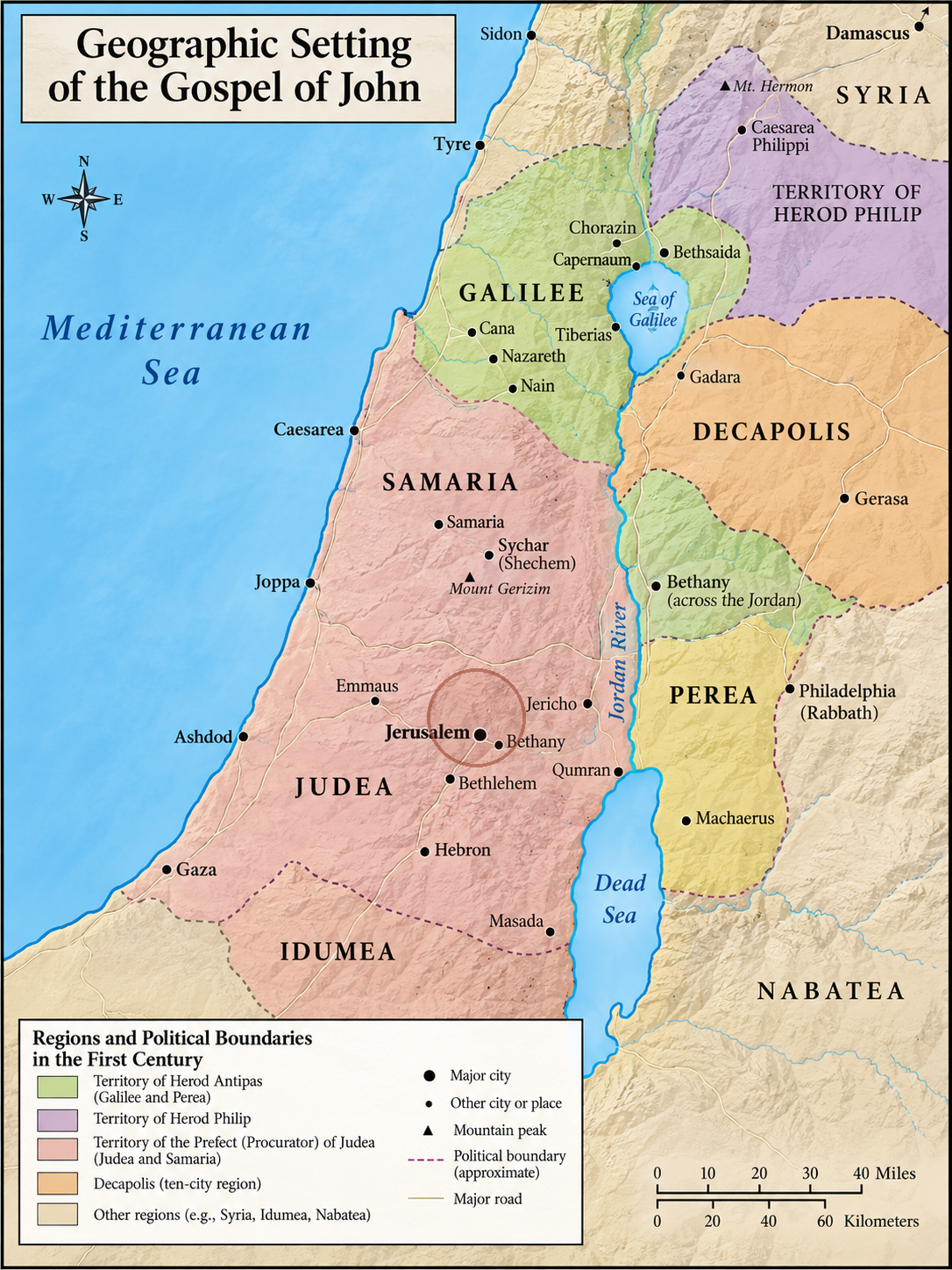
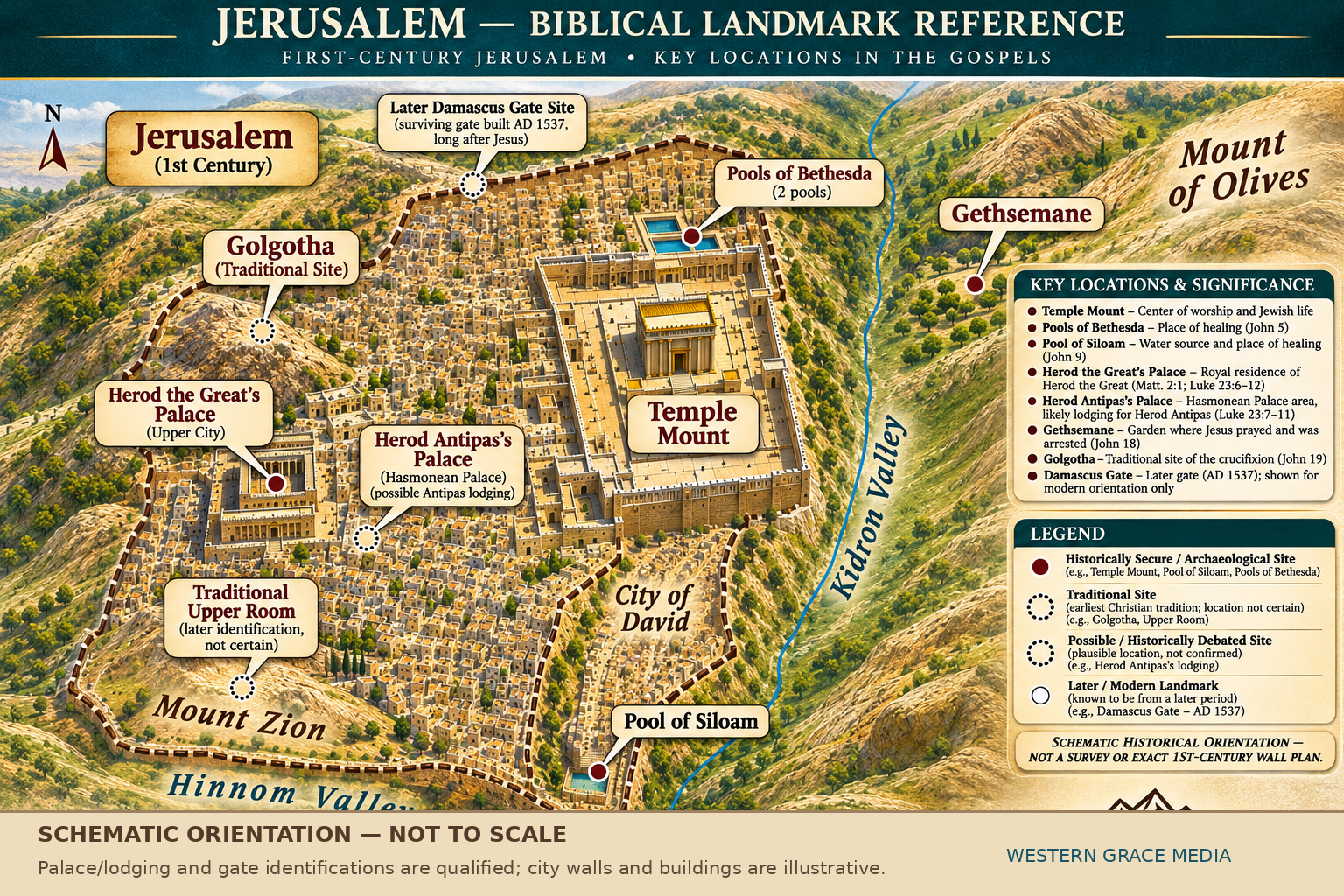
John 20 begins at the garden tomb near Jerusalem and later records appearances to disciples behind closed doors. The shaded atlas provides context; the historical landmark map shows the traditional Golgotha area without identifying a verified tomb or gathering-room coordinate.
Regional location

The outlined box locates the wider regional atlas.
Places in John 20
Garden tomb (20:1–18): John 19:41–42 places a new tomb in a garden near the cross. No exact modern coordinates are given.
Jerusalem: The city that provides historical orientation for the death, burial, and resurrection accounts.
Golgotha: Traditional identification near Jerusalem, not a point surveyed by the Gospel.
Disciples’ gathering (20:19, 26): John reports locked doors without identifying the house.
Map caution: This does not reconstruct Mary’s path, the garden boundary, or the exact tomb entrance.
Jerusalem: The Garden Tomb and the Risen Lord
Shared Jerusalem landmark master. John 20 does not give a verified tomb coordinate or exact location for the disciples’ locked gathering room.
Quick Study
but these are written that you may believe that Jesus is the Christ, the Son of God, and that believing you may have life in his name. John 20:31, WEB
The empty tomb leads to encounters with the living Lord. Jesus knows Mary, brings peace to frightened disciples, sends His followers as witnesses, and answers Thomas’s struggle with faith. John states the purpose of his testimony: that readers may believe Jesus is the Christ, the Son of God, and have life in His name.
The Chapter’s Major Movements
The Empty Tomb (20:1–2)
Mary Magdalene discovers the stone rolled away and calls the disciples.
The Disciples Investigate (20:3–10)
Peter and the beloved disciple see the empty tomb and linen cloths.
Mary Meets the Risen Jesus (20:11–18)
Jesus speaks Mary’s name and sends her with news of His resurrection.
Peace to the Disciples (20:19–20)
The risen Jesus appears among frightened disciples and shows His wounds.
Sent and Empowered (20:21–23)
Jesus commissions His followers and speaks of the Holy Spirit and forgiveness.
Thomas’s Honest Struggle (20:24–25)
Thomas doubts the other disciples’ report and asks for evidence.
Thomas Confesses Jesus (20:26–29)
Jesus meets Thomas, who calls Him “My Lord and my God!”
John’s Purpose (20:30–31)
John records these signs so readers may believe and have life in Jesus’ name.
Quick Study Flow
Historical and Interpretive Notes
Resurrection: Jesus who died is bodily alive. John connects His wounds and His living presence.
Empty tomb: Mary and the disciples investigate what they can see; the following encounters identify the risen Lord.
Scripture understood: John 20:8–9 distinguishes what was believed at the tomb from understanding the full scriptural necessity of resurrection.
Mary’s witness: Jesus calls her by name and sends her to tell the disciples. Scripture does not say why she initially failed to recognize Him.
Traditional tomb location: Historic Christian tradition identifies a site near Golgotha, but John gives no modern coordinate.
Peace and mission: Jesus offers peace to the frightened disciples and sends them as His witnesses.
Forgiveness (20:23): The church announces forgiveness through Christ, not personal authority to change God’s verdict by preference.
Thomas: He moves from resistance to confessing Jesus as Lord and God.
John’s purpose: The Gospel is selective eyewitness testimony, written so readers may believe and have life in His name.
Important Bible Words
| Word / Phrase | Simple Meaning | Why It Matters |
|---|---|---|
| Resurrection | Jesus truly raised from the dead | The risen Jesus is the same person who was crucified. |
| Empty tomb | Burial place without Jesus’ body | A real setting that leads toward encounters with the risen Lord. |
| First day of the week | The day after the Sabbath | The resurrection appearances begin on this day. |
| Beloved disciple | The disciple described as loved by Jesus | An eyewitness participant in the tomb account. |
| Rabboni | Aramaic address meaning Teacher / Master | Mary recognizes the risen Jesus. |
| Ascend | Go to the Father | Jesus’ resurrection leads into His continuing exalted mission. |
| Peace | Reconciliation and wholeness | The risen Lord reassures fearful disciples. |
| Holy Spirit | God’s Spirit promised by Jesus | He equips disciples for faithful witness. |
| Forgiveness | Release or remission of sins | The gospel announces real pardon through Christ. |
| Signs | Jesus’ deeds that reveal His identity | John selects these acts so that readers will believe. |
Translation Word Notes
Capitalized syllables show approximate classroom-style Biblical Greek stress. All full Scripture quotations remain WEB; the NKJV, NIV, and NLT columns offer short translation comparisons, not complete quotations.
| Verse | Greek / Pronunciation | NKJV | NIV | NLT | Meaning |
|---|---|---|---|---|---|
| 20:1 | mnēmeionmnay-MAY-on | tomb | tomb | tomb | A burial site; its precise modern location is not specified. |
| 20:5 | othoniaoh-THOH-nee-ah | linen cloths | strips of linen | linen wrappings | Cloth left in the tomb when Jesus had risen. |
| 20:8 | pisteuōpis-TEW-oh | believed | believed | believed | Trust in what was seen, developing toward fuller understanding. |
| 20:12 | angelosANG-geh-loss | angels | angels | angels | Messengers seen by Mary at the empty tomb. |
| 20:16 | Rabbounirah-boo-NEE | Rabboni | Rabboni | Rabboni | Aramaic address meaning Teacher, carried in Greek text. |
| 20:17 | haptomaiHAP-toh-my | cling | hold on | cling | The interaction concerns not holding Jesus back from His mission. |
| 20:19 | eirēnēay-RAY-nay | Peace | Peace | Peace | The risen Jesus gives assurance to the disciples. |
| 20:21 | apostellōah-poh-STEL-loh | send | send | send | The risen Christ commissions His followers. |
| 20:22 | pneumaPNEW-mah | Spirit | Spirit | Spirit | The Holy Spirit promised to Jesus’ followers. |
| 20:23 | aphiēmiah-FEE-ay-mee | forgive | forgive | forgive | Release from sins through the gospel of Christ. |
| 20:27 | apistosAH-pis-toss | unbelieving | doubting | faithless | Thomas is summoned away from unbelief into faith. |
| 20:28 | kyrios / theosKOO-ree-oss / THEH-oss | Lord / God | Lord / God | Lord / God | Thomas’s direct confession of Jesus’ divine identity. |
| 20:31 | zōēzoh-AY | life | life | life | The gift found by believing in Jesus’ name. |
The Gospel Connection
John 20 announces the victory of the risen Jesus over death. The Lord who died in John 19 is not merely remembered or honored: He is alive. His wounds identify Him with the crucified Savior, and His resurrection vindicates His identity and completed saving work. He gives peace, commissions faithful witness, and calls Thomas from unbelief to the confession “My Lord and my God!” The Gospel states its purpose plainly: these signs are written so we may believe that Jesus is the Christ, the Son of God, and have life in His name (20:30–31). Salvation is not earned by personal effort; it is received by faith in the crucified and risen Christ, whose grace produces a new life of obedient love.
Reflection
Am I trusting the risen Christ and responding to His peace with obedient faith?
A Short Prayer from John 20
Risen Lord Jesus, thank You for conquering death and giving Your people peace. Help me trust the witness of Your Word, bring my questions to You, and tell others that You are alive. Amen.
One Truth to Carry With You
The crucified Jesus is truly risen; His witnesses testify so that we may believe He is the Christ, the Son of God, and have life in His name.
Ready to Go Deeper?
SOAP means Scripture, Observation, Application, Prayer. Read the complete passage before considering the explanation. Scripture remains our final authority.
Read the entire WEB passage in context.
Notice the empty tomb, the physical appearances of Jesus, His words of peace, and the witness that invites belief.
Respond personally with faith, obedience, gratitude, repentance, or confidence in Christ.
Pray in response to the truth of the passage, not to imagined details.
The Stone Has Been Taken Away
What does this passage show about the risen Lord, faith, forgiveness, and faithful witness?
Mary comes before dawn to the tomb and sees the stone moved. Her immediate conclusion is that Jesus’ body has been taken; John does not portray her as anticipating the resurrection.
Mary reports the missing body to Peter and the beloved disciple. Her words “we don’t know” convey genuine confusion and urgency, not an already developed resurrection testimony.
The empty tomb is the beginning of the evidence, not a complete explanation by itself. John leads readers onward to testimony about the risen Jesus.
Where have I mistaken unanswered questions for proof that God has abandoned His promise?
Lord, meet me in confusion and lead me back to Your faithful Word.
The Linen Cloths and the Disciples
What does this passage show about the risen Lord, faith, forgiveness, and faithful witness?
Peter and the other disciple run to the tomb. John carefully reports who arrives, who enters, and the linen cloths and separate head cloth they observe.
The beloved disciple sees and believes, yet verse 9 adds that the disciples had not yet understood the Scripture concerning the necessity of Jesus’ rising. Do not assume his belief already contained every later insight.
The bodily resurrection is not presented as a vague symbol of hope. The details of an actual tomb and grave cloths prepare for personal encounters with the risen Lord.
Will I examine the testimony about Jesus carefully, rather than accepting either an easy dismissal or an unsupported embellishment?
God of truth, help me attend to what Scripture really says and follow its evidence with faith.
Mary Weeps Outside the Tomb
What does this passage show about the risen Lord, faith, forgiveness, and faithful witness?
While the disciples depart, Mary remains and weeps. Her sorrow is not condemned; John gives a compassionate picture of someone who loves Jesus and fears His body has been lost.
Two angels are present where His body had lain. Their question highlights Mary’s grief, yet the text does not suggest they reveal everything at this point.
The scene directs attention beyond an open tomb toward the person of the risen Christ. The hope of Christianity is Jesus Himself, not simply an unexplained absence.
How can I bring honest grief to God and remain attentive to what He reveals in His Word?
Compassionate Savior, help me bring my tears to You and receive Your hope.
The Risen Jesus Calls Mary by Name
What does this passage show about the risen Lord, faith, forgiveness, and faithful witness?
Mary sees Jesus but does not recognize Him until He calls her by name. The one she thought lost now speaks to her as the living Lord.
“Rabboni” is an Aramaic form of address explained in the WEB as “Teacher.” Jesus tells Mary not to cling to Him and sends her to announce His coming ascension; the issue is His new resurrection mission, not a claim that all touch is forbidden.
Mary faithfully announces “I have seen the Lord.” Her testimony is personal and concrete, though John does not give an exact modern coordinate for the garden tomb.
What would change in my daily life if I lived as one who belongs to the risen Jesus and has good news to tell?
Risen Lord, teach me to know Your voice through Scripture and speak truthfully of You.
Peace in a Locked Room
What does this passage show about the risen Lord, faith, forgiveness, and faithful witness?
The disciples gather behind locked doors in fear. In context, their fear concerns hostile authorities, not every Jewish person; the disciples themselves were Jewish.
Jesus stands among them and offers peace. He shows His hands and side, confirming continuity between the crucified Jesus and the risen Jesus.
Their gladness is rooted in seeing the Lord. The promise of peace does not erase every outside danger, but the risen Savior truly comes to His frightened people.
Where do I need to trust the risen Christ instead of allowing fear to rule my choices?
Jesus, speak Your peace into my anxious heart and strengthen my courage.
Sent by the Father; Empowered by the Spirit
What does this passage show about the risen Lord, faith, forgiveness, and faithful witness?
The risen Jesus sends the disciples as the Father sent Him. Their mission is rooted in His authority and must continue His truth, not replace it with their own message.
Jesus breathes on them and says “Receive the Holy Spirit.” Christians discuss the relationship between this moment and Pentecost in Acts 2. John’s emphasis is the risen Lord providing for their mission.
The language of forgiving and retaining sins must be read with the gospel: the church proclaims the forgiveness found in Christ and warns that rejecting Him leaves people in their sins. This does not mean any individual can forgive sins by personal whim.
How can I speak the gospel with humility, clarity, and dependence on the Holy Spirit?
Father, send me as a faithful witness. Holy Spirit, guide my words toward the truth of Christ.
Thomas Asks for Evidence
What does this passage show about the risen Lord, faith, forgiveness, and faithful witness?
Thomas was absent at the earlier appearance. Other disciples tell him they have seen the Lord, but he insists upon seeing and touching the crucifixion wounds.
His demand shows a struggle to trust their report. John does not mock sincere questions, but he does not present unbelief as the ideal response.
Jesus will meet Thomas with an invitation to believe. The testimony of trustworthy witnesses remains central for Christians who cannot physically see Jesus today.
When I have questions, do I bring them honestly to Scripture while remaining willing to believe its testimony?
Patient Lord, help my questions become a path toward deeper trust rather than hardened refusal.
My Lord and My God
What does this passage show about the risen Lord, faith, forgiveness, and faithful witness?
Jesus returns when Thomas is present, again offering peace. He directly addresses Thomas’s earlier demand and calls him to exchange unbelief for belief.
Thomas responds to Jesus with the unambiguous confession “My Lord and my God!” This is one of the Gospel’s clearest personal acknowledgments of Jesus’ deity.
Jesus blesses those who believe without having seen Him directly. Their faith is not groundless; it rests on the Spirit-preserved apostolic testimony John is giving.
Can I confess “My Lord and my God” not only with my lips but also with daily obedience?
Lord Jesus, I worship You as my Lord and my God. Grow in me faithful, obedient belief.
These Things Are Written So You May Believe
What does this passage show about the risen Lord, faith, forgiveness, and faithful witness?
John acknowledges that Jesus performed many more signs than the Gospel records. He has selected sufficient testimony with a clear purpose.
The purpose is that readers believe Jesus is the Christ, the Son of God. John does not present faith as a mere intellectual compliment; life is found in His name.
The Gospel invites people who never saw Jesus in person to trust the written witness. John 20 prepares us for the continued call to follow the risen Lord in John 21.
What is my response to John’s stated purpose—do I trust Jesus as the Christ and seek life in His name?
Father, thank You for giving this trustworthy witness. Help me believe in Your Son and live in His name.
Hard Questions
Does the empty tomb alone prove the resurrection?
John includes the empty tomb, linen cloths, Scripture, and eyewitness meetings with the risen Jesus. The empty tomb is important evidence, but the chapter builds a fuller testimony than an empty space by itself.
What did the beloved disciple believe in John 20:8?
Verse 8 says he saw and believed, while verse 9 says the disciples still lacked full understanding of the Scripture about resurrection. We should not claim he already understood every implication at this moment.
Why was Mary unable to recognize Jesus at first?
John reports that she did not know it was Jesus until He spoke her name. The passage does not explain the cause, so we should not invent details about His appearance.
Does “Don’t hold me” mean Jesus could not be touched?
No. John 20:17 fits the announcement that He is ascending to the Father and sending Mary as a witness. Jesus later invites Thomas to examine His wounds. The text does not support a rule that His risen body was untouchable.
Where exactly was Jesus’ tomb?
John 19:41–42 places a new tomb in a garden near the crucifixion site; John 20 reports the same tomb. The Church of the Holy Sepulchre is an ancient traditional identification, but John gives no surveyed coordinates.
How could Jesus appear when the doors were locked?
John states both that the doors were locked and that Jesus stood among the disciples. This highlights the reality and power of His resurrection. The text does not explain the physics, so we should not supply a speculative mechanism.
Were the disciples afraid of all Jewish people?
No. The disciples themselves were Jewish. In this setting their fear concerns possible hostility from specific authorities after Jesus’ execution. Scripture must never be used to assign blame collectively to Jewish people.
How does John 20:22 relate to Pentecost in Acts 2?
Evangelicals interpret the timing in different ways: as a symbolic anticipatory act, an initial bestowal, or an aspect of the same mission later publicly empowered at Pentecost. John emphasizes Jesus’ giving of the Spirit; Acts describes the outpouring at Pentecost. Neither passage should be ignored.
Can disciples forgive sins by personal authority in John 20:23?
Forgiveness belongs to God and comes through Christ. Jesus authorizes His witnesses to announce the gospel and its consequence: those who receive Christ have forgiveness; those who reject Him remain in sin. Christians differ on aspects of church practice, but the commission cannot mean forgiveness by arbitrary human preference.
Was Thomas wrong to ask for proof?
His reluctance is real, and Jesus corrects his unbelief. Yet Jesus graciously meets him and directs him to believe. Questions should lead us toward Scripture’s testimony rather than endless refusal.
Why is Thomas’s confession important?
“My Lord and my God!” is addressed to the risen Jesus. It supports John’s consistent teaching that Jesus is not merely a teacher but truly divine, as already expressed in John 1:1 and 1:14.
What does “believe” mean in John 20:31?
John records true signs so readers may trust Jesus as the promised Christ and Son of God and receive life in His name. Genuine faith is personal reliance upon Him, not merely agreement that He is historically interesting.
Where do I need the risen Jesus to replace fear with peace?
How does Mary’s truthful witness challenge me to share what Scripture says about Jesus?
Do I follow Jesus as “my Lord and my God,” including when I have hard questions?
Whom can I tell about the life found in Jesus’ name?
A Prayer of Gratitude for the Risen Lord
Holy Father, thank You that the cross was not the end. You raised Your Son, and through Him You offer forgiveness, peace, and everlasting life. Lord Jesus, You knew Mary’s grief and called her by name. You came to frightened disciples and spoke peace. You met Thomas in his weakness and called him to believe. Forgive my unbelief, my fear, and my reluctance to speak about You. Holy Spirit, lead me into the truth of the apostolic witness and make my words faithful to Scripture. Help me confess with Thomas, “My Lord and my God!” Let my confidence rest not in imagined details but in the testimony You have given, that Jesus is the Christ, the Son of God, and that believing I may have life in His name. Amen.
The crucified Jesus is truly risen; His witnesses testify so that we may believe He is the Christ, the Son of God, and have life in His name.