John 21
Follow Me
The risen Jesus provides for His disciples, restores Peter, and calls him to care for His sheep and follow Him.
Scripture quotations: World English Bible Classic (WEB)

John 21 — Geographic Setting
John 21 places the risen Jesus beside the Sea of Tiberias (Sea of Galilee). The atlas gives the first-century political and geographic context. The close-up below uses the same WGM relief shading; the exact fishing shore is not supplied by Scripture.
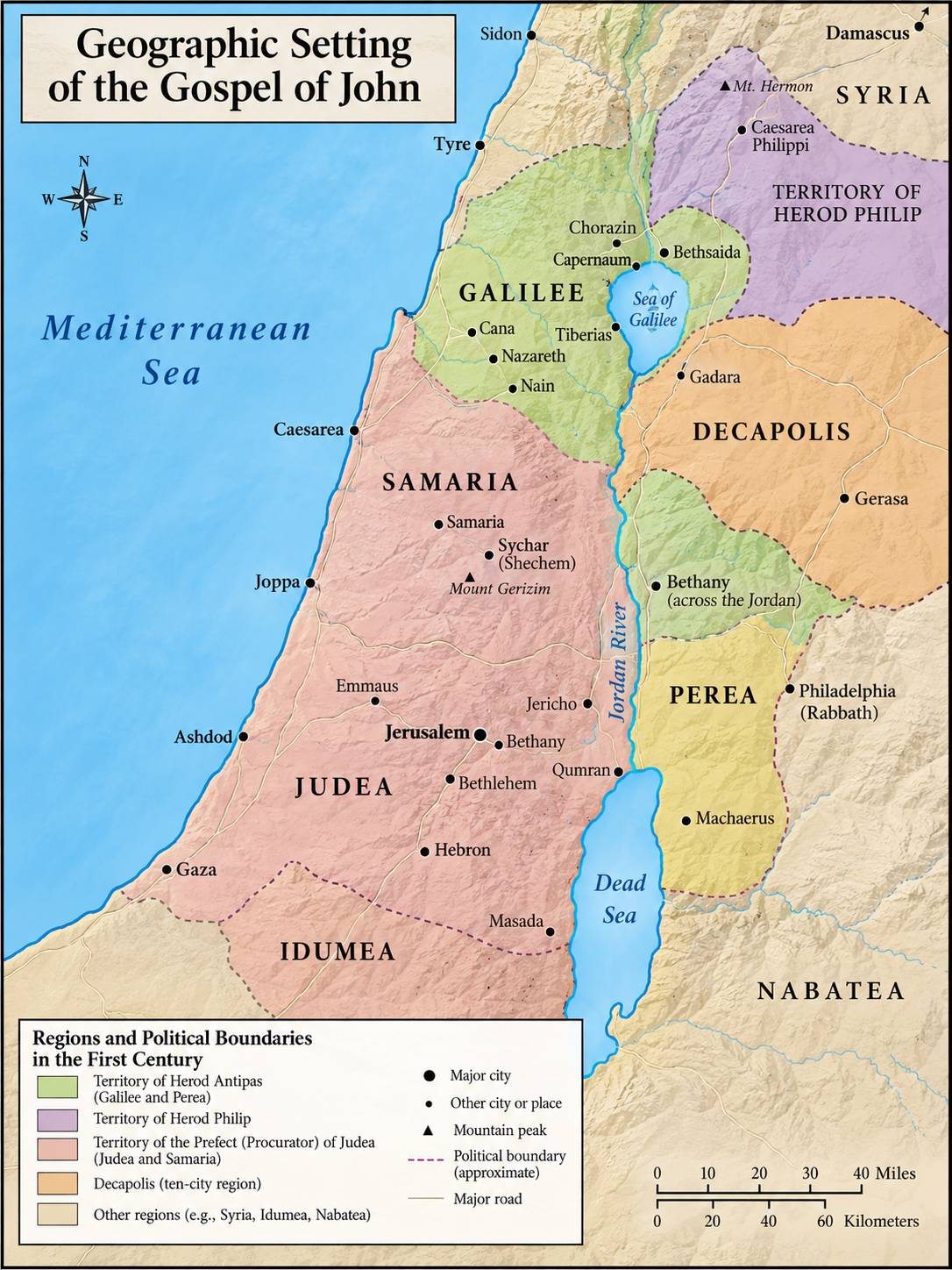
Regional location

The outlined box indicates the coverage of the regional atlas.
Places in John 21
Sea of Tiberias / Galilee (21:1): The same freshwater lake, in the northern region.
Cana (21:2): Nathanael is from Cana; John does not locate the catch there.
Capernaum / Tiberias: Nearby places for wider Bible-geography context, not confirmed event sites in this chapter.
Fishing and breakfast (21:3–14): No precise shoreline or boat route is identified.
Political regions: Boundaries and rulers are approximate for the first century.
Sea of Galilee — The Risen Lord at the Shore
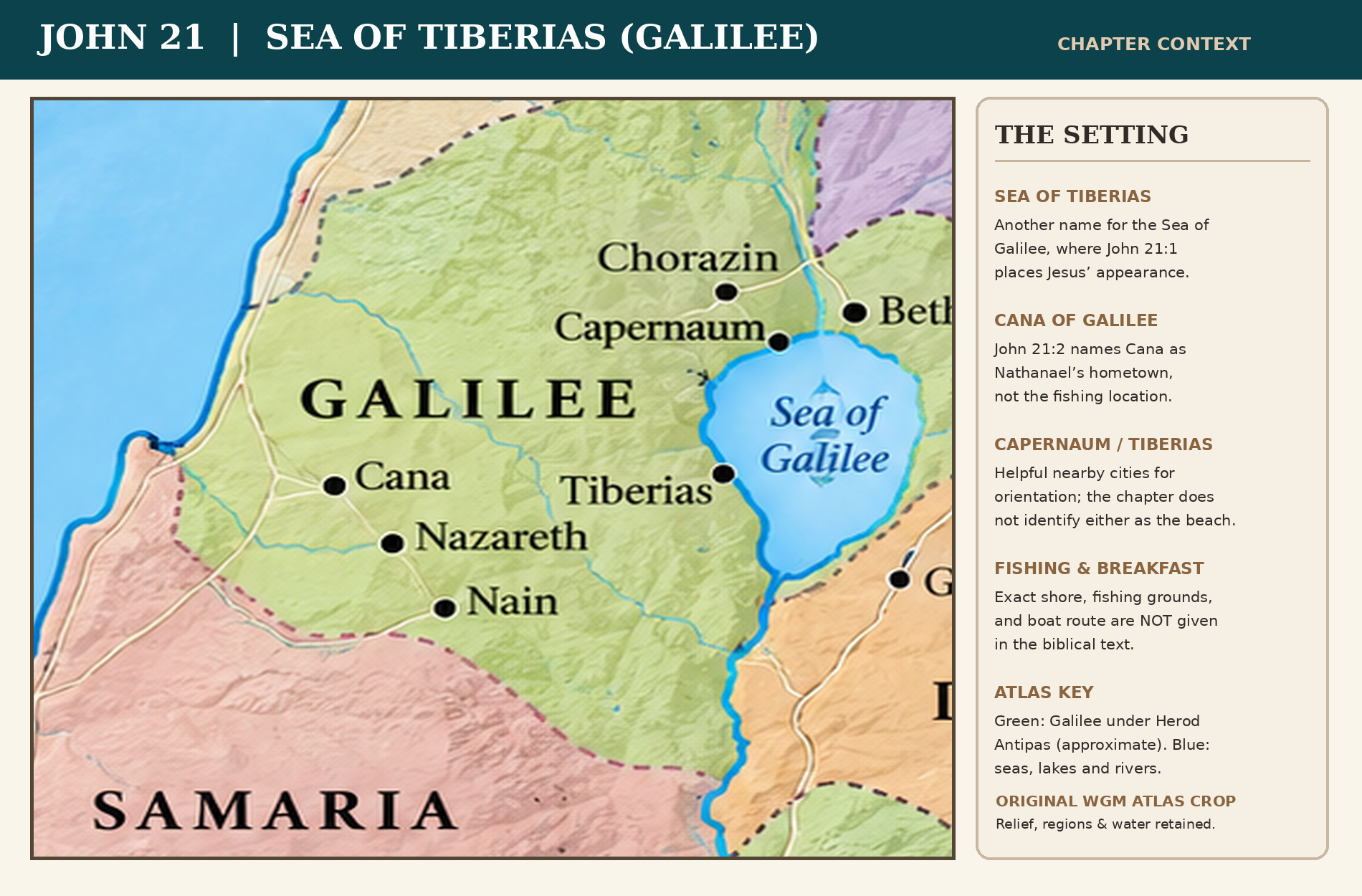
The geographic close-up uses the same WGM original atlas relief shading. Exact boat course, fishing site, and breakfast beach are unknown.
Quick Study
Jesus said to him, “If I desire that he stay until I come, what is that to you? You follow me.” John 21:22, WEB
John 21 completes the Gospel with the living Lord again revealing Himself. He speaks into the disciples’ failed fishing, provides a meal, and entrusts Peter with the care of His flock. Jesus then calls Peter to follow without comparing his calling to another disciple’s, and the Gospel closes by affirming its trustworthy testimony.
The Chapter’s Major Movements
The Sea of Tiberias (21:1–3)
Seven disciples fish through the night but catch nothing.
Jesus on the Shore (21:4–6)
The risen Jesus speaks; obedient casting brings a remarkable catch.
It Is the Lord (21:7–11)
Recognition, Peter’s eager response, and the full net.
Breakfast with Jesus (21:12–14)
The risen Lord graciously shares a real meal with His disciples.
Peter Restored and Commissioned (21:15–17)
Three questions of love are answered by the charge to feed Christ’s sheep.
Follow Me (21:18–19)
Jesus calls Peter to faithful discipleship even through suffering.
Do Not Compare Callings (21:20–23)
Jesus corrects speculation about the beloved disciple’s future.
The Witness Is True (21:24–25)
John closes with the reliability and selectivity of Gospel testimony.
Quick Study Flow
Historical and Interpretive Notes
Two names for one lake: Sea of Tiberias and Sea of Galilee name the same body of water.
Disciples fishing: John reports their work and empty nets without assigning motives or moral failure.
The risen Lord: Jesus appears beside the shore, gives an authoritative command, and eats with the disciples.
153 fish: The count is reported without a secret numerical meaning in the text.
Peter restored: Jesus’ three questions recall Peter’s denial, and his love for Christ is expressed in service to Christ’s flock.
Greek for love: agapaō and phileō are both used, but their difference should not be exaggerated into a fixed hierarchy.
Peter’s future: John explains that Jesus foretells a death that will glorify God; exact later historical details remain outside the chapter.
The beloved disciple: Jesus corrects a rumor that he would never die.
Final testimony: The Gospel closes by affirming the trustworthiness of the witness and the abundance of Jesus’ works.
Important Bible Words
| Word / Phrase | Simple Meaning | Why It Matters |
|---|---|---|
| Sea of Tiberias | Another name for the Sea of Galilee | The setting of the chapter’s first appearance. |
| Revealed Himself | Made Himself known | The risen Jesus initiates His appearance to the disciples. |
| Charcoal fire | A fire for cooking / warming | Recalls Peter’s earlier denial by a charcoal fire (18:18). |
| Lambs and sheep | Jesus’ people | Those entrusted to Peter’s pastoral care still belong to Christ. |
| Feed and tend | Nourish, guide, care for | Pastoral leadership expresses love through service. |
| Glorify God | Honor God with one’s life and death | John uses the phrase when explaining Peter’s future death. |
| Follow me | Jesus’ direct call to discipleship | Peter must obey his own calling, not compare himself to others. |
| Beloved disciple | The disciple whom Jesus loved | A key witness whose report the Gospel commends. |
| Witness | Truthful testimony | The reader is invited to trust the recorded revelation of Jesus. |
| Resurrection | Jesus’ bodily rising from death | His appearance, meal, and call rest on His living presence. |
Translation Word Notes
Capitalized syllables show approximate classroom-style Biblical Greek stress. All full Scripture quotations remain WEB; the NKJV, NIV, and NLT columns offer short translation comparisons, not complete quotations.
| Verse | Greek / Pronunciation | NKJV | NIV | NLT | Meaning |
|---|---|---|---|---|---|
| 21:1 | phaneroōfah-neh-ROH-oh | showed Himself | appeared | revealed Himself | The living Jesus makes Himself known after the resurrection. |
| 21:3 | halieuōhah-lee-EW-oh | go fishing | go fishing | go fishing | Ordinary fishing; Peter’s motive is not given. |
| 21:5 | paidionpie-DEE-on | Children | Friends | Fellows | Warm address to those on the boat. |
| 21:6 | diktuonDIK-too-on | net | net | net | The fish-filled net is a concrete detail of the sign. |
| 21:7 | kyriosKOO-ree-oss | Lord | Lord | Lord | The disciple recognizes the risen Jesus. |
| 21:9 | anthrakiaan-thrah-KEE-ah | fire of coals | burning coals | charcoal fire | Charcoal fire echoes the earlier denial setting. |
| 21:12 | aristonAH-ris-ton | breakfast | breakfast | breakfast | Jesus welcomes His followers to a meal. |
| 21:15 | agapaōah-gah-PAH-oh | love | love | love | A word for love; avoid exaggerating its contrast with phileō here. |
| 21:15 | phileōfee-LEH-oh | love | love | love | Another love term in the threefold exchange; context is primary. |
| 21:16 | poimainōpoy-MY-noh | Tend | Take care of | Take care of | Care for and shepherd Jesus’ flock. |
| 21:17 | boskōBOS-koh | Feed | Feed | Feed | Nourish Jesus’ sheep with faithful care. |
| 21:19 | akoloutheōah-koh-loo-THEH-oh | Follow | Follow | Follow | A call to obedient discipleship. |
| 21:22 | menōMEH-noh | remain | remain alive | remain | A hypothetical statement, not a prediction of immortality. |
| 21:24 | martyreōmar-too-REH-oh | testifies | testifies | testifies | The Gospel closes with trustworthy testimony. |
The Gospel Connection
John 21 shows the risen Savior who died for sinners and conquered death bringing grace to a disciple who had denied Him. Jesus does not erase Peter’s failure by pretending it never happened; He restores him to loving service. The same Lord who fed His followers by the lake calls them to feed and tend His flock, and to follow even when obedience is costly. The Gospel of John has already told us why these testimonies were written: that we may believe Jesus is the Christ, the Son of God, and have life in His name (John 20:31). We do not earn salvation by fishing successfully, serving perfectly, or comparing ourselves with other believers. We receive life through faith in Christ, and His grace produces a changed life of love, obedience, and faithful witness.
Reflection
Am I following the risen Christ and serving His people with love?
A Short Prayer from John 21
Risen Jesus, thank You for meeting Your followers with grace, provision, and truth. Where I have failed, restore my heart. Teach me to love You, serve Your people, and follow You without comparison. Amen.
One Truth to Carry With You
The risen Jesus graciously restores His followers and calls each one to love Him, care for His people, and faithfully follow Him.
Ready to Go Deeper?
SOAP means Scripture, Observation, Application, Prayer. Read the complete passage before considering the explanation. Scripture remains our final authority.
Read the entire WEB passage in context.
Notice Jesus’ provision, His words to Peter, the call to follow, and the Gospel’s closing witness.
Respond personally with faith, obedience, gratitude, repentance, or confidence in Christ.
Pray in response to the truth of the passage, not to imagined details.
The Disciples Return to Fishing
What does this passage show about Jesus, discipleship, love, and trustworthy witness?
John returns us from the empty tomb to Galilee. Jesus reveals Himself again to a group of seven disciples at the Sea of Tiberias, another name for the Sea of Galilee.
Peter announces that he is going fishing and the others join him. Scripture does not give Peter’s motive; it does not say that fishing itself was sinful or proof he had abandoned his calling.
Their entire night produces no fish. John sets human effort and empty nets beside what happens when the risen Lord speaks.
How can I work faithfully while remembering that my ultimate hope and direction come from Jesus, not my own results?
Lord Jesus, help me be honest about fruitless effort and attentive to what Your Word says.
The Risen Lord Speaks from the Shore
What does this passage show about Jesus, discipleship, love, and trustworthy witness?
At daybreak Jesus stands on the shore, but the disciples do not immediately recognize Him. John records the uncertainty without inventing a cause.
Jesus asks whether they have food, receives their truthful “No,” and directs them to cast the net on the right. Their response leads to an extraordinary catch.
The contrast emphasizes the power and provision of the risen Christ. It does not teach that every obedient believer is guaranteed financial or material success.
Where do I need to obey what Jesus has made clear rather than insist on controlling the outcome?
Father, make my obedience humble and my confidence rooted in Your Son rather than material results.
It Is the Lord!
What does this passage show about Jesus, discipleship, love, and trustworthy witness?
The beloved disciple recognizes Jesus and says, “It’s the Lord!” Peter goes into the water while the others bring the boat and net toward shore.
John supplies concrete details: the boat is about two hundred cubits away, a charcoal fire awaits them, and the net holds 153 large fish without tearing.
These details belong to eyewitness narrative. The number 153 is recorded, but John does not explain a secret symbolic code; we should not turn speculation into doctrine.
Do I respond to the risen Lord with eagerness and practical obedience, like the disciples bringing the catch?
Risen Christ, teach me to recognize Your provision and respond with grateful faith.
Come and Eat Breakfast
What does this passage show about Jesus, discipleship, love, and trustworthy witness?
Jesus invites the disciples to breakfast and gives them bread and fish. The risen Lord who conquered death also cares for His people in ordinary bodily needs.
The disciples know it is the Lord. John explicitly calls this the third recorded manifestation to the gathered disciples after His resurrection, according to his narrative reckoning.
The scene joins resurrection reality, fellowship, and the patient care of Jesus. It is not an account of a merely symbolic or imaginary appearance.
How does the risen Jesus’ willingness to share a meal strengthen my confidence in His real resurrection and loving care?
Thank You, Jesus, that You are truly risen and that You receive Your disciples with grace.
Do You Love Me? Feed My Sheep
What does this passage show about Jesus, discipleship, love, and trustworthy witness?
Jesus questions Peter three times about his love, recalling the seriousness of Peter’s earlier three denials (John 18:17, 25–27). Peter grieves at the third question, yet the conversation gives him a renewed charge.
The Greek uses agapaō and phileō for love, and boskō and poimainō for feeding and tending. Because John often varies near-synonyms, the main point should not depend on claiming these terms always mark completely different levels of love.
Love for Jesus is shown through caring for Jesus’ lambs and sheep: His people remain His flock, not Peter’s possession. The call is both personal and pastoral.
What concrete act of humble service would demonstrate my love for Jesus and care for people He loves?
Good Shepherd, restore me when I fail and help me love You by caring for Your people.
Follow Me, Whatever It Costs
What does this passage show about Jesus, discipleship, love, and trustworthy witness?
Jesus foretells that Peter will die in a way that glorifies God. John himself explains the saying; we must not invent more detail than the passage provides.
The risen Lord calls Peter with the clear command “Follow me.” Peter’s mission will involve suffering, yet Jesus remains worthy of lifelong faithfulness.
Christian discipleship is not a promise of comfort or public success. It is trusting and following the Lord who has already given His own life for His sheep.
What fears about the future might keep me from following Jesus faithfully today?
Lord, give me courage to follow You wherever obedience leads, with my hope fixed on Your resurrection.
What Is That to You? You Follow Me
What does this passage show about Jesus, discipleship, love, and trustworthy witness?
Peter notices the disciple whom Jesus loved and asks what will happen to him. Jesus redirects Peter to his own calling rather than satisfying curiosity about another believer.
Jesus gives a hypothetical statement about the beloved disciple remaining until His coming; verse 23 explicitly corrects the rumor that this disciple would not die.
This is a model for reading responsibly: repeat what Jesus actually said, distinguish it from what people inferred, and do not compare personal callings as though they were competitions.
Where have comparison, rumors, or speculation distracted me from simply following Christ?
Jesus, guard me from envy and careless claims. Teach me to follow Your Word faithfully.
A Faithful Witness to an Inexhaustible Savior
What does this passage show about Jesus, discipleship, love, and trustworthy witness?
The Gospel closes by affirming the witness of the disciple behind its testimony. The point is the truthfulness of what has been written, not a claim that everything Jesus did was recorded.
The statement that the world could not contain all the books is a literary way to magnify how much more Jesus did. John’s selected account gives what we need to believe (20:30–31).
John 21 ends not with Peter’s failure but with the risen Christ restoring, commissioning, and calling His disciples to follow Him. The Gospel’s invitation remains personal: believe in Jesus and follow Him.
What truth from the Gospel of John will I carry forward, and whom can I encourage with it?
Father, thank You for the trustworthy testimony to Jesus. Help me live in the light of His resurrection and follow Him.
Hard Questions
Where did John 21 take place?
At the Sea of Tiberias, another name for the Sea of Galilee. John does not identify the exact stretch of beach. Capernaum and Tiberias are helpful regional reference points, not confirmed landing sites.
Did Peter go fishing because he had abandoned Jesus?
John does not state his motive. Fishing may have met practical needs, and Peter’s restored calling is central to the chapter. Avoid treating guesses about his motive as Scripture.
Why did the disciples not recognize Jesus immediately?
John says they did not know it was Jesus at first. The morning setting and distance may matter, but the text does not explain the precise reason.
Are the 153 fish a hidden biblical code?
John records the number, and readers have suggested many symbols. He supplies no explanation for a numerical code, so the safest reading treats it as a memorable eyewitness detail of the great catch.
What does the charcoal fire tell us?
A charcoal fire is mentioned at Peter’s denial in John 18:18 and again in John 21:9. This literary connection is fitting as Peter faces the risen Jesus after his denial.
Why did Jesus ask Peter three times if he loved Him?
The threefold question naturally recalls Peter’s three denials and gives him opportunity to affirm devotion. The response leads to responsibility for Christ’s flock rather than humiliation for its own sake.
Do agapaō and phileō prove two different kinds of love here?
Some Christians suggest a deliberate contrast. Yet John also varies other near-synonyms, including words for feed and tend. The passage’s decisive point is the threefold call to love Jesus and care for His people.
Does “Feed my sheep” make Peter the owner of the church?
No. The sheep are Jesus’ sheep. Peter is entrusted with pastoral care under the Good Shepherd (John 10), not ownership independent of Christ.
Did Jesus predict Peter’s crucifixion?
John states that Jesus referred to the kind of death by which Peter would glorify God. Later Christian tradition associates Peter with crucifixion, but John 21 does not specify every circumstance.
Did Jesus promise the beloved disciple would never die?
No. John 21:23 explicitly rejects that rumor. Jesus gave a hypothetical statement to redirect Peter: “You follow me.”
Does John 21 disagree with John 20 calling an earlier appearance the third?
John 21:14 refers to the third appearance to the disciples in John’s narrative count; it does not claim Jesus made only three appearances to all people. Different Gospel accounts select different appearances.
Why end with “the world could not contain the books”?
The statement emphasizes that John’s written selection does not exhaust Jesus’ works. It reinforces rather than contradicts John 20:30–31, where the Gospel’s purpose is that readers believe and have life.
What does the risen Jesus’ provision teach me about depending on Him rather than demanding visible success?
How can I show love for Christ by serving and feeding those entrusted to my care?
Where has comparison with another believer distracted me from Jesus’ command, “Follow me”?
What lasting truth from this entire Gospel will shape my worship, witness, and obedience?
A Prayer of Faithful Following
Father in heaven, thank You for sending Your Son, who died for sinners and is truly risen. Lord Jesus, You met Your disciples beside the sea, filled their nets, and welcomed them to breakfast. You knew Peter’s failure and still called him to care for Your sheep. You know my failures and fears, too. Forgive my pride and my tendency to compare myself with others. Give me a love for You that expresses itself in obedience, care, humility, and truth. Help me follow You wherever You lead, trusting Your goodness even when the future is uncertain. Holy Spirit, guard me against invented meanings and careless rumors. Anchor me in the trustworthy testimony of Scripture, and use this Gospel to deepen my faith that Jesus is the Christ, the Son of God, and that believing I have life in His name. Amen.
The risen Jesus graciously restores His followers and calls each one to love Him, care for His people, and faithfully follow Him.