JOHN 1 · AVAILABLE
The Word Became Flesh
Chapter-context atlas with the sharp regional locator, complete Quick Study and SOAP Deep Dive with all 51 WEB verses.
The eternal Word became flesh. Through signs, witnesses, teaching, the cross, and the resurrection, John invites us to believe that Jesus is the Christ, the Son of God, and to have life in His name.
Book Introduction · Scripture quotations: World English Bible (WEB)

Begin with this introduction before John 1. This is a reference booklet, not a SOAP lesson. The chapter studies will include both Quick Study and Deep Dive.
John announces that Jesus is the eternal Son of God who entered human history, revealed the Father, gave His life, rose again, and offers eternal life to everyone who believes in Him. The Gospel calls readers to respond personally to who Jesus is, rather than merely admire what He did.
John 20:30–31, WEB
“Therefore Jesus did many other signs in the presence of his disciples, which are not written in this book; but these are written, that you may believe that Jesus is the Christ, the Son of God, and that believing you may have life in his name.”
John tells the story of Jesus through selected signs, conversations, public teachings, personal encounters, and the events surrounding His death and resurrection. He begins before creation itself: “In the beginning was the Word” (John 1:1). He then declares that the Word became flesh (1:14). Jesus is not presented merely as a teacher carrying a message from God; He is the Son who reveals the Father and makes God known.
Matthew, Mark, and Luke share many overlapping accounts and are commonly called the Synoptic Gospels. John includes some events found in the others, but gives sustained attention to different conversations, signs, festivals, and Jesus’ statements about His identity. These differences in selection and emphasis need not be treated as competing purposes.
The Gospel itself: The book does not place the author’s personal name in its opening. It connects its testimony to “the disciple whom Jesus loved” (John 21:20–24). John 21:24 identifies this disciple as a witness associated with the written testimony, while the precise editorial relationship of the closing verses is discussed by interpreters.
Early Christian tradition: The Gospel was traditionally attributed to John the son of Zebedee, one of Jesus’ twelve apostles. Early church witnesses, including Irenaeus, connected John with the Gospel and with Ephesus.
Scholarly discussion: Scholars disagree over whether the apostle personally composed every part in its present form or whether his eyewitness testimony was preserved and shaped in a Johannine community. The book’s own emphasis is that its testimony concerns Jesus and is offered so readers may believe.
A frequently proposed date is approximately AD 85–95, though earlier and later dates within the first-century discussion have been argued. The Gospel does not supply a publication date. Its detailed awareness of Jewish settings and its mature reflection on Jesus are interpreted differently by scholars; neither establishes an exact year.
Ephesus in Roman Asia (in modern-day western Türkiye) is the traditional place associated with John’s later ministry and with the Gospel’s origin. John itself does not explicitly state its place of composition. The traditional location is a reasonable historical proposal, not a fact stated by the text.
The original readers likely included communities familiar with both Jewish Scripture and the wider Greek-speaking Roman world. John explains some Jewish terms and customs (for example, John 1:38, 1:41; 4:9), while expecting readers to wrestle seriously with Israel’s hopes and Scriptures. The precise first audience is not named.
John’s stated purpose is explicit: the recorded signs and testimony are meant to lead readers to believe that Jesus is the Messiah, the Son of God, and to receive life in His name (20:30–31). Christians disagree about whether “believe” here primarily invites initial faith or also strengthens existing believers; the Gospel serves both proclamation and deepened trust.
Roman rule: Judea and Galilee lay within a complex political world shaped by Roman imperial authority and regional rulers. In the passion narrative Pontius Pilate acts as Roman governor in Judea.
Jewish worship and Scripture: The temple at Jerusalem, the synagogue, the Law of Moses, and Israel’s festivals form the religious context for much of Jesus’ ministry. Passover (John 2; 6; 11–19), Tabernacles (John 7–8), and Dedication (John 10) provide important settings for understanding His words.
Different Jewish groups: Priests, Pharisees, and other leaders appear in the Gospel, but they are not interchangeable labels for all Jewish people. Jesus, His first disciples, and many believers in John were themselves Jewish. References to “the Jews” must be read in their literary and historical contexts, never used to blame Jewish people collectively for Jesus’ death.
Everyday life: Wells, vineyards, fishing boats, shepherding, feasts, household hospitality, and burial customs provide vivid settings for John’s teaching.
Galilee: A northern region that includes Cana and the area around the Sea of Galilee, where Jesus performed signs and taught.
Samaria: A region between Galilee and Judea. John 4 describes Jesus’ encounter with a Samaritan woman near Sychar and Jacob’s well; their conversation exposes significant historical divisions.
Judea and Jerusalem: The southern region and its central city, where temple festivals, controversy, Jesus’ trial, crucifixion, and resurrection form major parts of the account.
Bethany and the Jordan area: Several episodes involve Bethany near Jerusalem and places east of the Jordan. “Bethany beyond the Jordan” in John 1:28 has an uncertain exact archaeological location, so it should not be pinned confidently on a map.
The Gospel records movement among these settings but does not identify every road traveled. A finished topographical map should distinguish known centers from uncertain sites rather than invent a precise travel itinerary.
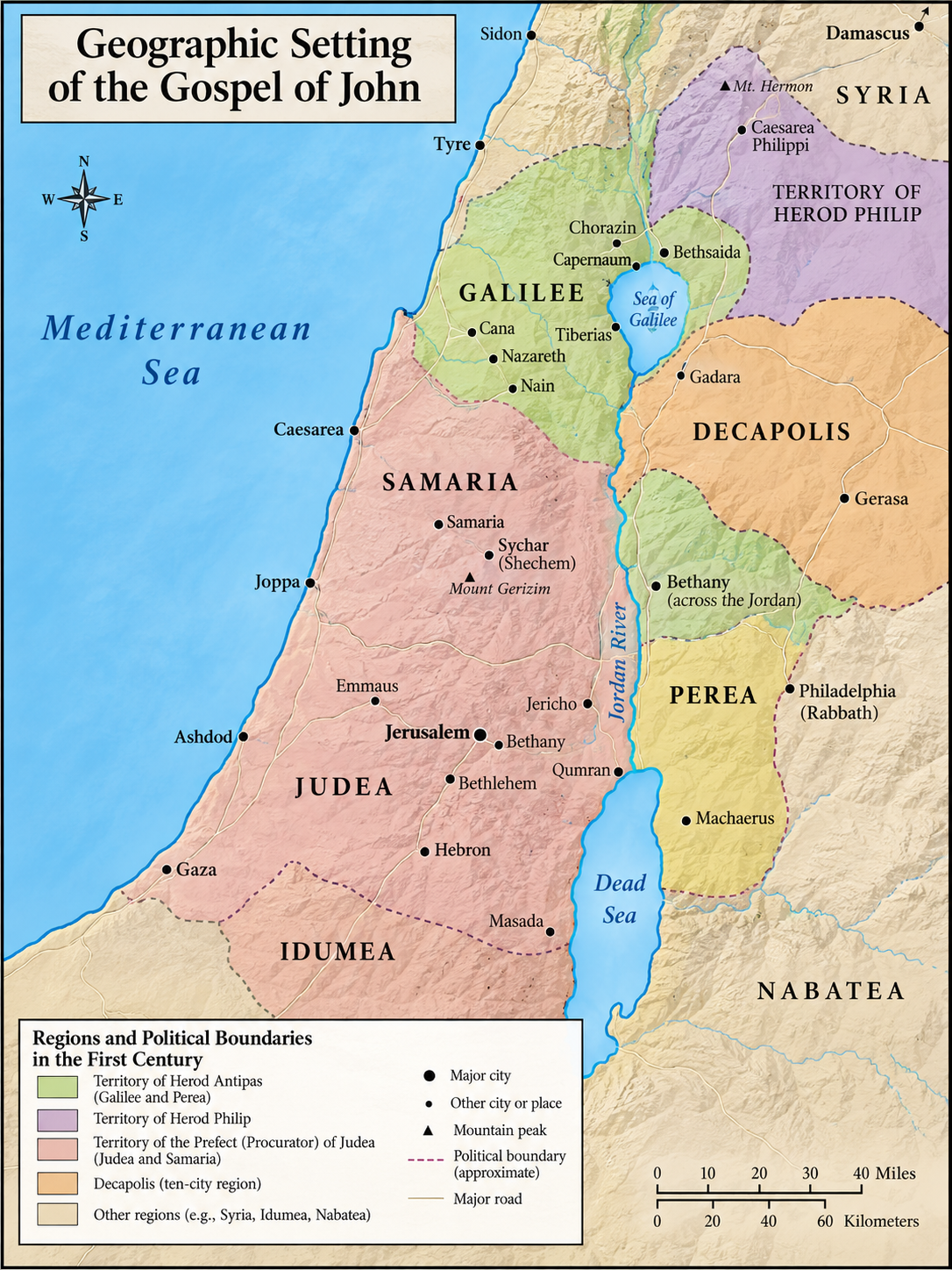
The red box shows the area of the main map.
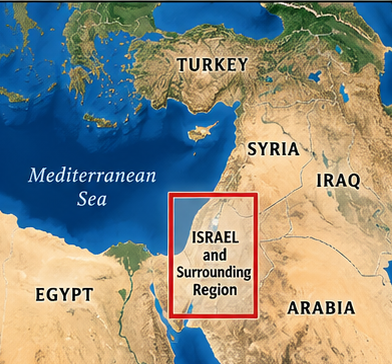
Red box indicates the main map area.
Pastel shading identifies approximate first-century political regions. Terrain shading suggests mountains and valleys, and blue identifies seas, lakes, and rivers.
The modern inset provides present-day geographic orientation, not ancient political borders. Some ancient sites and boundaries remain uncertain.
John 1:1–18 — Prologue: The eternal Word, creation, light, incarnation, and revelation of the Father.
John 1:19–12:50 — Public ministry: Witnesses, disciples, signs, conversations, growing division, and the approach of Jesus’ hour.
John 13:1–17:26 — Jesus with His disciples: Love, service, the Holy Spirit, abiding, suffering, and Jesus’ prayer.
John 18:1–20:31 — Death and resurrection: Arrest, trial, crucifixion, empty tomb, resurrection appearances, and the Gospel’s stated purpose.
John 21 — Epilogue: The risen Jesus, a miraculous catch, Peter’s restoration, and the continuing call to follow Him.
These divisions are study aids, not inspired headings. The precise boundaries of literary sections can be described in more than one faithful way.
John presents Jesus as the eternal Word who was with God and was God (1:1), and who became flesh (1:14). He is the Lamb of God who takes away the sin of the world (1:29), the Son sent by the Father (3:16–17), the giver of living water and bread of life, the Good Shepherd who lays down His life, and the resurrection and the life.
The cross is not a tragic interruption in Jesus’ mission. John repeatedly points toward His “hour,” when He willingly gives His life and accomplishes the Father’s purpose. His resurrection confirms the truth of His claims and leads to the invitation of John 20:31. John speaks both of salvation as a present possession for the believer and of a future resurrection hope (5:24–29; 6:39–40).
Our Protestant Evangelical approach: Scripture is the final authority. The workbook follows the historic Christian understanding of Jesus’ deity, His atoning death, bodily resurrection, and salvation by grace through faith. We will not reshape the text to fit contemporary political or cultural ideologies; legitimate interpretive questions will be handled with humility.
Read the passage first. The Scripture is the authority; the explanation is there to assist, not replace, your own reading.
Ask what John actually says. Notice the speaker, audience, setting, repeated language, and the purpose of each sign.
Use context responsibly. Historical background, biblical cross-references, and Greek vocabulary can illuminate the text without becoming more important than it.
Recognize uncertainty. Where the text is not explicit or faithful Christians disagree, the workbook will say so.
Respond in faith. The goal is not simply information about Jesus but knowing, trusting, loving, and following Him.
Chapter-context atlas with the sharp regional locator, complete Quick Study and SOAP Deep Dive with all 51 WEB verses.
Complete Quick Study and five SOAP Deep Dive passages, all 25 WEB verses, and the Cana–Capernaum–Jerusalem atlas with detailed regional locator.
Complete Quick Study and seven SOAP passages, all 36 WEB verses, and the Jerusalem/Judean chapter atlas with a sharp regional locator.
Complete Quick Study, nine SOAP passages, all 54 WEB verses, the Samaria–Galilee chapter atlas, and a sharp regional locator.
Complete Quick Study, nine SOAP passages, all 47 WEB verses, the Jerusalem chapter atlas and Pool of Bethesda illustration.
Complete Quick Study, twelve SOAP passages, all 71 WEB verses, Sea of Galilee atlas and lake context map.
Complete Quick Study, ten SOAP passages, all 53 WEB verses, Feast of Booths atlas and Jerusalem detail map.
Complete Quick Study, ten SOAP passages, all 59 WEB verses, Jerusalem atlas and temple context map.
Complete Quick Study, eight SOAP passages, all 41 WEB verses, Jerusalem atlas and Pool of Siloam context map.
Complete Quick Study, ten SOAP passages, all 42 WEB verses, Jerusalem atlas, Feast of Dedication context, and a sharp modern locator.
Complete Quick Study, eleven SOAP passages, all 57 WEB verses, Bethany/Jerusalem atlas, original context map, and a sharp locator.
Complete Quick Study, ten SOAP passages, all 50 WEB verses, Bethany/Jerusalem atlas, original context map, and a sharp locator.
Complete Quick Study, eight SOAP passages, all 38 WEB verses, Reusable Jerusalem landmark map (Bethesda, Siloam, palaces, Gethsemane, Golgotha, Mount Zion), and sharp regional locator.
Complete Quick Study, eight SOAP passages, all 31 WEB verses, Jerusalem landmark context, and Greek pronunciation.
Complete Quick Study, eight SOAP passages, all 27 WEB verses, Jerusalem context maps, and Greek pronunciation.
Complete Quick Study, eight SOAP passages, all 33 WEB verses, Jerusalem context maps, and Greek pronunciation.
Complete Quick Study, eight SOAP passages, all 26 WEB verses, Jesus’ prayer, Jerusalem context maps, and Greek pronunciation.
Complete Quick Study, ten SOAP passages, all 40 WEB verses, arrest and trial context maps, and Greek pronunciation.
Complete Quick Study, eleven SOAP passages, all 42 WEB verses, the crucifixion and garden tomb context maps, and Greek pronunciation.
The empty tomb, appearances, Thomas, and John’s purpose.
Chapter workbook coming after introduction approval.
A catch of fish, Peter’s restoration, and discipleship.
Chapter workbook coming after introduction approval.
John wants readers to know who Jesus is, including His unique relationship with the Father (1:18; 20:31).
Belief in Jesus and life in His name recur across signs, teaching, and personal encounters (3:16; 5:24; 20:31).
Miracles point beyond themselves to Jesus; witnesses call people to consider His identity (2:11; 5:31–40).
The imagery describes revelation, moral response, and the darkness that resists Jesus (1:4–9; 3:19–21).
Jesus uses memorable images and striking claims to explain His identity and life-giving work (6:35; 8:12; 10:11; 11:25; 14:6; 15:1).
Jesus’ glory is revealed in obedient self-giving, death, and victory over death (12:23–33; 19–20).
Jesus promises the Helper; love, abiding, and witness mark His followers (14–16).
John includes passages that deserve careful study, including John 7:53–8:11, which is absent from many early manuscripts and bracketed or noted in many modern Bibles. We will explain textual and interpretive questions carefully, without presenting disputed details as certain.
Read John 1 slowly. Notice what the text says about the Word, creation, light, life, testimony, the Lamb of God, and the first disciples. Ask how these descriptions answer John's central question: Who is Jesus?
Scripture quotations are from the public-domain World English Bible. Authorship, date, and place of composition are presented with explicit distinctions between the Gospel's statements, early tradition, and scholarly discussion. This introduction contains a geographic overview; the historical atlas map appears in both the HTML and the PDF.
21 chapter workbooks are planned. The Introduction and John 1–19 are ready. Later chapters will activate as their finished studies are added.
The biblical context, authorship, purpose, setting, major themes, and all 21 chapter previews.
Chapter-context atlas with the sharp regional locator, complete Quick Study and SOAP Deep Dive with all 51 WEB verses.
Complete Quick Study and five SOAP Deep Dive passages, all 25 WEB verses, and the Cana–Capernaum–Jerusalem atlas with detailed regional locator.
Complete Quick Study and seven SOAP passages, all 36 WEB verses, and the Jerusalem/Judean chapter atlas with a sharp regional locator.
Complete Quick Study, nine SOAP passages, all 54 WEB verses, the Samaria–Galilee chapter atlas, and a sharp regional locator.
Complete Quick Study, nine SOAP passages, all 47 WEB verses, the Jerusalem chapter atlas and Pool of Bethesda illustration.
Complete Quick Study, twelve SOAP passages, all 71 WEB verses, Sea of Galilee atlas and lake context map.
Complete Quick Study, ten SOAP passages, all 53 WEB verses, Feast of Booths atlas and Jerusalem detail map.
Complete Quick Study, ten SOAP passages, all 59 WEB verses, Jerusalem atlas and temple context map.
Complete Quick Study, eight SOAP passages, all 41 WEB verses, Jerusalem atlas and Pool of Siloam context map.
Complete Quick Study, ten SOAP passages, all 42 WEB verses, Jerusalem atlas, Feast of Dedication context, and a sharp modern locator.
Complete Quick Study, eleven SOAP passages, all 57 WEB verses, Bethany/Jerusalem atlas, original context map, and a sharp locator.
Complete Quick Study, ten SOAP passages, all 50 WEB verses, Bethany/Jerusalem atlas, original context map, and a sharp locator.
Complete Quick Study, eight SOAP passages, all 38 WEB verses, Reusable Jerusalem landmark map (Bethesda, Siloam, palaces, Gethsemane, Golgotha, Mount Zion), and sharp regional locator.
Complete Quick Study, eight SOAP passages, all 31 WEB verses, Jerusalem landmark context, and Greek pronunciation.
Complete Quick Study, eight SOAP passages, all 27 WEB verses, Jerusalem context maps, and Greek pronunciation.
Complete Quick Study, eight SOAP passages, all 33 WEB verses, Jerusalem context maps, and Greek pronunciation.
Complete Quick Study, eight SOAP passages, all 26 WEB verses, Jesus’ prayer, Jerusalem context maps, and Greek pronunciation.
Complete Quick Study, ten SOAP passages, all 40 WEB verses, arrest and trial context maps, and Greek pronunciation.
Complete Quick Study, eleven SOAP passages, all 42 WEB verses, the crucifixion and garden tomb context maps, and Greek pronunciation.
The empty tomb, appearances, Thomas, and John’s purpose.
Chapter workbook coming after introduction approval.
A catch of fish, Peter’s restoration, and discipleship.
Chapter workbook coming after introduction approval.